
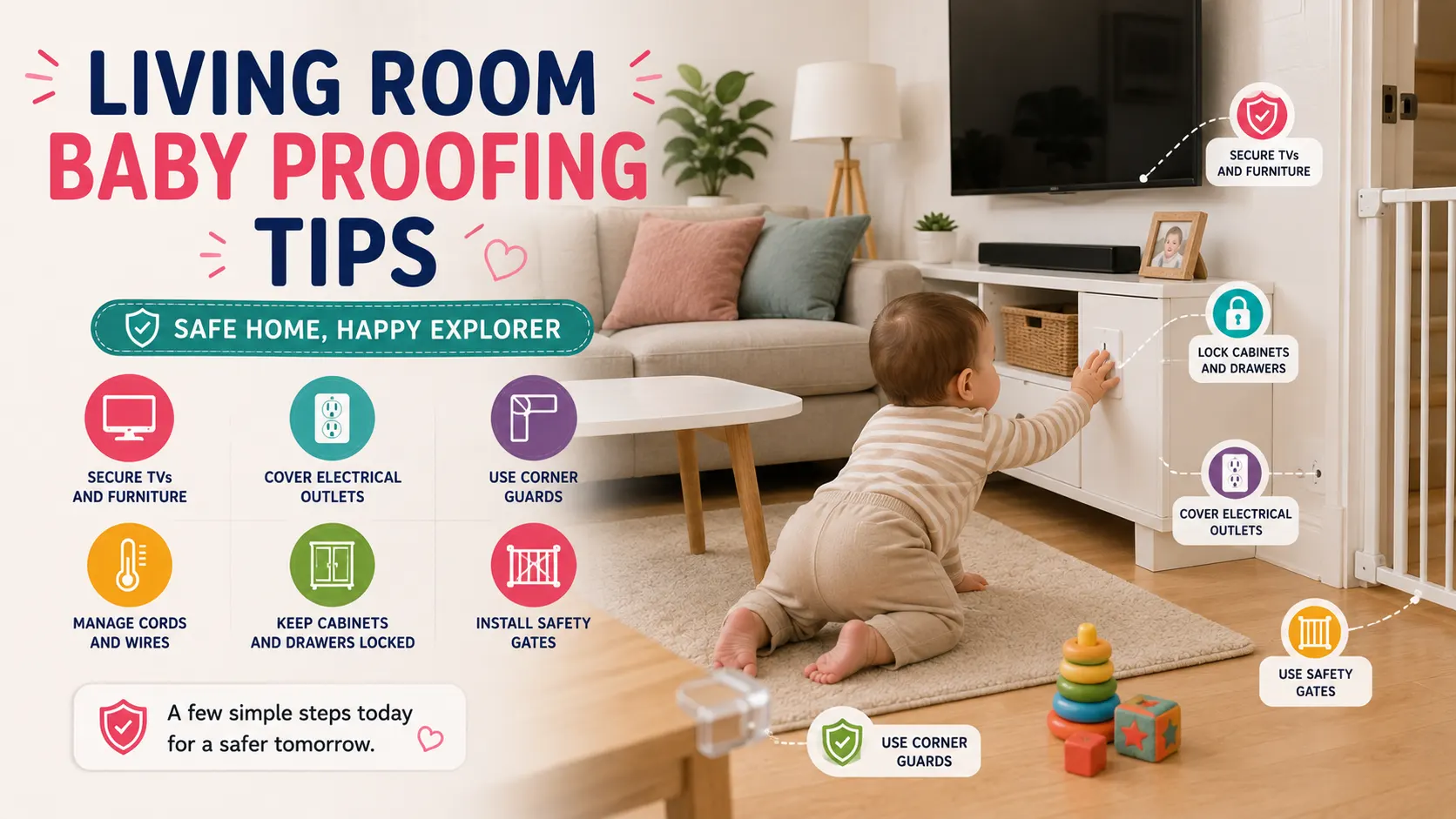

The living room causes a specific kind of trouble other rooms don’t: it’s full of things designed to be interesting — remotes, cords, glowing screens, low shelves — sitting at exactly a baby’s height and reach. This guide focuses on the two hazard clusters that cause the most living-room-specific incidents: the entertainment center (TV, remotes, cords) and furniture stability, then covers the rest of the room.
Quick answer: Anchor every piece of furniture taller than 30 inches to a wall stud, mount or securely strap the TV separately from its stand, and check every remote and battery-powered device for a screwed-in (not just snap-on) battery cover — button batteries are one of the most serious and overlooked hazards in this specific room.
The 30-Inch Rule for Furniture Anchoring
A commonly used guideline among childproofing professionals: any piece of furniture over 30 inches tall should be anchored to a wall stud, regardless of how sturdy it looks. This includes bookcases, dressers, media consoles, and even tall floor lamps. A few specifics:
- Use anti-tip straps or brackets rated for your specific wall type — drywall anchors and plaster anchors are not interchangeable, and using the wrong one significantly reduces holding strength
- Anchor into a wall stud whenever possible, not just drywall, since drywall alone often can’t hold the weight of a determined toddler pulling or climbing
- Move tall or wobbly floor lamps behind heavier, stable furniture rather than leaving them freestanding in open floor space
- Re-check anchors periodically — a strap that was snug when installed can loosen over months of use
Baby Proofing the Entertainment Center
This deserves its own focus because it combines several risks in one spot: tip-over weight, cords, and small parts.
- Mount the TV to the wall if possible. This is consistently the top recommendation from child safety experts, since it removes tip-over risk entirely rather than just reducing it.
- If wall-mounting isn’t an option, place the TV on sturdy, low furniture, anchor it with a dedicated anti-tip strap (both to the wall and to the stand itself), and push it back as close to the wall as possible.
- Cover buttons on the TV and any AV components with a button shield or blocker — a removable strip that blocks physical buttons while leaving your remote fully functional.
- Store game consoles, cable boxes, and streaming devices behind latched cabinet doors rather than leaving them exposed on open shelves.
- Manage cords with a cord concealer or by zip-tying them together and tucking them behind the unit, since loose or looped cords from a TV, console, and cable box together create a real strangulation risk, not just a tripping one.
- Cover outlets and power strips specifically around the entertainment center, since this is often where multiple devices cluster into one power strip at floor level.
The Button Battery Risk (Worth Its Own Section)
Remotes, key fobs, thermometers, sound machines, and small toys all commonly use button batteries — and this is genuinely one of the most dangerous, overlooked hazards in a typical living room. A swallowed button battery can cause serious internal injury quickly, which is different from most other choking-style hazards in terms of urgency.
- Check every remote, key fob, and small electronic device for a battery compartment that requires a screwdriver or a deliberate slide-and-lock mechanism — not one that pops open with a light squeeze
- If a compartment isn’t secure, tape it shut as an interim fix
- Store any spare or removed batteries in a locked, high cabinet, never loose in a drawer
- If you ever suspect your baby has swallowed a button battery, this is a same-day emergency room situation, not a “wait and see” one — button batteries can cause internal burns within hours
Coffee Tables and Low Furniture
- Add corner guards to any coffee table, side table, or low shelf with sharp corners — this matters most during the crawling-to-early-walking window, when a fall into a hard edge is common
- Consider temporarily moving a glass-topped coffee table to a less central spot, or replacing it, until your child is walking steadily
- Clear small decorative items, candles, and breakables from any low surface within reach
- Check that low furniture itself doesn’t wobble or slide, since an unstable low table can still cause a fall even without a full tip-over
Houseplants: What’s Actually Toxic
Many common houseplants are toxic if ingested, and it’s easy to have one in the living room without realizing it:
- Pothos, philodendron, and peace lily are all commonly kept houseplants that are toxic if a baby chews on or ingests leaves
- Some plants also have sharp, serrated leaves or thorns that pose an injury risk separate from toxicity
- Move any toxic or sharp-leafed plant well out of reach, or relocate it to a room your baby doesn’t have access to
- If you’re unsure whether a specific plant is toxic, check with Poison Control or a plant-specific toxicity database rather than guessing
Fireplace, Rugs, and Remaining Hazards
- Install a fireplace screen in front of any hearth — note that the screen itself can still get hot, so this reduces but doesn’t eliminate burn risk
- Store fireplace logs, matches, lighters, and tools well out of reach
- Add non-slip grip pads underneath any area rugs, since a sliding rug is a fall risk for both new walkers and the adults carrying them
- Add window clings to large sliding glass doors or floor-to-ceiling windows to prevent collision injuries once your baby is cruising or walking
- Block access to floor heaters or radiators with a small gate or barrier if your living room has one
Continue exploring: browse the full Baby Safety hub.
Frequently Asked
Common Questions