
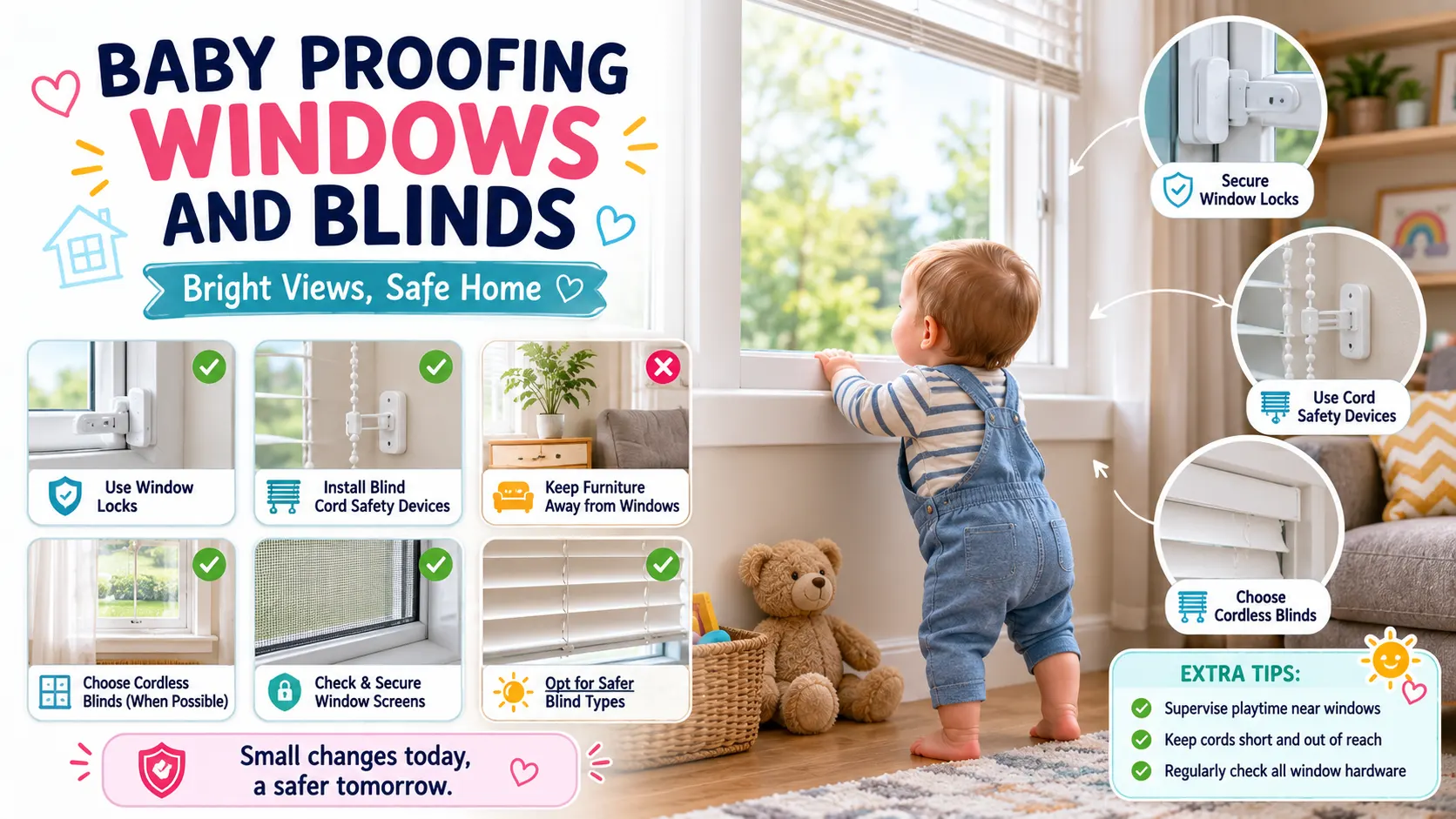

Windows create two separate hazards that need two separate fixes: cords, which pose a silent strangulation risk, and open windows themselves, which pose a fall risk. The most persistent myth in this category is that a window screen protects against both — it does neither. This guide covers what actually works for each hazard, including how to do it without blocking your only fire escape route.
Quick answer: Replace corded blinds with cordless versions wherever possible, and use ASTM F2090-compliant window guards or stops that limit any window’s opening to under 4 inches — never rely on an insect screen for fall prevention, regardless of how sturdy it looks.
The Screen Myth (Read This First)
An insect screen is designed to keep bugs out during ventilation — that’s its entire purpose. It is not designed, tested, or rated to hold a child’s weight. In an analysis of window fall incidents, a screen was present in 80% of cases, and it still failed to prevent the fall, because the weight of even a toddler pushes through a standard screen with minimal resistance.
If you take away one thing from this guide, it’s this: a screen in the window is not a safety device, no matter how sturdy it looks or feels when you press on it.
Cord Strangulation: What the Data Actually Shows
Window covering cords are on the CPSC’s list of top “hidden hazards” in the home. A few specifics worth knowing:
- On average, about 8–9 children under age 5 die every year in the U.S. from strangulation in window covering cords
- This can happen silently and in moments, even with an adult nearby, which is part of why it’s easy to underestimate
- Blinds sold before November 2000 often have inner cords (used to raise the slats) that can form a loop a child’s neck can become caught in — if you have older blinds like this, replace them immediately rather than retrofitting
- As of federal rules finalized in 2022–2023, window covering cords are officially classified as a “substantial product hazard,” with mandatory safety standards now covering both stock and custom window coverings
Fixing Cords: Cordless vs. Retrofit
Cordless is the only option that fully eliminates the hazard. If you’re replacing blinds anyway, cordless versions are widely available at most retailers and cost roughly the same as corded versions.
If replacement isn’t possible right now, these steps reduce — but don’t eliminate — the risk:
- Move cribs, beds, and furniture away from windows and their cords, ideally to a different wall entirely
- Shorten pull cords as much as possible, and keep any remaining cord wound up and secured well out of reach
- Install cord stops (the small donut-shaped pieces attached to pull cords) and adjust them so they sit within 1–2 inches of the head rail when the blind is fully lowered
- Free retrofit kits are available from the Window Covering Safety Council, though note that most retrofit kits don’t address dangling pull cords specifically — cordless replacement remains the only complete fix
Don’t forget baby monitor cords in this same category — keep them, and any other cord near a crib or changing table, well out of reach the same way you would a blind cord.
Window Falls: Guards vs. Stops
| Window Stops | Window Guards | |
|---|---|---|
| What it does | Limits how far a window can physically open (to under 4 inches) | Creates a physical barrier across the window opening |
| Best for | Windows you still want to open partially for ventilation | Windows on upper floors, or where a full barrier is preferred |
| Standard to check for | ASTM F2090 compliance | ASTM F2090 compliance |
| Fire escape consideration | Should have a quick-release mechanism | Must have a quick-release mechanism |
Both device types should comply with ASTM F2090, the official standard for window fall prevention devices — this ensures the product has been tested and includes a proper quick-release mechanism, which matters as much as the barrier itself.
The Fire Escape Trade-Off
This is the detail most childproofing guides skip: a window guard or stop that can’t be quickly released is itself a safety hazard, since a window may be your only escape route in a fire.
- Never nail, glue, or permanently seal a window shut, even one you never plan to open
- Choose guards and stops specifically labeled with a quick-release mechanism, not a decorative or non-releasing bar
- Make sure every adult in the household knows how to release the mechanism quickly, without needing a tool or key that might not be on hand during an emergency
- If your home has windows designated as emergency egress points by local building code, confirm any guard or stop you install doesn’t violate that code
- Practice your home fire escape plan periodically, including how windows factor into it, once your children are old enough to participate
Furniture Placement
Even a perfectly guarded window can become accessible if a determined toddler can climb to it:
- Move cribs, toy chests, beds, and any climbable furniture away from windows entirely
- This applies even to furniture that seems too low to matter — young children are resourceful about stacking or using multiple pieces to reach height
- If your layout makes this difficult, prioritize the window guard/stop fix first, since it addresses the hazard directly regardless of furniture placement
Continue exploring: browse the full Baby Safety hub.
Frequently Asked
Common Questions