
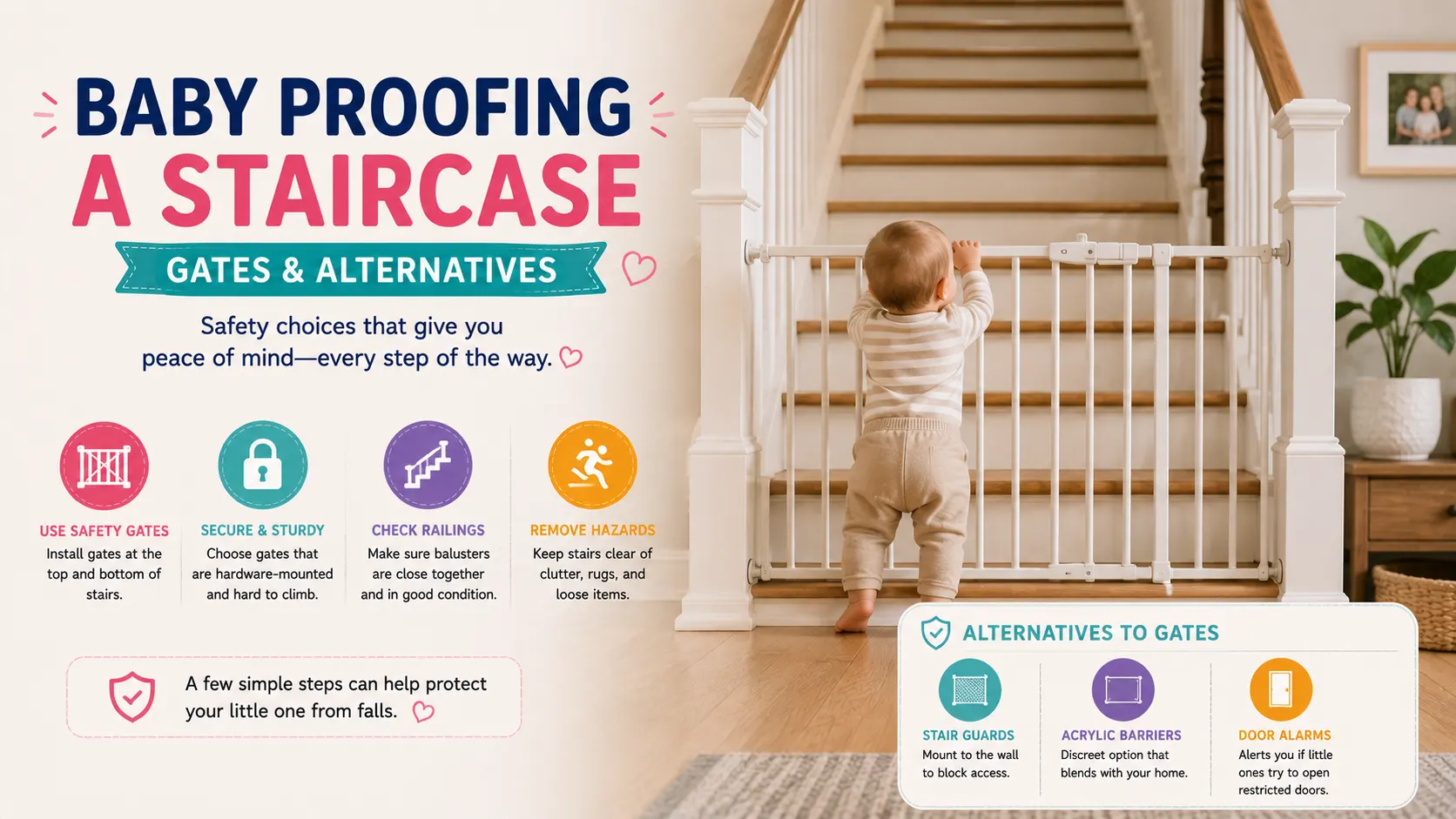

Roughly 93,000 children under 5 are treated in U.S. emergency rooms each year for stair-related injuries — about one child every six minutes. A baby gate is one of the simplest fixes available, and also one of the most frequently installed incorrectly. This guide covers exactly which gate type goes where, the installation details that actually matter, and what to use when a standard gate isn’t the right fit.
Quick answer: Use a hardware-mounted gate at the top of every staircase — pressure-mounted gates are not secure enough for this location and can be pushed loose under a fall’s weight. A pressure-mounted gate is acceptable at the bottom, though hardware-mounted is more secure there too.
Why the Top of the Stairs Is Non-Negotiable
A gate at the top of a staircase does a different job than one at the bottom. At the bottom, a gate that gives way results in a baby reaching the stairs from floor level — not ideal, but not immediately dangerous. At the top, a gate that gives way results in a fall down the entire flight. This is why the U.S. Consumer Product Safety Commission specifically recommends that only screw-mounted (hardware-mounted) gates be used at the top of stairs — no exceptions, regardless of how tight a pressure fit seems.
The relevant safety standard here is ASTM F1004, the federal standard for expansion gates and expandable enclosures, which became mandatory in 2021. Confirm any gate you buy for stair use is labeled as meeting this standard.
Hardware-Mounted vs. Pressure-Mounted, Compared
| Hardware-Mounted | Pressure-Mounted | |
|---|---|---|
| How it attaches | Screws directly into wall studs or a banister post | Tension against opposing walls, no drilling |
| Top of stairs | Required — the only safe option | Never — can be pushed loose under force |
| Bottom of stairs | Recommended, most secure | Acceptable |
| Between rooms (level floor) | Overkill, but fine | Ideal — quick, damage-free, movable |
| Installation time | 20–40 minutes, requires basic tools | Under 5 minutes, no tools |
| Ongoing maintenance | Occasional screw tightness check | Needs re-tightening periodically — tension loosens over time |
| Trip hazard | Minimal, no floor-level bar on most models | Often has a floor-level bar that can catch a foot |
The floor-level bar on many pressure-mounted gates is worth flagging specifically: it’s part of the frame and stays in place even when the gate is open, creating a real trip hazard right at the top of a staircase — one more reason this gate type doesn’t belong there.
Installation Mistakes That Undo a Good Gate
Even a hardware-mounted gate fails to do its job if installed incorrectly. Common mistakes:
- Screwing into drywall instead of a stud or banister post. Drywall alone doesn’t hold under real force — locate a stud with a stud finder, or anchor into the banister itself where the gate is designed for that.
- Choosing a gate that swings the wrong direction. A gate at the top of stairs should only swing toward the landing, away from the steps — never out over the staircase, since that risks someone tripping or falling while opening it.
- Not testing the auto-close and latch monthly. Springs weaken over time. A gate that swings closed but doesn’t fully latch creates a false sense of security that’s arguably worse than an obviously open gate.
- Buying based on your baby’s current size instead of a future toddler’s strength. A gate that easily contains a 6-month-old may not hold up to a determined, climbing 2.5-year-old — buy and install with that later stage in mind.
- Leaving gaps at the sides. A gate that isn’t flush against the wall or banister on both sides leaves a squeeze-through gap even if the gate itself is sturdy.
Banister and Railing Gaps
A secure gate doesn’t help if the railing next to it has gaps a baby’s body or head could pass through:
- Check for gaps wider than about 4 inches between banister spindles
- If gaps are too wide, mesh guards or plexiglass panels can be attached to the railing to close the space without a full renovation
- This applies to any railing your baby has access to, not just the top of the stairs — landings and open lofts with railings need the same check
Alternatives to a Standard Gate
Retractable gates — a mesh barrier that pulls across an opening and retracts into a housing when not in use. Good for wider stair openings or spaces where a swinging gate is awkward, though check the specific product’s rating for stair use before relying on it at the top.
Closing off the staircase entirely — for homes with a door at the top or bottom of the stairs already, keeping that door closed (with a door knob cover, if your baby is tall enough to reach the handle) can serve the same function as a gate without adding hardware.
A stair barrier or banister-to-wall gate — designed specifically for open staircases without a doorframe on either side, mounting from a wall stud to the banister rather than between two walls.
A play yard as a temporary landing barrier — not a substitute for a proper stair gate, but useful as an additional layer if your baby spends supervised time on a landing near stairs.
None of these alternatives should be treated as a downgrade from a proper hardware-mounted gate at the top of the stairs specifically — they’re situational options for stair configurations a standard swing gate doesn’t fit well.
Continue exploring: browse the full Baby Safety hub.
Frequently Asked
Common Questions