

Three months is often called the “magic age” for a reason: the newborn fog starts to lift, fussiness tends to ease, and your baby suddenly becomes a much more active participant in play. The biggest headline of this month is hand discovery — your baby will realize, seemingly for the first time, that those things floating in front of their face are actually theirs, and they’ll spend long stretches staring at, clasping, and mouthing their own hands.
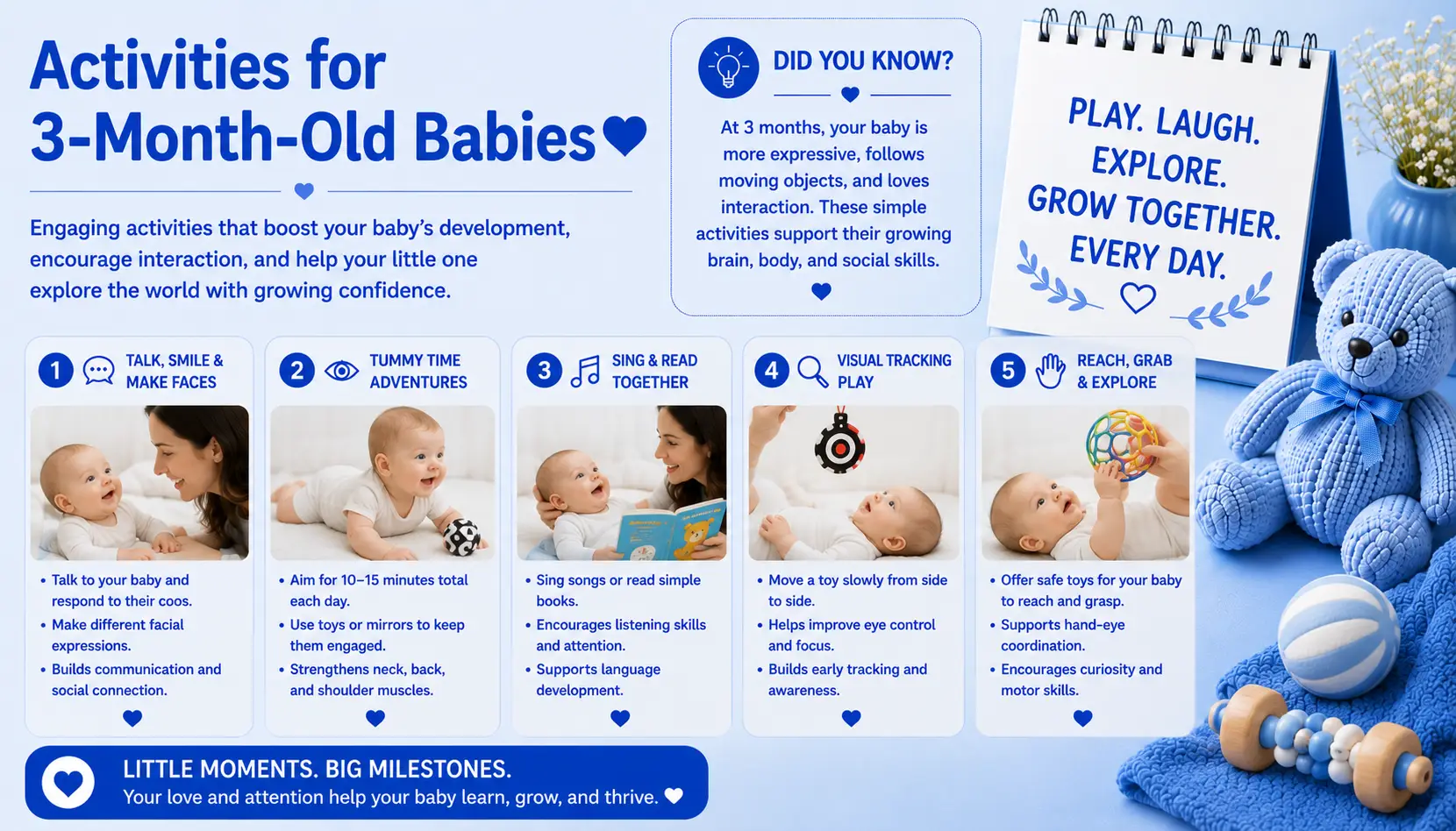
Here’s a guide to activities for a 3-month-old, built around this stage’s biggest developmental leaps: hand discovery, stronger head control, and the first real signs of reaching and batting at objects.
What’s New at 3 Months
Hand discovery — bringing hands together at midline, staring at them, and mouthing them
Stronger head control — lifting the head to about 90 degrees and pushing up on forearms during tummy time (sometimes called a “mini cobra pose”)
Swiping and batting at dangling toys, even if they don’t always connect yet
Briefly grasping and shaking lightweight toys placed in their hand
Pushing down with legs when held upright with feet on a firm surface
First real laughs, for some babies, alongside more frequent social smiling and cooing
Activities to Support Hand Discovery
Since hands are the star of the show this month, activities that encourage midline play and grasping are especially valuable.
Bring hands together gently, helping baby clasp them at the center of their body
Offer lightweight rattles or rings to grasp, drop, and try again
Hang toys at batting height on a play gym, so swipes give an immediate, motivating response
Talk through what they’re doing — “You’re reaching! You’ve got it!” — language and motor skills develop together
Tummy Time (With a Bigger Goal Now)
Tummy time gets more productive this month as neck and arm strength improve.
Aim for about 20–30 minutes total per day, broken into several sessions
Encourage the “mini push-up” by placing a toy or your face just out of reach
Try face-to-face tummy time on your chest for extra motivation and bonding
Movement & Body Awareness Activities
Supported standing — hold baby upright with feet on a firm surface and let them push down and bounce
Bicycle legs, gently pedaling baby’s legs during floor time or a diaper change
Stretch and clap — gently clap baby’s hands together or stretch their arms out wide
Copy-me faces — make simple expressions for baby to watch and eventually begin mimicking
Sensory & Visual Activities
Tracking games — slowly move a toy or your face side to side for baby to follow
High-contrast or colorful toys, since color perception is sharpening around this age
Textured toys for grasping practice, offering different surfaces to explore
Music and rhythmic sounds, like a heartbeat-paced lullaby or gentle rocking to a beat
Try Babywearing
Three months is a popular age to start babywearing more regularly, since head and neck control is now steady enough for many carriers.
Keeps baby close while freeing up your hands for daily tasks
Offers a calming, rhythmic experience through your movement and heartbeat
A great option for fussy periods, walks, or simply getting things done around the house
When to Check In With Your Pediatrician
Every baby develops at their own pace, but it’s worth mentioning to your pediatrician if, by 3 months, your baby hasn’t responded to noises, doesn’t follow people or objects with their eyes, hasn’t smiled, rarely moves their arms or legs, or their limbs seem unusually floppy. These are general guidelines, not a strict checklist — but early conversations with your doctor are always worthwhile if something feels off.
FAQ
What activities are best for a 3-month-old baby?
Activities that support hand discovery (grasping toys, midline play), tummy time to build strength, supported standing, and sensory play with textured or colorful toys are all well-matched to a 3-month-old’s developmental stage.
Why is my 3-month-old always staring at their hands?
This is a normal and important developmental milestone called hand discovery — babies around this age realize their hands are part of their own body and are fascinated by watching and controlling them.
How much tummy time should a 3-month-old have?
Most guidelines recommend around 20–30 minutes total per day at this age, broken into shorter sessions, as babies build the strength for the “mini push-up” on their forearms.
When do babies start laughing?
Some babies begin laughing as early as 3 months, though it’s more common between 3 and 4 months. Timing varies quite a bit from baby to baby.
Is 3 months a good age to start babywearing?
Yes — many parents find 3 months a good time to start regular babywearing, since most babies have developed enough head and neck control to be worn safely and comfortably in a carrier.