
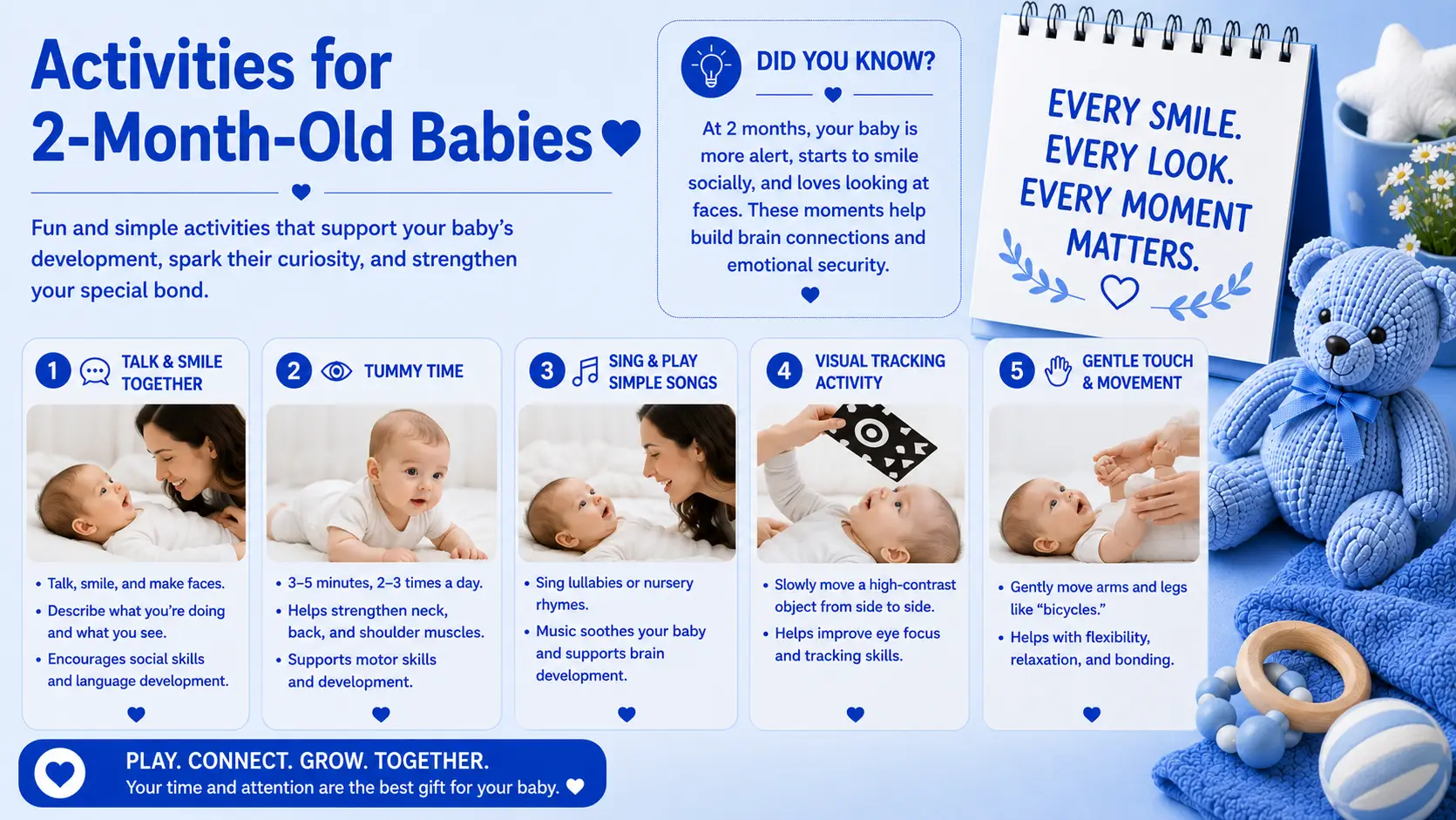

Somewhere around the 8-week mark, something wonderful happens: your baby starts smiling back. Not the reflexive half-smile of the newborn weeks, but a real, responsive “social smile” aimed directly at you. It’s one of the most anticipated 2-month milestones, and it’s a sign that your baby’s brain is shifting from pure survival mode into genuine social connection. Wake windows are also stretching a little longer now, which means slightly more time for play than you had in month one.
Here’s a guide to activities for a 2-month-old, built around what babies are actually capable of and excited about at this stage.
What’s New at 2 Months
Before jumping into activity ideas, it helps to know what’s typically emerging around this age:
Social smiling — smiling in response to your face or voice, not just reflexively
Cooing and early vocal sounds, like soft “oohs” and “aahs”
Tracking movement with their eyes more smoothly
Holding their head up at roughly a 45-degree angle during tummy time
Reacting to sounds, turning or looking toward a noise nearby
Calming down when spoken to or picked up, recognizing familiar voices and touch
Every baby moves through these at their own pace — some smile socially as early as 6 weeks, others closer to 10 or 12 — so a slight difference in timing usually isn’t cause for concern.
Make Funny Faces
At 2 months old, watching your face is genuinely one of your baby’s favorite activities.
Get close (8–12 inches away), smile, and talk in a warm, sing-song voice
Exaggerate facial expressions — wide eyes, big smiles, an open mouth — babies this age love it
Pause after a few seconds to see if baby responds with a smile or coo of their own
Tummy Time
Tummy time remains one of the most important activities at this stage, now with a slightly bigger goal.
Aim for a total of 15–30 minutes per day, broken into several shorter sessions
Place a toy or your face at eye level to encourage baby to lift and hold their head up
Try tummy time on your chest as a gentler alternative if baby resists the floor
Sound & Voice Games
Hearing is sharpening quickly, and 2-month-olds are starting to actively search for the source of a sound.
Rattle tracking — gently shake a rattle to the side of baby’s head and watch them try to turn toward the sound
“Conversations” — repeat back the coos and sounds your baby makes; this back-and-forth is an early form of communication
Singing simple, repetitive songs during daily routines
Reading aloud from simple board books, describing the pictures as you go
Outdoor & Sensory Time
Longer wake windows mean a little more room for gentle outings and sensory variety.
Stroller or carrier walks, narrating what you see and hear along the way
High-contrast books or cards for a few minutes of visual tracking practice
Textured fabrics, letting baby feel different materials you hold for them
Soft music during calm, alert periods
Bonding-Focused Activities
Connection remains just as important as stimulation at this age.
Skin-to-skin contact, which continues to support bonding and regulation well past the newborn stage
Gentle massage, especially during a calming bedtime routine
Babywearing, keeping baby close while you move through your day
Simply talking through your day, narrating diaper changes, meals, and errands
Watching for Milestone Concerns
While every baby develops on their own timeline, it’s worth mentioning to your pediatrician if, by around 2 months, your baby isn’t smiling at people, doesn’t respond at all to loud noises, isn’t tracking faces or objects with their eyes, or can’t briefly hold their head up during tummy time. Most of the time these are simply timing differences, but your pediatrician can help you know when to keep an eye on something versus when it’s nothing to worry about.
FAQ
What activities are best for a 2-month-old baby?
Tummy time, face-to-face interaction with exaggerated expressions, talking and singing, reading simple board books, and short outdoor walks are all well-suited activities for a 2-month-old’s developing skills.
Most babies begin true social smiling — smiling in response to a face or voice — somewhere between 6 and 12 weeks old, with 8 weeks being a common average.
How much tummy time should a 2-month-old get?
Most guidelines recommend working toward 15–30 minutes of tummy time per day at this age, broken into several shorter sessions rather than one long stretch.
How long can a 2-month-old stay awake between naps?
Wake windows at 2 months are typically a bit longer than the newborn stage, often ranging from about 45 minutes to just over an hour, though this varies by baby.
What if my 2-month-old isn’t smiling yet?
It’s not necessarily a cause for concern, since social smiling develops on a range — some babies smile as early as 6 weeks and others closer to 3 months. If your baby also isn’t making eye contact, tracking movement, or responding to sound, mention it to your pediatrician.