
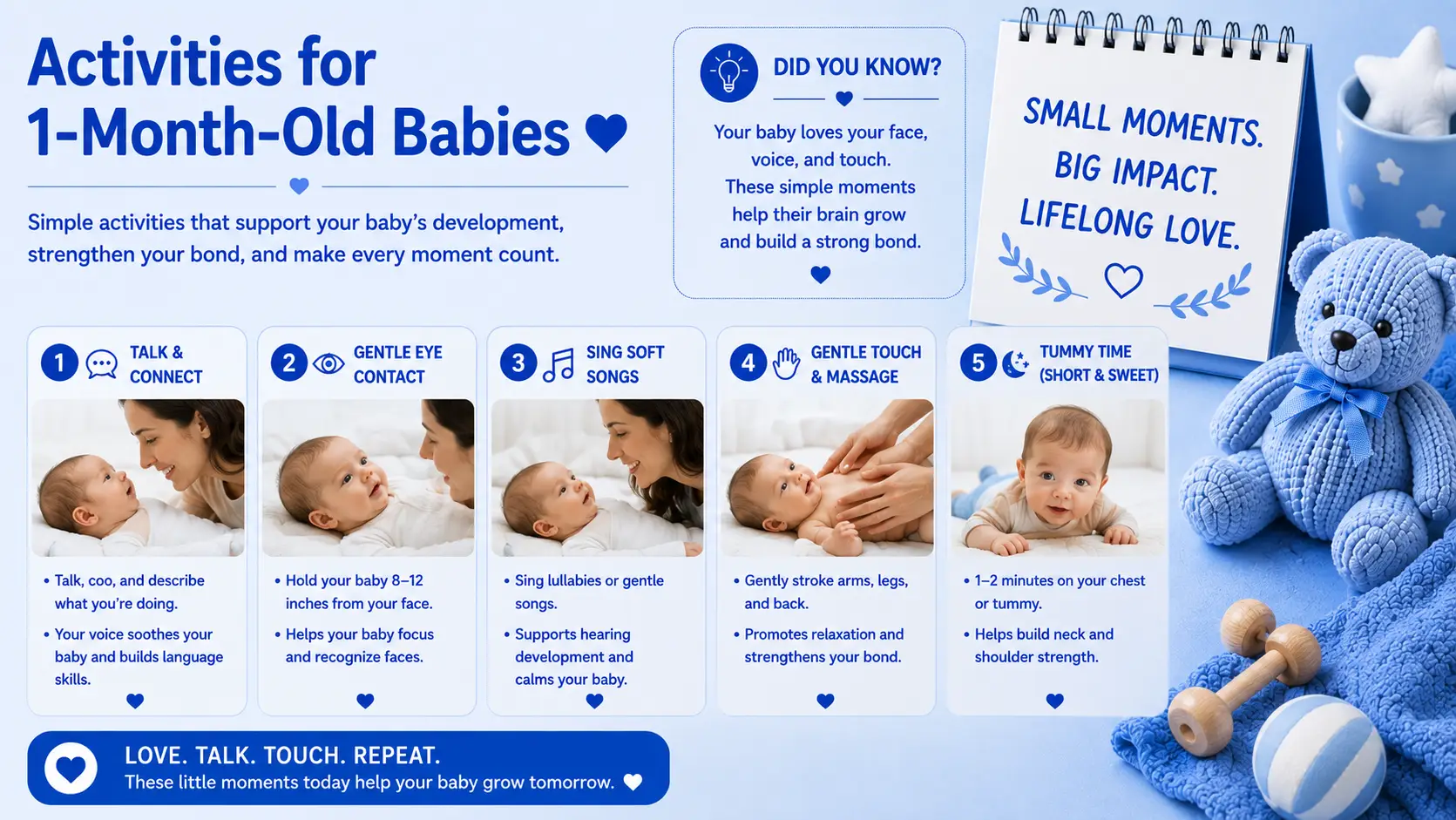

If your 1-month-old seems to do little more than eat, sleep, and cry, you’re not imagining it — that’s genuinely most of what a newborn this age does. A 1-month-old typically sleeps around 15–16 hours over a 24-hour period and stays awake for only 30 to 90 minutes at a stretch. That doesn’t leave much time for “activities” in the traditional sense, and that’s completely normal. At this stage, the most valuable thing you can offer isn’t a packed schedule of stimulation — it’s calm, responsive interaction during the short windows your baby is alert.
Here’s what to know about activities for a 1-month-old, along with what’s actually developmentally appropriate at this stage.
What a 1-Month-Old Can Actually Do
Before diving into activity ideas, it helps to know what a 1-month-old’s abilities look like, so expectations stay realistic:
Briefly lifts their head during tummy time
Moves both arms and legs, though movements are still jerky
Keeps hands mostly in closed fists, occasionally bringing them near the mouth
Watches faces and briefly tracks a slowly moving object with their eyes
Startles at loud noises
Comforts themselves by sucking on a fist or fingers
Makes cooing sounds and shows interest by watching your face
Because a newborn’s world is still so new, “play” at this stage looks like sensory exposure and connection, not structured games.
Tummy Time
Tummy time is the single most recommended activity for a 1-month-old, and it’s never too early to start.
Begin with short 3–5 minute sessions, a few times a day
Place baby on your chest or a firm mat while they’re awake and alert (never during sleep)
Get down at eye level or hold a small toy nearby to encourage head lifting
Stop if baby becomes fussy — short and frequent beats long and forced at this age
Sensory & Visual Activities
A newborn’s vision is still developing and works best at close range with bold contrast.
High-contrast cards or books, held about 8–12 inches from baby’s face
Slow object tracking — move a toy or your face gently side to side for baby to follow
Face-to-face talking, since faces are one of the most engaging things a 1-month-old can focus on
Soft, patterned fabrics in view, though avoid anything overstimulating like flashing lights or loud toys
Sound & Voice Activities
Hearing develops early, and a 1-month-old is already tuning into familiar voices.
Talking and narrating throughout the day — describing a diaper change, a feed, or what you see outside
Singing softly or humming a familiar tune
White noise or gentle music during calmer moments
Reading aloud, even though comprehension is still far off — the rhythm of your voice is what matters
Touch & Bonding Activities
Touch is deeply comforting to a newborn and doubles as both play and bonding.
Skin-to-skin contact, which helps regulate heart rate, temperature, and stress for both of you
Gentle infant massage, using slow strokes on arms, legs, and back
Holding and rocking, especially useful during overstimulated or fussy moments
Babywearing for short stretches, keeping baby close during everyday tasks
Signs Your Baby Needs a Break
Newborns overstimulate easily, and it’s just as important to know when to pause as it is to know what to try.
Turning their face away
Yawning or arching their back
Fussing or crying
Closing their eyes or looking away repeatedly
When you notice these cues, it’s time to stop the activity and offer calm, quiet comfort instead.
A Note on Expectations at This Age
It’s easy to feel like you should be “doing more” with a newborn, especially with so much content online about developmental activities. At 1 month, though, less truly is more. Short bursts of tummy time, talking, and touch, repeated throughout the day, are exactly what a 1-month-old needs — there’s no elaborate setup required, and no need to compare your baby’s engagement to older infants.
FAQ
What activities are good for a 1-month-old baby?
Short tummy time sessions, high-contrast visual play, talking and singing, skin-to-skin contact, and gentle infant massage are all appropriate and beneficial activities for a 1-month-old.
How much tummy time should a 1-month-old have?
Most guidelines suggest starting with several short sessions of 3–5 minutes a day at this age, gradually building toward longer total tummy time as neck strength improves over the following months.
How long can a 1-month-old stay awake between naps?
Most 1-month-olds can stay awake for about 30 to 90 minutes at a time, which is a helpful window to plan brief activities like tummy time or talking before the next sleep stretch.
Can I overstimulate my 1-month-old with too much activity?
Yes — newborns overstimulate easily. Watch for cues like turning away, yawning, arching the back, or fussing, and pause the activity for calm comfort when you see them.
Do 1-month-olds need toys?
Not really — at this age, faces, voices, touch, and simple high-contrast visuals are more engaging and developmentally appropriate than most toys. Soft, patterned items are enough if you want something visual to offer.