
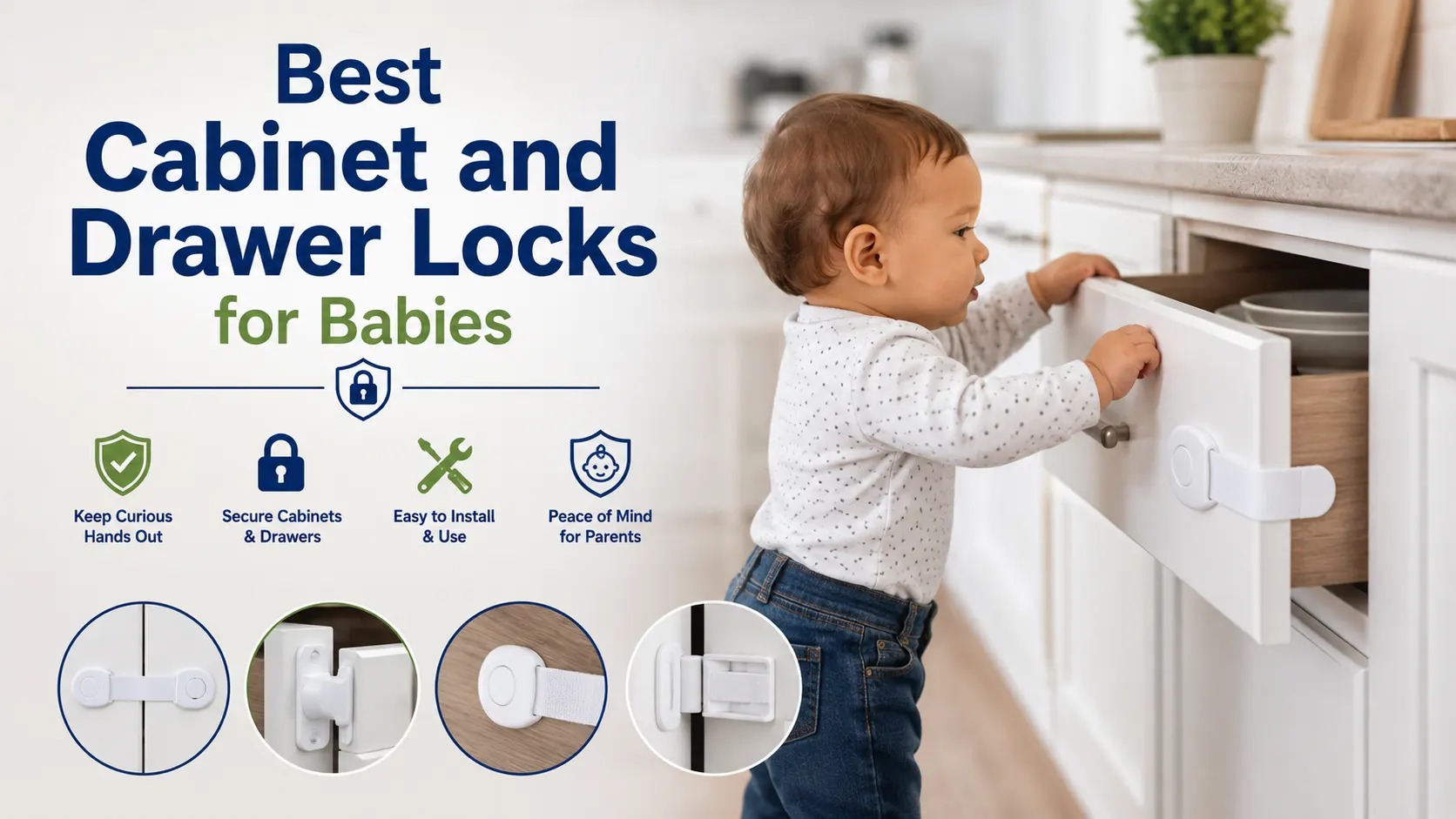

Most parents assume a toddler defeats a cabinet lock through brute force — prying, pulling, wearing down the hardware. That happens, but a more common failure mode is quieter: a toddler watches an adult open the lock a few times and simply copies the motion. This changes what “secure” actually means for a lock — visibility and mechanism matter as much as raw strength.
Quick answer: Magnetic cabinet locks are consistently rated the hardest for toddlers to defeat, specifically because the entire mechanism is hidden inside the cabinet — there’s nothing visible to watch, grab, or copy. Adhesive strap locks are the easiest to defeat, both through observation and through adhesive failure over time.
How Toddlers Actually Defeat Locks
Two distinct failure modes explain most cabinet lock defeats, and they call for different fixes:
- Observation and mimicry — a toddler watches a parent operate a visible latch or strap a handful of times and reproduces the motion. This is why a lock’s visibility matters: if a toddler can see the mechanism working, they eventually learn to work it too, often faster than parents expect.
- Physical degradation — repeated pulling, jiggling, and tugging gradually loosens adhesive or wears down a mechanical latch, even without the toddler ever understanding how it works.
A lock that’s strong against pulling force but fully visible in operation can still fail through the first pathway. This is the main reason magnetic locks consistently outperform other types in real-world use — there’s no visible mechanism to learn from.
Lock Types Compared
| Type | Visibility | Defeat Resistance | Key Management | Best For |
|---|---|---|---|---|
| Magnetic lock | Fully hidden inside cabinet | Highest — nothing to watch or grab | Requires a magnetic “key”; losing both is a real risk | Highest-priority cabinets (under-sink, medicine storage) |
| Adhesive strap lock | Visible latch and strap | Lower — both defeatable by force and by imitation | No key needed | Lower-risk cabinets, temporary/rental use |
| Sliding/spring latch | Partially visible | Moderate | No key needed | Cabinet pairs, pantry doors |
| Internal U-shaped latch | Mostly hidden, operates by feel | Moderate to high | No key needed | Drawers and cabinets with a small gap between doors |
Where Magnetic Locks Can Go Wrong
Magnetic locks test best against determined toddlers, but they come with tradeoffs worth knowing before you commit to them for every cabinet in the house:
- Losing both magnetic keys means losing access to every cabinet using that lock system until you find or replace a key — keep a backup key in a separate, memorable location specifically for this reason
- Nearby metal or hidden screws inside a cabinet door can interfere with the magnet’s function — test that the latch releases cleanly before fully committing the adhesive during installation
- Magnetic locks tend to be the more expensive option per cabinet, though buying a larger multi-lock kit reduces the per-unit cost significantly if you’re covering an entire kitchen
None of this makes magnetic locks a bad choice — it means budgeting a few extra minutes for correct installation and having a key-loss plan, rather than assuming they’re maintenance-free.
Where to Prioritize First
Not every cabinet needs the same level of security. Prioritize magnetic or another high-defeat-resistance lock for:
- The under-sink cabinet in the kitchen (commonly the highest-risk storage spot in the house)
- Bathroom medicine and toiletry storage
- Any cabinet holding cleaning chemicals, regardless of room
- Knife blocks or drawers with sharp tools
Lower-risk cabinets — those holding pots, plastic containers, or other non-hazardous items — can reasonably use a simpler, less expensive lock type, or in some cases be left as a designated “yes cabinet” your baby is allowed to explore freely.
What to Check Before Buying
- Look for a lock explicitly rated to a recognized safety standard (ASTM F3492 is the relevant standard for child-resistant cabinet and drawer locks) rather than relying on marketing language like “childproof” alone
- Check the maximum thickness the lock accommodates for both cabinet doors and drawers — many locks have a stated maximum material thickness, and exceeding it weakens the hold
- Confirm whether it works on your cabinet material — some adhesive locks perform differently on painted wood, unfinished wood, laminate, or metal, and a lock tested primarily on one surface type may not hold as well on another
- No-drill, no-tool installation is worth prioritizing if you rent or don’t want to damage cabinet finishes, but weigh this against the generally lower defeat-resistance of adhesive-mounted options
Installation Notes That Prevent Early Failure
- Clean the cabinet surface thoroughly before applying any adhesive-mounted lock — dust, grease (especially in the kitchen), or residue significantly weakens adhesive bond strength
- Give adhesive time to fully cure before testing or relying on the lock, per the specific product’s instructions — testing too early can loosen a bond that would otherwise hold
- For magnetic locks, use the included alignment template if one is provided, since correct placement affects both function and holding strength
- Recheck adhesive-mounted locks periodically, especially in kitchens and bathrooms where heat and humidity accelerate adhesive breakdown
Continue exploring: browse the full Baby Safety hub.
Frequently Asked
Common Questions