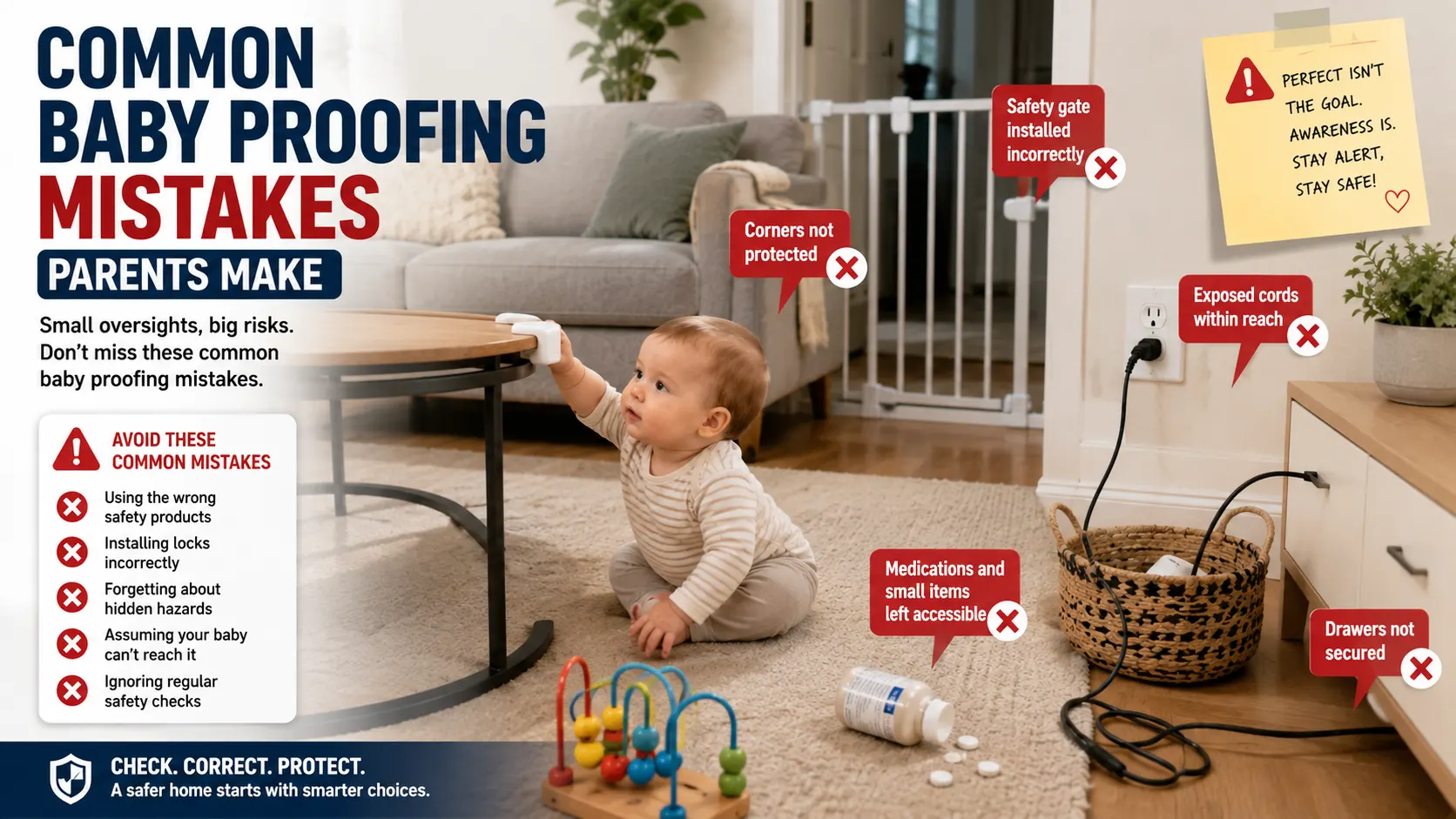

Most baby proofing content is organized by product — outlet covers, cabinet locks, stair gates. This one is organized around the actual mistakes, which fall into two very different buckets: mistakes in how parents approach baby proofing as a process, and specific physical hazards that get missed even by parents who’ve covered every “obvious” box. A lot of babyproofing advice focuses on products, but the riskiest mistakes often have more to do with how things are installed, what gets ignored, and when it all happens.
Process Mistakes: How Baby Proofing Approach Goes Wrong
Mistake 1: Waiting for Signs of Mobility Before Starting
Crawling happens quickly — one week a baby is wobbling in place, and the next they’re moving fast, and many parents wait for visible signs of movement before baby proofing, by which point it’s already too late. Start the highest-risk fixes (furniture anchoring, detectors) before your baby is mobile at all, not after you notice the first roll or scoot.
Mistake 2: Treating Baby Proofing as a One-Time Project
Baby proofing isn’t a one-time job — what works at six months won’t cut it at a year, since reach, climbing ability, and problem-solving all change substantially in that window. A setup that was thorough at one stage needs an active re-check at the next, not just a single pass before baby arrives.
Mistake 3: Outsourcing Vigilance to Products
It’s easy to feel “done” once outlets are covered and cabinets are locked, but products reduce risk — they don’t replace supervision. A latch can be defeated, a cover can loosen, and a determined toddler eventually tests every barrier in the house. The mistake isn’t buying the products; it’s treating their presence as equivalent to active attention.
Mistake 4: Baby Proofing Only Your Own Home
Grandparents’ houses, babysitters’ homes, and even friends’ places for a playdate are rarely held to the same standard, and a mobile baby doesn’t know the difference between “safe here” and “safe there.” A quick floor-level scan at any new environment matters as much as the setup in your own house.
Mistake 5: Assuming Everyone in the Household Follows the Same Standards
A partner, grandparent, or babysitter who doesn’t know the specific rules (cabinet stays locked, gate stays closed, outlet cover goes back on after vacuuming) can undo careful baby proofing without realizing it. A quick, explicit conversation about the household’s specific safety habits matters more than most parents assume — it’s easy to think safety habits are obvious when they’ve become automatic for you specifically.
Mistake 6: Not Testing Your Own Installations
Buying a good product isn’t the same as installing it correctly. A furniture anchor that isn’t screwed into a stud, a cabinet latch that isn’t actually engaging, or a gate that isn’t properly tensioned all look “done” without functioning as intended. A hands-on strength test after installing anything — pulling, pushing, or trying to defeat it yourself — catches this gap immediately.
Mistake 7: Trusting a “Baby-Proofed” Label as Zero-Risk
No single product or fully baby-proofed room eliminates risk entirely — it reduces it. Treating a well-set-up nursery or play area as a place where supervision can fully relax is a common and understandable, but risky, assumption.
Physical Hazards That Get Missed Even by Careful Parents
Hot Beverages and Liquids
Setting down a hot coffee, tea, or soup on a low table without a second thought is one of the most common oversights, and it’s a genuine accident risk once a baby starts reaching for things. Babies start reaching for objects from as young as around 3 months old, so a cup within their range — even one they can’t yet grab intentionally — can be pulled over by an exploring hand. Keep hot drinks on high, sturdy surfaces away from edges, and avoid holding or nursing a baby while drinking something hot.
Door Hinges and Pinch Points
Fingers caught in door hinges are a common injury once a baby starts crawling and pulling up, and even interior doors can swing or slam shut unexpectedly from a draft or another family member’s quick push. Door hinge guards and pinch guards address this directly, and it’s worth checking every door your baby has access to, not just exterior ones.
Bath Water Testing Method
Checking bath water temperature with your hand isn’t as sensitive as it feels — testing with your elbow or wrist gives a more accurate read on whether the water is actually comfortable for a baby’s more sensitive skin, since palms are naturally less temperature-sensitive from regular use.
Toys Meant for Older Children
It’s genuinely difficult to fully separate a younger baby’s toys from an older sibling’s, but toys made for older kids frequently include small parts that are a choking hazard for a baby. A dedicated play space or play yard for the baby, with their own toys stored separately, is a more realistic fix than trying to police every toy in a shared space at all times.
Seasonal and Event-Based Hazard Spikes
Holidays, birthday parties, and gatherings introduce temporary hazards that don’t exist on a normal day — balloons, small decorations, unfamiliar house guests’ bags and coat pockets, and food set out at a height that’s normally out of reach. It’s worth a specific pre-event mental check rather than assuming your everyday baby proofing covers it.
Reachable Items That “Used to Be” Out of Reach
A shelf, counter, or table that was safely out of reach at eight months can become reachable at fourteen months once a baby learns to climb or pull a chair over. Re-scanning surfaces that were previously ruled “safe by height” is worth doing at each new mobility milestone, not just the floor-level items.
A Simple System to Avoid the Process Mistakes
- Set a recurring calendar reminder (every 2–3 months, or at each new mobility milestone) to walk through the home again, rather than relying on remembering to do it.
- Write down your household’s specific safety rules — which cabinets stay locked, which gates stay closed — somewhere a babysitter or visiting relative can see it, rather than assuming it’ll come up in conversation.
- Do a hands-on test of every installed product the same day you install it, not just a visual check.
- Keep a small travel kit (a couple of outlet covers, a roll of tape) for visits to other homes, so “not my house” doesn’t mean “not baby-proofed at all” for the afternoon.
The Bottom Line
The mistakes that cause the most trouble usually aren’t missing products — they’re process gaps: starting too late, treating baby proofing as finished after one pass, and assuming products alone cover what active supervision used to. Layer in a few specific, easy-to-miss physical hazards — hot beverages, door hinges, an inaccurate bath temperature test — and most of what trips up even careful, well-prepared parents is covered.
Continue exploring: browse the full Baby Safety hub.
Frequently Asked
Common Questions