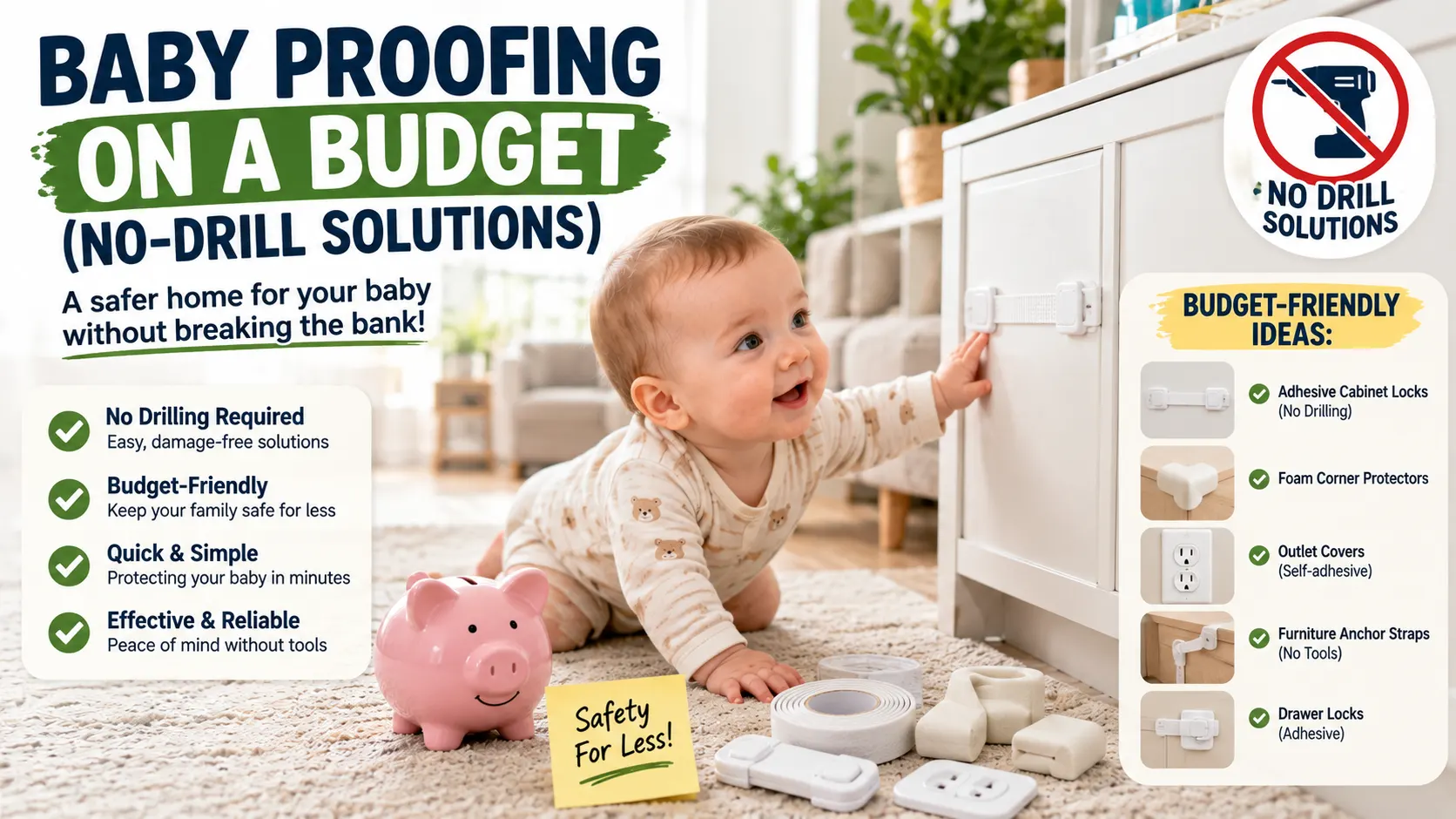

No-drill baby proofing has come a long way — most categories now have a genuinely effective alternative that doesn’t cost your security deposit or require a landlord’s permission. But there’s one important exception buried in a lot of renter-focused guides without a clear fix offered: pressure-mounted gates are not safe at the top of a staircase, no matter how tempting the no-drill convenience is. This guide covers what to swap in, what to build for free, and the one spot where “no-drill” needs a smarter workaround rather than a shortcut.
The One Safety Exception: Stair Gates
Multiple child safety sources are consistent on this point: a pressure-mounted gate can be pushed loose under a determined shove or fall, which is an acceptable risk between rooms on a flat surface, but not at the top of a staircase, where a gate failure means a fall down stairs rather than into a flat, safe room.
The actual no-drill-friendly solution: look for a gate designed to clamp onto the banister or newel post with a hardware bracket, rather than one that relies purely on wall-to-wall pressure tension. These clamp onto existing stair railings without drilling into drywall or studs, giving you hardware-level security at the specific spot where pressure-mounting genuinely isn’t safe. It’s a slightly bigger investment than a basic pressure gate, but it’s the correct budget tradeoff — this is not the place to save money with a lesser option.
No-Drill Swaps by Category
Furniture Anchoring
- Command-strip-style furniture anchors work for lightweight shelving, small dressers, and decor items, using strong adhesive rather than screws.
- For heavier dressers and bookshelves, adhesive-only anchors aren’t a full substitute for a stud-mounted anchor — this is a case worth having the direct landlord conversation about (see below), since the safety stakes are high enough to justify asking for an exception.
- Furniture-to-furniture anchoring (securing a lighter piece to a heavier, more stable piece next to it) is a genuine no-cost fallback when neither drilling nor a strong adhesive anchor is available.
- Strategic placement — positioning tall or climbable furniture in a corner, away from windows, and out of high-traffic paths reduces risk even before any hardware goes in, and costs nothing.
Cabinet and Drawer Locks
- Adhesive magnetic locks attach with strong double-sided tape rather than screws and leave no holes, working well for kitchen and bathroom cabinets in a rental.
- A simple rubber band or hair tie looped around two cabinet handles is a genuine zero-cost temporary fix for low-risk cabinets that don’t contain chemicals or sharp items.
- Repositioning contents — moving hazardous items (cleaning products, sharp tools) to a high shelf instead of relying entirely on a lock is a free, immediate first step while you source a proper lock.
Outlet Covers
- Sliding outlet plate covers with adhesive backing exist as a no-drill option, and are more secure than loose plug caps.
- Save your original outlet covers when you swap them out, so you can reinstall the originals at move-out.
- Peel-off adhesive plug covers are the lowest-cost option, though as covered in our full outlet safety guide, these are best treated as a secondary or travel option rather than your primary solution, since they’re removable by a determined toddler.
Corner and Edge Guards
- Adhesive foam or silicone corner guards are inherently no-drill by design and one of the easiest wins on this list.
- A genuine free DIY option: pool noodles, cut lengthwise and secured with strong double-sided tape or velcro strips, work as a padded edge guard for a coffee table or hearth at a fraction of the cost of purpose-made guards.
Baby Gates (Non-Stair)
- Pressure-mounted gates are appropriate and safe for doorways and flat-surface room dividers, just not stair tops as covered above.
- Freestanding play yards, especially secondhand ones, double as a room divider or contained play space without touching walls at all.
Cords and Cord Management
- Adhesive cord clips and raceways route cords along a baseboard without drilling.
- A free option: binder clips or bread-bag clips can bundle and secure loose cords along furniture edges in a pinch.
- Blind and curtain cords should be tied up out of reach regardless of drilling — this is a zero-cost fix (just securing existing cords higher) that matters as much as any purchased product.
Window Safety
- Window guards that clip onto the existing frame without drilling are available, though check the weight rating carefully.
- A no-cost interim step: keep furniture that could be climbed moved away from windows entirely, and don’t rely on a screen alone to hold a child’s weight, regardless of what safety product is or isn’t installed yet.
Free DIY Hacks Worth Knowing
- Repurpose secondhand baby gear — playpens, gates, and corner guards from other families are functionally identical to new ones and often available free or cheap through local parent groups.
- Use existing furniture as barriers — a couch or bookshelf positioned to block access to a room or hazard costs nothing and can supplement (not replace) a proper gate.
- Designate one fully baby-proofed room rather than trying to cover an entire apartment at once — a single well-secured space where baby spends most independent playtime is more realistic and effective than a thin layer of safety spread across every room.
- Maximize vertical, off-floor storage — over-the-door organizers and stackable bins keep hazards up and out of a crawling baby’s reach without any wall-mounted hardware at all.
How to Remove No-Drill Baby Proofing Without Losing Your Deposit
- Warm adhesive before removing it — a hairdryer on low heat softens strong adhesive, making it peel away more cleanly than pulling cold.
- Use dental floss or fishing line to gently saw behind a stubborn adhesive strip rather than prying with a tool that could damage paint or the surface underneath.
- Test removal on a small, hidden area first if you’re unsure how a wall or cabinet finish will react.
- Keep the original hardware you removed (outlet plates, cabinet knobs) in a labeled bag or box for easy reinstallation at move-out.
- Do a walkthrough before your final move-out inspection, specifically checking for adhesive residue, small holes from lighter-duty screws, or scuff marks from gates, so you can address anything minor before your landlord does.
Talking to Your Landlord: A Simple Script
Many landlords are more flexible about safety-related requests than general renovation ones, especially for something as clearly justified as child safety. A simple approach:
“We have a baby who’s starting to [crawl/pull up/walk], and we’d like to install a furniture anchor and a stair gate for safety. Both involve a small number of screw holes that we’re happy to patch and paint before we move out. Would that be alright, or is there a specific product or approach you’d prefer we use?”
Framing it as a specific, small, patchable request — rather than a general “can we drill into walls” question — makes it easier for a landlord to say yes.
Prioritizing on a Tight Budget
If you can only address a few things right now, in rough order:
- Stair gates (clamp-style, not basic pressure-mount, for the top of any staircase)
- Cabinet locks for chemicals and medications
- Furniture anchoring, using the strongest no-drill method available or the landlord conversation if the furniture is heavy
- Outlet covers
- Corner guards, DIY pool-noodle version is a fine starting point
- Everything else, as budget allows
Frequently Asked Questions
Are pressure-mounted gates safe to use anywhere in a rental? They’re safe for doorways and flat-surface room dividers, but not at the top of a staircase, where a gate failure results in a fall down stairs. Use a clamp-style gate that attaches to the banister or newel post for that specific location instead.
Will baby proofing damage my security deposit? Not if you choose adhesive-based, no-drill products and remove them carefully at move-out — warming adhesive before removal and keeping original hardware (outlet plates, knobs) to reinstall are the main steps that protect your deposit.
What’s the cheapest way to baby proof corners and edges? Pool noodles cut lengthwise and secured with double-sided tape or velcro work as a genuinely free or very low-cost alternative to purpose-made corner guards.
Should I still ask my landlord about drilling for something like a heavy furniture anchor? It’s worth asking directly, especially for high-stakes items like anchoring a heavy dresser or bookshelf — many landlords will approve a small, patchable hole for child safety specifically, even with a general no-drilling policy.
What should I prioritize first on a very tight budget? Stair gates (using a clamp-style option, not basic pressure-mount) and cabinet locks for chemicals and medications are the highest-priority items to address first, even before furniture anchoring or corner guards.
The Bottom Line
No-drill baby proofing covers nearly every category effectively now, from adhesive furniture anchors to magnetic cabinet locks to pool-noodle corner guards — the one place worth spending more or having the landlord conversation is stair gates, where a basic pressure-mounted option genuinely isn’t safe at the top of a staircase. Everywhere else, a combination of adhesive products, smart furniture placement, and a few free DIY swaps gets you most of the way there without risking your deposit.
Continue exploring: browse the full Baby Safety hub.
Frequently Asked
Common Questions