
Skip to content
DidYouSearch DidYouSearch
  • did you search?
  • Baby Plus+
    • Baby Activities
      • Arts & Crafts
      • Indoor Activities
      • Montessori
      • Music
      • Outdoor Activities
      • Reading
      • Sensory Play
      • Tummy Time
    • Baby Development
      • Brain Development
      • Cognitive Development
      • Emotional Development
      • Fine Motor Skills
      • Growth Milestones
      • Monthly Milestones
      • Motor Skills
      • Physical Development
      • Social Development
      • Speech Development
    • Baby Feeding
      • Allergies
      • Baby Led Weaning
      • Bottle Feeding
      • Breast feeding
        • Breastfeeding Diet
        • Breastfeeding Positions
        • Latch Problems
        • Low Milk Supply
        • Mastitis
        • Pumping Schedule
        • Weaning
      • Burping
      • Cluster Feeding
      • Feeding Schedule
      • Formula Feeding
        • Formula Amount
        • Formula Brands
        • Formula Comparison
        • Formula Preparation
        • Formula Storage
      • Hydration
      • Pumping
      • Solid Foods
    • Baby Gear Reviews
      • Best Baby Carrier
      • Best Baby Monitor
      • Best Baby Strollers
      • Best Bottles
      • Best Breast Pump
      • Best Car Seat
      • Best Cribs
      • Best Diapers
      • Best Formula
      • Best Toys
    • Baby Growth
      • Growth Spurts
      • Height Charts
      • Monthly Growth
      • Percentiles
      • Weight Charts
    • Baby Health
      • Allergies
      • Cold
      • Constipation
      • Cough
      • Diarrhea
      • Ear Infection
      • Fever
      • Flu
      • Pediatric Visits
      • Rashes
      • Teething
      • Vaccines
      • Vomiting
    • Baby Nutrition
      • Dairy
      • Drinks
      • Eggs
      • Fish
      • Fruits
      • Healthy Recipes
      • Meat
      • Snacks
      • Vegetables
      • Vitamins
    • Baby Products
      • Baby Carriers
      • Bassinets
      • Bottles
      • Breast Pumps
      • Car Seats
      • Cribs
      • Diaper Bags
      • High Chairs
      • Monitors
      • Strollers
      • Swings
      • Toys
      • Walkers
    • Baby Recipes
      • BLW Recipes
      • Breakfast
      • Dinner
      • Finger Foods
      • Lunch
      • Purees
      • Snacks
    • Baby Safety
      • Baby Proofing
      • Car Seats
      • Choking Hazards
      • CPR
      • Home Safety
      • Poison Prevention
      • Safe Sleep
      • Sun Protection
      • Water Safety
  • Baby Names
    • Boy Names
    • Girl Names
    • American baby boy names
    • American baby girl names
    • Biblical Names
    • Middle Names
    • Modern Names
    • Short Names
    • Unique Names
    • Unisex Names
  • Recommended
    • Baby Shopping
      • Baby Registry
      • Budget Baby Shopping
      • Hospital Bag
      • Must Have Products
      • Newborn Checklist
      • Nursery Ideas
    • Baby Sleep
      • Bedtime Routine
      • Co Sleeping
      • Crib Safety
      • Nap Schedules
      • Night Wakings
      • Sleep Environment
      • Sleep Products
      • Sleep Regression
      • Sleep Training
      • Wake Windows
      • White Noise
    • Childcare
      • Daycare
      • Babysitters
      • Kindergarten
      • Nannies
      • Preschool
    • Newborn Care
      • Nail Care
      • Baby Hygiene
      • Bathing
      • Crying
      • Diapering
      • Ear Care
      • Eye Care
      • Skin Care
      • Soothing Techniques
      • Temperature
      • Umbilical Cord
    • Special Needs
      • Premature Babies
      • Autism Signs
      • Developmental Delays
      • Down Syndrome
      • NICU
      • Twins
    • Seasonal Baby Care
      • Spring
      • Summer
      • Travel
      • Fall
      • Holidays
      • Winter
  • Parenting
    • Bonding
    • Discipline
    • Emotional Intelligence
    • First Time Parents
    • Gentle Parenting
    • Positive Parenting
    • Routines
    • Single Parents
    • Working Parents
  • Pregnancy
    • Pregnancy Complications
    • Labor & Delivery
    • Postpartum Recovery
    • Pregnancy Exercises
    • Pregnancy Medications
    • Pregnancy Nutrition
    • Pregnancy Sleep
    • Pregnancy Symptoms
    • Pregnancy Tests
    • Pregnancy Vitamins
    • Pregnancy Weeks
  • Toddler
    • Preschool
    • Speech
    • Tantrums
    • Toddler Food
    • Toddler Sleep
    • Behavior
    • Independence
    • Learning
    • Potty Training
  • Traveling with Baby
    • Road Trips
    • Beach
    • Camping
    • Flying
    • Hotels
    • Packing Lists
  • did you search?
  • Baby Plus+
    • Baby Activities
      • Arts & Crafts
      • Indoor Activities
      • Montessori
      • Music
      • Outdoor Activities
      • Reading
      • Sensory Play
      • Tummy Time
    • Baby Development
      • Brain Development
      • Cognitive Development
      • Emotional Development
      • Fine Motor Skills
      • Growth Milestones
      • Monthly Milestones
      • Motor Skills
      • Physical Development
      • Social Development
      • Speech Development
    • Baby Feeding
      • Allergies
      • Baby Led Weaning
      • Bottle Feeding
      • Breast feeding
        • Breastfeeding Diet
        • Breastfeeding Positions
        • Latch Problems
        • Low Milk Supply
        • Mastitis
        • Pumping Schedule
        • Weaning
      • Burping
      • Cluster Feeding
      • Feeding Schedule
      • Formula Feeding
        • Formula Amount
        • Formula Brands
        • Formula Comparison
        • Formula Preparation
        • Formula Storage
      • Hydration
      • Pumping
      • Solid Foods
    • Baby Gear Reviews
      • Best Baby Carrier
      • Best Baby Monitor
      • Best Baby Strollers
      • Best Bottles
      • Best Breast Pump
      • Best Car Seat
      • Best Cribs
      • Best Diapers
      • Best Formula
      • Best Toys
    • Baby Growth
      • Growth Spurts
      • Height Charts
      • Monthly Growth
      • Percentiles
      • Weight Charts
    • Baby Health
      • Allergies
      • Cold
      • Constipation
      • Cough
      • Diarrhea
      • Ear Infection
      • Fever
      • Flu
      • Pediatric Visits
      • Rashes
      • Teething
      • Vaccines
      • Vomiting
    • Baby Nutrition
      • Dairy
      • Drinks
      • Eggs
      • Fish
      • Fruits
      • Healthy Recipes
      • Meat
      • Snacks
      • Vegetables
      • Vitamins
    • Baby Products
      • Baby Carriers
      • Bassinets
      • Bottles
      • Breast Pumps
      • Car Seats
      • Cribs
      • Diaper Bags
      • High Chairs
      • Monitors
      • Strollers
      • Swings
      • Toys
      • Walkers
    • Baby Recipes
      • BLW Recipes
      • Breakfast
      • Dinner
      • Finger Foods
      • Lunch
      • Purees
      • Snacks
    • Baby Safety
      • Baby Proofing
      • Car Seats
      • Choking Hazards
      • CPR
      • Home Safety
      • Poison Prevention
      • Safe Sleep
      • Sun Protection
      • Water Safety
  • Baby Names
    • Boy Names
    • Girl Names
    • American baby boy names
    • American baby girl names
    • Biblical Names
    • Middle Names
    • Modern Names
    • Short Names
    • Unique Names
    • Unisex Names
  • Recommended
    • Baby Shopping
      • Baby Registry
      • Budget Baby Shopping
      • Hospital Bag
      • Must Have Products
      • Newborn Checklist
      • Nursery Ideas
    • Baby Sleep
      • Bedtime Routine
      • Co Sleeping
      • Crib Safety
      • Nap Schedules
      • Night Wakings
      • Sleep Environment
      • Sleep Products
      • Sleep Regression
      • Sleep Training
      • Wake Windows
      • White Noise
    • Childcare
      • Daycare
      • Babysitters
      • Kindergarten
      • Nannies
      • Preschool
    • Newborn Care
      • Nail Care
      • Baby Hygiene
      • Bathing
      • Crying
      • Diapering
      • Ear Care
      • Eye Care
      • Skin Care
      • Soothing Techniques
      • Temperature
      • Umbilical Cord
    • Special Needs
      • Premature Babies
      • Autism Signs
      • Developmental Delays
      • Down Syndrome
      • NICU
      • Twins
    • Seasonal Baby Care
      • Spring
      • Summer
      • Travel
      • Fall
      • Holidays
      • Winter
  • Parenting
    • Bonding
    • Discipline
    • Emotional Intelligence
    • First Time Parents
    • Gentle Parenting
    • Positive Parenting
    • Routines
    • Single Parents
    • Working Parents
  • Pregnancy
    • Pregnancy Complications
    • Labor & Delivery
    • Postpartum Recovery
    • Pregnancy Exercises
    • Pregnancy Medications
    • Pregnancy Nutrition
    • Pregnancy Sleep
    • Pregnancy Symptoms
    • Pregnancy Tests
    • Pregnancy Vitamins
    • Pregnancy Weeks
  • Toddler
    • Preschool
    • Speech
    • Tantrums
    • Toddler Food
    • Toddler Sleep
    • Behavior
    • Independence
    • Learning
    • Potty Training
  • Traveling with Baby
    • Road Trips
    • Beach
    • Camping
    • Flying
    • Hotels
    • Packing Lists
Close

Search

Home/Baby Safety/Baby Proofing/Non-Toxic Baby Proofing (Low-VOC Paint, Safe Cleaners)
Baby ProofingBaby Safety

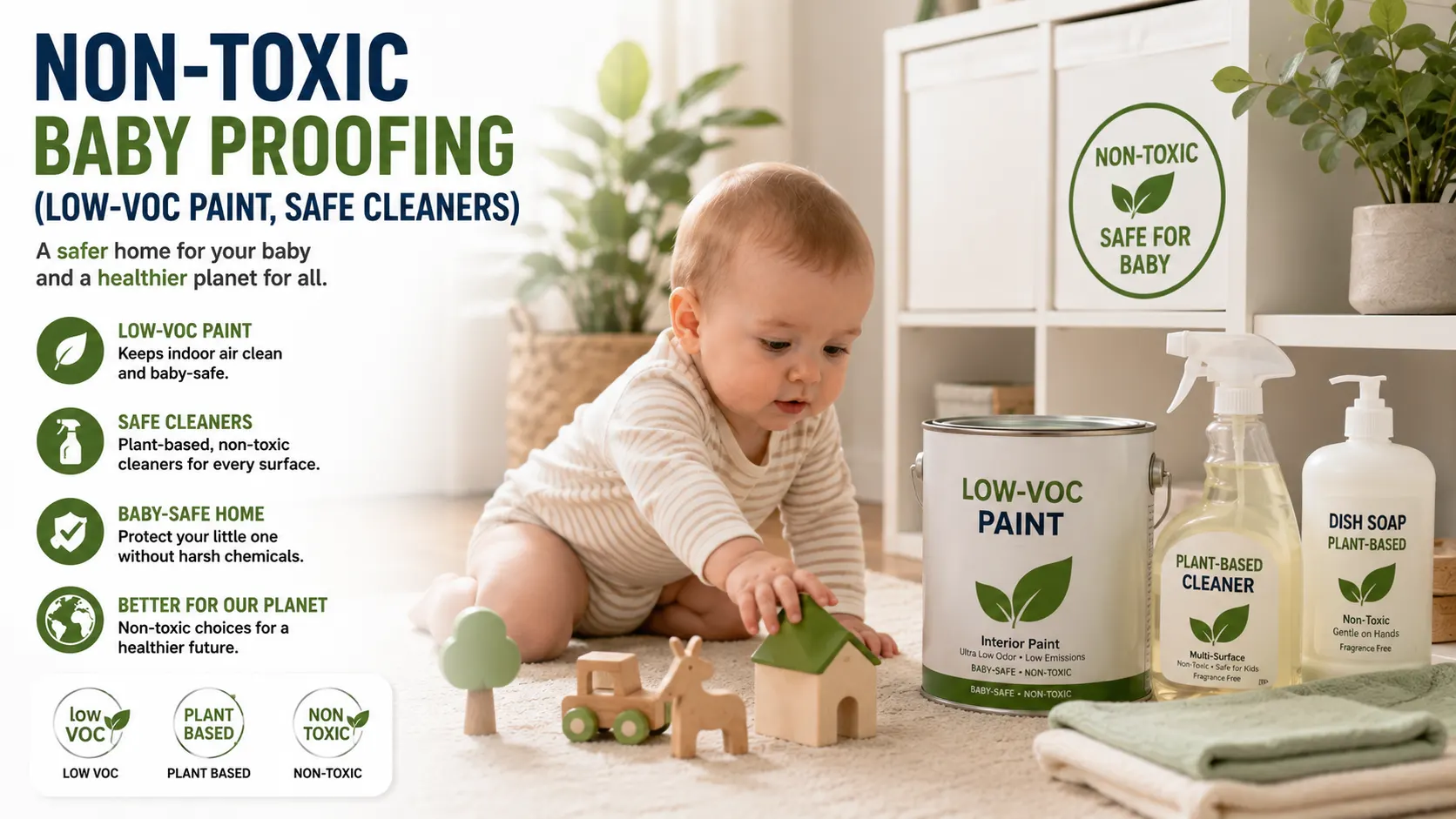
Non-Toxic Baby Proofing (Low-VOC Paint, Safe Cleaners)

By Ali
August 3, 2026 6 Min Read
0

Most non-toxic nursery guides are brand comparison lists — “the 11 best low-VOC paints” — which go stale the moment a product is discontinued and don’t help you decide what’s actually worth prioritizing. This guide takes a different approach: it explains why babies are more vulnerable to chemical exposure than adults, ranks the changes that matter most, and covers paint and cleaning products with the practical details — like actual off-gassing wait times and dangerous product mixing combinations — that most round-ups skip.

Why Babies Are More Vulnerable to Chemical Exposure

Contents hide
1 Why Babies Are More Vulnerable to Chemical Exposure
2 The “Total Chemical Load” Principle
3 Priority Ranking: What to Address First
3.1 Tier 1: Highest Priority (Direct, Sustained Contact)
3.2 Tier 2: Moderate Priority (Ongoing but Less Direct)
3.3 Tier 3: Lower Priority (Diminishing Returns)
4 Low-VOC and Zero-VOC Paint: What to Know
4.1 What VOCs Actually Are
4.2 How Long to Wait Before Baby Uses a Freshly Painted Room
4.3 What to Look for on a Label
4.4 Painting Furniture and Toys Specifically
5 Safe Cleaning Products: What to Avoid and What to Use
5.1 Ingredients Worth Avoiding Around Babies
5.2 Critical Safety Warning: Never Mix These
5.3 DIY Non-Toxic Cleaner Basics
5.4 What to Prioritize Buying vs. DIY-ing
6 Air Quality Beyond Paint and Cleaners
7 The Bottom Line
8 Frequently Asked
9 Common Questions

<cite index=”41-1″>Babies breathe at roughly 40–60 breaths per minute, close to twice the rate of an adult, and their lungs are still developing, which makes them less efficient at processing and clearing chemical exposures than an adult body.</cite> On top of breathing rate, babies spend more time at floor level where heavier VOCs and dust settle, and they explore surfaces by mouth, which adds a direct ingestion pathway that adults don’t have in the same way.

The “Total Chemical Load” Principle

<cite index=”41-2″>The broader principle worth understanding is total chemical load rather than any single product in isolation — each individual source of chemical exposure might be minor on its own, but they add up across paint, furniture, mattresses, cleaning products, and flooring in the same room.</cite> This is why a single “best paint” purchase doesn’t fully solve the problem, and why the priority ranking below matters more than perfecting any one category.

Priority Ranking: What to Address First

Not every non-toxic swap matters equally. Here’s a rough order based on direct, prolonged exposure — what baby breathes concentrated, touches directly, or mouths — rather than treating every category as equally urgent.

Tier 1: Highest Priority (Direct, Sustained Contact)

  • Crib mattress — baby spends more hours in direct contact with this than almost anything else in the room.
  • Cleaning products used on surfaces baby touches or mouths — changing table, floor, toys, high chair tray.
  • Laundry detergent for anything touching baby’s skin directly (clothing, sheets, blankets).

Tier 2: Moderate Priority (Ongoing but Less Direct)

  • Nursery paint, especially if applied close to when baby will start spending time in the room.
  • Upholstered furniture and gliders, particularly older pieces that may contain flame retardants.
  • New carpet or rugs, a significant VOC source when freshly installed.

Tier 3: Lower Priority (Diminishing Returns)

  • Decorative items with minimal contact (framed art, curtains, non-mouthable decor).
  • Furniture finishes on pieces baby won’t directly mouth or handle regularly, once fully cured.
  • Air-purifying houseplants — a nice-to-have addition to air quality, not a primary defense, and only worth it with baby-safe plant varieties.

Low-VOC and Zero-VOC Paint: What to Know

What VOCs Actually Are

<cite index=”42-1″>VOCs are the chemical fumes responsible for the “new paint smell,” and they can cause respiratory irritation, headaches, and dizziness even in adults — a stronger effect on a baby’s developing respiratory system is a reasonable concern.</cite> Low-VOC and zero-VOC paints are formulated with fewer or none of these solvents, releasing meaningfully fewer fumes both during and after application.

How Long to Wait Before Baby Uses a Freshly Painted Room

This is the detail most guides skip entirely. Even with zero-VOC paint, plan to:

  • Paint the nursery several weeks before baby will spend real time in it, not the week before — this applies even more to standard low-VOC paint than to zero-VOC formulas.
  • Ventilate heavily during and for several days after painting — open windows, use fans, and keep the door open rather than sealing the room to “protect” the fresh paint.
  • Let the paint fully cure, not just dry to the touch — surface dryness happens within hours, but full curing (and the tail end of off-gassing) takes longer, so avoid rushing furniture placement or heavy room use immediately after the paint feels dry.

What to Look for on a Label

  • “Zero-VOC” or “low-VOC” claims, ideally backed by a third-party indoor air quality certification rather than the claim alone.
  • Water-based formulas over solvent-based ones, which is closely related to but not identical to the VOC content.
  • No added formaldehyde, particularly relevant for pre-finished furniture and cabinetry, not just wall paint.
  • Low or no odor once fully dry, which is a rough proxy for lower ongoing off-gassing, though not a substitute for checking the actual VOC content.

Painting Furniture and Toys Specifically

If you’re painting a crib, dresser, or wooden toys rather than walls, the standard applies even more strictly, since these items involve direct and repeated contact:

  • Choose finishes explicitly labeled non-toxic and food-contact-safe once cured, not just “low-VOC” wall paint repurposed for furniture.
  • Milk paint is a commonly used non-toxic option for furniture and toys, containing no VOCs.
  • Seal painted wooden toys with a food-contact-safe finish (like a cured plant-based oil or wax) for extra protection against a baby who mouths them.

Safe Cleaning Products: What to Avoid and What to Use

Ingredients Worth Avoiding Around Babies

  • Chlorine bleach — effective but harsh, and should never be combined with ammonia or other cleaners (see the warning below).
  • Ammonia-based cleaners — similar concern, and a common ingredient in glass and multi-surface cleaners.
  • Synthetic fragrance — often a broad category hiding numerous undisclosed chemical compounds; “fragrance-free,” not just “unscented,” is the more reliable label.
  • Quaternary ammonium compounds (“quats”) — common in many disinfecting wipes and sprays; look for products that disclose specific active ingredients rather than vague “disinfectant” labeling.

Critical Safety Warning: Never Mix These

This deserves its own callout, since it’s a genuine safety hazard, not just a chemical-exposure concern:

  • Never mix bleach with ammonia — this combination produces toxic chloramine gas.
  • Never mix bleach with vinegar or other acids — this can release chlorine gas.
  • When switching between cleaning products, rinse the surface with plain water first rather than assuming leftover residue from a previous product won’t react with the next one.

DIY Non-Toxic Cleaner Basics

  • All-purpose surface cleaner: diluted white vinegar and water is effective for many general surfaces, though avoid it on natural stone, since the acidity can etch the surface over time.
  • Toy and high-touch surface cleaning: a mild castile soap and water solution is gentle and effective for washable toys and surfaces baby directly touches or mouths.
  • Avoid essential oils in DIY cleaners intended for baby’s direct environment, particularly in the early months — many essential oils aren’t well-studied for infant exposure, and some are genuinely unsafe in concentrated or repeated contact.

What to Prioritize Buying vs. DIY-ing

  • Laundry detergent for baby’s clothing and bedding: worth buying a dedicated fragrance-free, dye-free formula rather than DIY-ing, since laundry chemistry is harder to replicate safely at home.
  • General surface and floor cleaning: a reasonable place to DIY with vinegar or castile soap-based solutions if you prefer.
  • Disinfecting during illness: this is a case where efficacy matters more than avoiding all chemicals — a properly used, labeled disinfectant is appropriate when actually needed (like after a stomach virus), rather than defaulting to a gentler DIY cleaner that may not adequately disinfect.

Air Quality Beyond Paint and Cleaners

  • Ventilate regularly, not just after painting — opening windows for even a short period daily helps clear a range of everyday VOC sources (furniture off-gassing, cleaning product residue, cooking fumes drifting from other rooms).
  • Consider a HEPA air purifier for the nursery specifically, which helps with dust and particulates more than gas-phase VOCs, but is a reasonable additional layer.
  • Choose baby-safe houseplants only if adding any — some common houseplants are toxic if a mobile baby reaches and mouths them, so check toxicity before choosing based on air-quality reputation alone.
  • New carpet and rugs are a significant, often-overlooked VOC source — installing well ahead of baby’s arrival, or choosing lower-VOC options, follows the same logic as paint timing.

The Bottom Line

Non-toxic baby proofing isn’t about perfecting every single product in the house at once — it’s about recognizing total chemical load and prioritizing the items with the most direct, sustained contact first: the mattress, cleaning products used on baby’s surfaces, and laundry detergent, ahead of wall paint and decorative items. When you do paint or deep-clean, timing and ventilation matter as much as the product label itself.

Continue exploring: browse the full Baby Safety hub.

Frequently Asked

Common Questions

Plan to paint several weeks ahead of when baby will spend real time there, with heavy ventilation during and after painting, even with zero-VOC paint — surface dryness happens quickly, but full off-gassing and curing takes longer than a day or two.
Yes — low-VOC paint contains a reduced but nonzero amount of volatile organic compounds, while zero-VOC formulas are designed to contain effectively none. Both are safer than standard paint, but zero-VOC generally allows for a shorter safe wait time before heavy use of the room.
The crib mattress and any cleaning products used on surfaces baby directly touches or mouths, since these involve the most direct and sustained contact, ahead of wall paint or decorative items.
Yes, for many general surface and toy-cleaning purposes — diluted vinegar or castile soap solutions work well. Avoid combining cleaning products from different categories (especially anything containing bleach) due to the risk of producing toxic gas, and stick to purpose-made products for laundry and illness-related disinfecting.
Author

Ali

Digital Marketing enthusiast with a passion for SEO, web design, analytics, and creative problem-solving.

Follow Me
Other Articles
Previous

Baby Proofing for Pets and Babies Together

Next

Baby Proofing on a Budget (No-Drill Solutions)

No Comment! Be the first one.

Leave a Reply Cancel reply

Your email address will not be published. Required fields are marked *

What is Did You Search?

The “Did You Search” website was created for all mothers and families. Just search to find all your needs about your children.

Links

  • about
  • contact
  • privacy policy
  • medical disclaimer
  • sitemap
Copyright 2026 — DidYouSearch. All rights reserved.