
Skip to content
DidYouSearch DidYouSearch
  • did you search?
  • Baby Plus+
    • Baby Activities
      • Arts & Crafts
      • Indoor Activities
      • Montessori
      • Music
      • Outdoor Activities
      • Reading
      • Sensory Play
      • Tummy Time
    • Baby Development
      • Brain Development
      • Cognitive Development
      • Emotional Development
      • Fine Motor Skills
      • Growth Milestones
      • Monthly Milestones
      • Motor Skills
      • Physical Development
      • Social Development
      • Speech Development
    • Baby Feeding
      • Allergies
      • Baby Led Weaning
      • Bottle Feeding
      • Breast feeding
        • Breastfeeding Diet
        • Breastfeeding Positions
        • Latch Problems
        • Low Milk Supply
        • Mastitis
        • Pumping Schedule
        • Weaning
      • Burping
      • Cluster Feeding
      • Feeding Schedule
      • Formula Feeding
        • Formula Amount
        • Formula Brands
        • Formula Comparison
        • Formula Preparation
        • Formula Storage
      • Hydration
      • Pumping
      • Solid Foods
    • Baby Gear Reviews
      • Best Baby Carrier
      • Best Baby Monitor
      • Best Baby Strollers
      • Best Bottles
      • Best Breast Pump
      • Best Car Seat
      • Best Cribs
      • Best Diapers
      • Best Formula
      • Best Toys
    • Baby Growth
      • Growth Spurts
      • Height Charts
      • Monthly Growth
      • Percentiles
      • Weight Charts
    • Baby Health
      • Allergies
      • Cold
      • Constipation
      • Cough
      • Diarrhea
      • Ear Infection
      • Fever
      • Flu
      • Pediatric Visits
      • Rashes
      • Teething
      • Vaccines
      • Vomiting
    • Baby Nutrition
      • Dairy
      • Drinks
      • Eggs
      • Fish
      • Fruits
      • Healthy Recipes
      • Meat
      • Snacks
      • Vegetables
      • Vitamins
    • Baby Products
      • Baby Carriers
      • Bassinets
      • Bottles
      • Breast Pumps
      • Car Seats
      • Cribs
      • Diaper Bags
      • High Chairs
      • Monitors
      • Strollers
      • Swings
      • Toys
      • Walkers
    • Baby Recipes
      • BLW Recipes
      • Breakfast
      • Dinner
      • Finger Foods
      • Lunch
      • Purees
      • Snacks
    • Baby Safety
      • Baby Proofing
      • Car Seats
      • Choking Hazards
      • CPR
      • Home Safety
      • Poison Prevention
      • Safe Sleep
      • Sun Protection
      • Water Safety
  • Baby Names
    • Boy Names
    • Girl Names
    • American baby boy names
    • American baby girl names
    • Biblical Names
    • Middle Names
    • Modern Names
    • Short Names
    • Unique Names
    • Unisex Names
  • Recommended
    • Baby Shopping
      • Baby Registry
      • Budget Baby Shopping
      • Hospital Bag
      • Must Have Products
      • Newborn Checklist
      • Nursery Ideas
    • Baby Sleep
      • Bedtime Routine
      • Co Sleeping
      • Crib Safety
      • Nap Schedules
      • Night Wakings
      • Sleep Environment
      • Sleep Products
      • Sleep Regression
      • Sleep Training
      • Wake Windows
      • White Noise
    • Childcare
      • Daycare
      • Babysitters
      • Kindergarten
      • Nannies
      • Preschool
    • Newborn Care
      • Nail Care
      • Baby Hygiene
      • Bathing
      • Crying
      • Diapering
      • Ear Care
      • Eye Care
      • Skin Care
      • Soothing Techniques
      • Temperature
      • Umbilical Cord
    • Special Needs
      • Premature Babies
      • Autism Signs
      • Developmental Delays
      • Down Syndrome
      • NICU
      • Twins
    • Seasonal Baby Care
      • Spring
      • Summer
      • Travel
      • Fall
      • Holidays
      • Winter
  • Parenting
    • Bonding
    • Discipline
    • Emotional Intelligence
    • First Time Parents
    • Gentle Parenting
    • Positive Parenting
    • Routines
    • Single Parents
    • Working Parents
  • Pregnancy
    • Pregnancy Complications
    • Labor & Delivery
    • Postpartum Recovery
    • Pregnancy Exercises
    • Pregnancy Medications
    • Pregnancy Nutrition
    • Pregnancy Sleep
    • Pregnancy Symptoms
    • Pregnancy Tests
    • Pregnancy Vitamins
    • Pregnancy Weeks
  • Toddler
    • Preschool
    • Speech
    • Tantrums
    • Toddler Food
    • Toddler Sleep
    • Behavior
    • Independence
    • Learning
    • Potty Training
  • Traveling with Baby
    • Road Trips
    • Beach
    • Camping
    • Flying
    • Hotels
    • Packing Lists
  • did you search?
  • Baby Plus+
    • Baby Activities
      • Arts & Crafts
      • Indoor Activities
      • Montessori
      • Music
      • Outdoor Activities
      • Reading
      • Sensory Play
      • Tummy Time
    • Baby Development
      • Brain Development
      • Cognitive Development
      • Emotional Development
      • Fine Motor Skills
      • Growth Milestones
      • Monthly Milestones
      • Motor Skills
      • Physical Development
      • Social Development
      • Speech Development
    • Baby Feeding
      • Allergies
      • Baby Led Weaning
      • Bottle Feeding
      • Breast feeding
        • Breastfeeding Diet
        • Breastfeeding Positions
        • Latch Problems
        • Low Milk Supply
        • Mastitis
        • Pumping Schedule
        • Weaning
      • Burping
      • Cluster Feeding
      • Feeding Schedule
      • Formula Feeding
        • Formula Amount
        • Formula Brands
        • Formula Comparison
        • Formula Preparation
        • Formula Storage
      • Hydration
      • Pumping
      • Solid Foods
    • Baby Gear Reviews
      • Best Baby Carrier
      • Best Baby Monitor
      • Best Baby Strollers
      • Best Bottles
      • Best Breast Pump
      • Best Car Seat
      • Best Cribs
      • Best Diapers
      • Best Formula
      • Best Toys
    • Baby Growth
      • Growth Spurts
      • Height Charts
      • Monthly Growth
      • Percentiles
      • Weight Charts
    • Baby Health
      • Allergies
      • Cold
      • Constipation
      • Cough
      • Diarrhea
      • Ear Infection
      • Fever
      • Flu
      • Pediatric Visits
      • Rashes
      • Teething
      • Vaccines
      • Vomiting
    • Baby Nutrition
      • Dairy
      • Drinks
      • Eggs
      • Fish
      • Fruits
      • Healthy Recipes
      • Meat
      • Snacks
      • Vegetables
      • Vitamins
    • Baby Products
      • Baby Carriers
      • Bassinets
      • Bottles
      • Breast Pumps
      • Car Seats
      • Cribs
      • Diaper Bags
      • High Chairs
      • Monitors
      • Strollers
      • Swings
      • Toys
      • Walkers
    • Baby Recipes
      • BLW Recipes
      • Breakfast
      • Dinner
      • Finger Foods
      • Lunch
      • Purees
      • Snacks
    • Baby Safety
      • Baby Proofing
      • Car Seats
      • Choking Hazards
      • CPR
      • Home Safety
      • Poison Prevention
      • Safe Sleep
      • Sun Protection
      • Water Safety
  • Baby Names
    • Boy Names
    • Girl Names
    • American baby boy names
    • American baby girl names
    • Biblical Names
    • Middle Names
    • Modern Names
    • Short Names
    • Unique Names
    • Unisex Names
  • Recommended
    • Baby Shopping
      • Baby Registry
      • Budget Baby Shopping
      • Hospital Bag
      • Must Have Products
      • Newborn Checklist
      • Nursery Ideas
    • Baby Sleep
      • Bedtime Routine
      • Co Sleeping
      • Crib Safety
      • Nap Schedules
      • Night Wakings
      • Sleep Environment
      • Sleep Products
      • Sleep Regression
      • Sleep Training
      • Wake Windows
      • White Noise
    • Childcare
      • Daycare
      • Babysitters
      • Kindergarten
      • Nannies
      • Preschool
    • Newborn Care
      • Nail Care
      • Baby Hygiene
      • Bathing
      • Crying
      • Diapering
      • Ear Care
      • Eye Care
      • Skin Care
      • Soothing Techniques
      • Temperature
      • Umbilical Cord
    • Special Needs
      • Premature Babies
      • Autism Signs
      • Developmental Delays
      • Down Syndrome
      • NICU
      • Twins
    • Seasonal Baby Care
      • Spring
      • Summer
      • Travel
      • Fall
      • Holidays
      • Winter
  • Parenting
    • Bonding
    • Discipline
    • Emotional Intelligence
    • First Time Parents
    • Gentle Parenting
    • Positive Parenting
    • Routines
    • Single Parents
    • Working Parents
  • Pregnancy
    • Pregnancy Complications
    • Labor & Delivery
    • Postpartum Recovery
    • Pregnancy Exercises
    • Pregnancy Medications
    • Pregnancy Nutrition
    • Pregnancy Sleep
    • Pregnancy Symptoms
    • Pregnancy Tests
    • Pregnancy Vitamins
    • Pregnancy Weeks
  • Toddler
    • Preschool
    • Speech
    • Tantrums
    • Toddler Food
    • Toddler Sleep
    • Behavior
    • Independence
    • Learning
    • Potty Training
  • Traveling with Baby
    • Road Trips
    • Beach
    • Camping
    • Flying
    • Hotels
    • Packing Lists
Close

Search

Home/Baby Activities/Montessori/Montessori Baby Activities (6–9 Months)
Montessori

Montessori Baby Activities (6–9 Months)

By DrAdam
August 12, 2026 5 Min Read
0

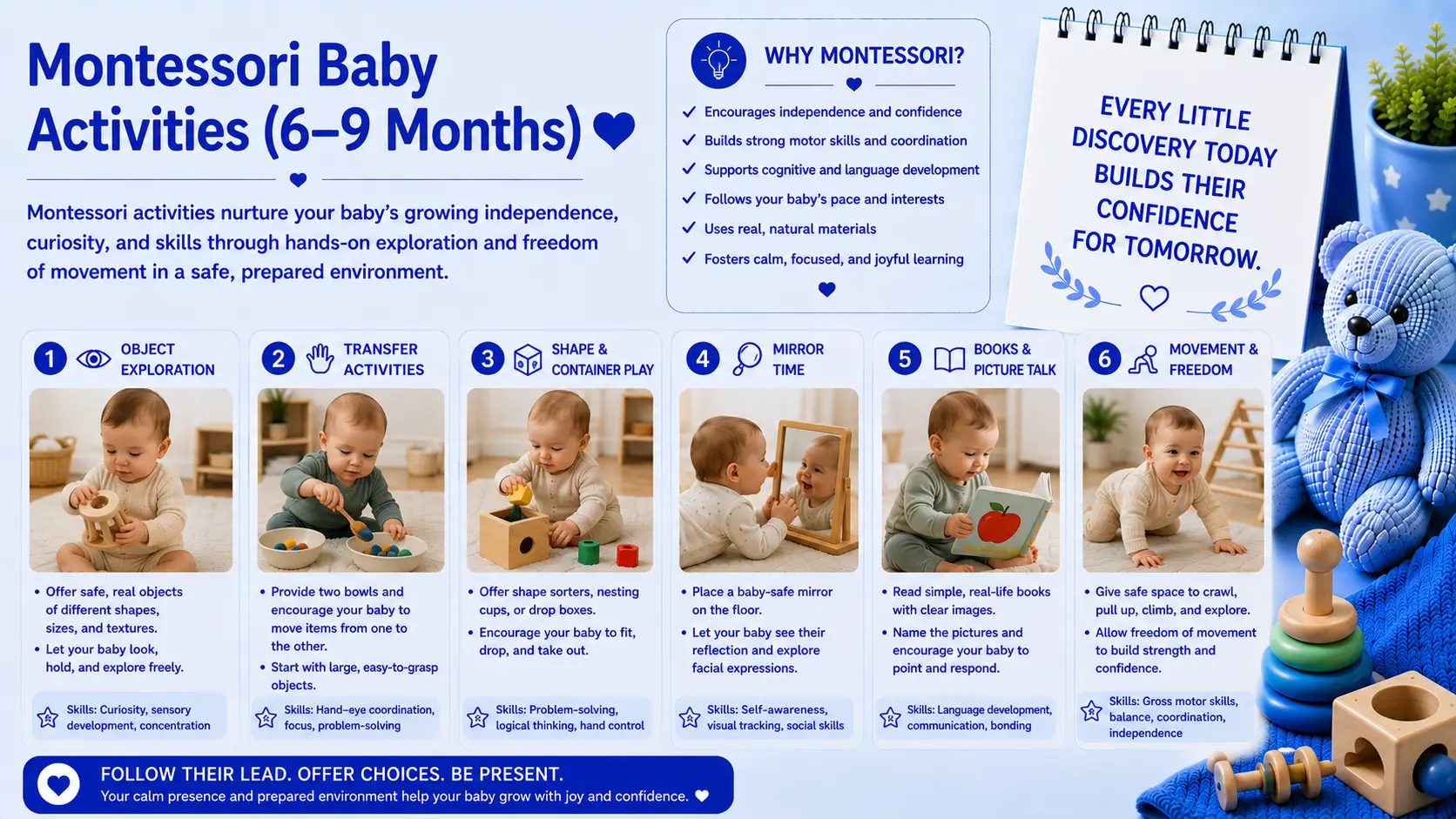
Between 6 and 9 months, babies shift from mostly reflexive movements to more purposeful exploration. They begin sitting more steadily, reaching with intention, transferring objects hand-to-hand, and discovering cause and effect. This stage is ideal for simple, open-ended Montessori-inspired activities that support language, movement, hand-eye coordination, and sensory development without overwhelming the child or requiring expensive toys.

Montessori activities for 6-9 months focus on following the child’s natural interests and providing just enough challenge. The goal is not to “teach” in the formal sense but to prepare a safe, inviting environment where the baby can practice skills independently.

Key Developmental Areas at This Age

Contents hide
1 Key Developmental Areas at This Age
2 Practical Montessori-Friendly Activities
3 Setting Up the Environment
4 Tips for Success
5 FAQ
5.1 What are the best Montessori activities for a 6-9 month old?
5.2 Do I need special Montessori toys?
5.3 When should I introduce an object permanence box?
5.4 How much structured play does a 6-9 month old need?
5.5 Is it okay if my baby mostly mouths the materials?

Babies in this range are typically working on:

Language: Babbling turns into clearer sounds. Talking, singing, and responding to their vocalizations build the foundation for conversation.

Movement: Rolling, sitting, pivoting, and early crawling or creeping. Free movement on a safe floor space encourages these skills far more than restricted seats or walkers.

Hand-eye coordination: Grasping, releasing, transferring objects, and early “in and out” work. The grasp often starts broad (palmar) and gradually becomes more refined.

Sensory and aural exploration: Mouthing, feeling different textures, and noticing sounds remain primary ways of learning.

Activities that match these interests tend to hold attention longer and feel more satisfying for the baby.

Practical Montessori-Friendly Activities

Treasure baskets One of the most popular and effective Montessori baby activities is the treasure basket. Fill a low, sturdy basket or shallow bowl with 8–12 safe household or natural objects of varied textures, weights, and materials: a wooden spoon, a soft brush, a large shell, a metal measuring cup, a small silicone ball, a piece of fabric, a smooth stone (too big to swallow), or a wooden ring. Sit nearby and let the baby explore at their own pace. Rotate a few items every week or two to keep interest high. This supports sensory exploration, grasp development, and concentration.

Object permanence box Around 8–9 months (once sitting is steady), many babies enjoy an object permanence box. A simple wooden or cardboard box with a hole on top and a tray or ramp that lets a ball roll out the side teaches that objects still exist when they disappear from view. The baby practices releasing the ball into the hole and retrieving it—excellent hand-eye coordination and early problem-solving. DIY versions work well with a sturdy cardboard box and a large wooden or soft ball.

Rings on a dowel or simple stacking Start with large wooden rings on a vertical peg or the base of a stacking toy. At first the baby usually removes the rings. Later they may attempt to replace them. This is classic early “in and out” work that builds grasp strength and coordination. Keep the materials simple so success feels achievable.

Soft balls and rolling toys A basket of soft fabric or lightweight balls invites reaching, grasping, and crawling after them. Larger rollers or balls that make gentle sounds encourage movement across the floor. These support gross motor development while remaining safe for mouthing.

Musical exploration Simple instruments—egg shakers, small bells, a soft drum, or a spinning drum—connect movement with sound. Babies love the cause-and-effect discovery of shaking or banging. Offer these one or two at a time so the experience stays focused.

Egg and cup or peg and cup These small “posting” activities help refine the grasp. The egg or peg fits comfortably in a baby’s hand, and placing it in and out of the cup builds wrist control and concentration. Present slowly and allow plenty of repetition.

Everyday language and observation Narrate daily life in clear, rich language: “You’re reaching for the blue cup.” Sing simple songs and pause so the baby can respond. Read short board books with real photographs or clear illustrations. These moments support language development more effectively than flashcards or screens.

Many families also enjoy low-cost or DIY options such as sensory bottles (securely sealed jars with water and floating items), large soft blocks for early banging or transferring, and a low mirror with a pull-up bar for movement practice once the baby shows interest in standing.

Setting Up the Environment

A prepared Montessori space for this age is calm and accessible. Place a few carefully chosen materials on a low shelf or in baskets the baby can reach while sitting or crawling. Limit the number of items out at once—three to five options is often plenty. Rotate based on what the baby returns to repeatedly. Prioritize natural materials (wood, metal, fabric, rubber) over plastic when possible, because they offer richer sensory feedback. Always supervise and check for choking hazards; everything goes in the mouth at this stage.

Free floor time remains essential. Avoid prolonged use of containers that restrict movement. A soft mat or rug in a clear area gives space for rolling, sitting, and beginning to crawl.

Tips for Success

Observe more than you direct. If the baby is deeply engaged with one object, resist the urge to introduce something new. Follow their lead and offer help only when frustration appears. Short, focused sessions of independent exploration often matter more than long structured “lessons.” Keep expectations realistic—repetition is how babies master skills.

These Montessori activities for 6-9 month olds work well at home with everyday items and a few thoughtful materials. The emphasis stays on respect for the child’s pace, rich sensory experiences, and opportunities for real movement and concentration.

FAQ

What are the best Montessori activities for a 6-9 month old?

Treasure baskets, simple object permanence play, rings on a dowel, soft balls for reaching and crawling, basic musical instruments, and everyday language-rich interactions rank among the most useful. Focus on materials that support grasping, releasing, movement, and sensory exploration.

Do I need special Montessori toys?

No. Many effective activities use household objects or simple DIY materials. A few well-chosen wooden or fabric items can enhance the experience, but the principles—freedom of movement, real materials, and observation—matter more than branded products.

When should I introduce an object permanence box?

Most babies show readiness once they sit steadily and can intentionally release objects, often around 8 months. Watch for interest in dropping or hiding toys and introduce it then. Earlier is fine if the baby is ready; later is also fine.

How much structured play does a 6-9 month old need?

Very little. Short periods of focused exploration mixed with plenty of free movement and responsive interaction work best. Follow the child’s cues rather than a rigid schedule.

Is it okay if my baby mostly mouths the materials?

Yes. Mouthing is a primary way infants explore texture, temperature, and shape at this age. Choose safe, non-toxic materials and supervise closely. The sensory input supports development even when it looks like “just chewing.”


Author

DrAdam

Dr. Adam. Obstetrician and Gynecologist

Follow Me
Other Articles
Previous

Montessori Baby Activities (3–6 Months)

Next

Montessori Baby Activities (9–12 Months)

No Comment! Be the first one.

Leave a Reply Cancel reply

Your email address will not be published. Required fields are marked *

What is Did You Search?

The “Did You Search” website was created for all mothers and families. Just search to find all your needs about your children.

Links

  • about
  • contact
  • privacy policy
  • medical disclaimer
  • sitemap
Copyright 2026 — DidYouSearch. All rights reserved.