Skip to content
DidYouSearch DidYouSearch
  • did you search?
  • Baby Plus+
    • Baby Activities
      • Arts & Crafts
      • Indoor Activities
      • Montessori
      • Music
      • Outdoor Activities
      • Reading
      • Sensory Play
      • Tummy Time
    • Baby Development
      • Brain Development
      • Cognitive Development
      • Emotional Development
      • Fine Motor Skills
      • Growth Milestones
      • Monthly Milestones
      • Motor Skills
      • Physical Development
      • Social Development
      • Speech Development
    • Baby Feeding
      • Allergies
      • Baby Led Weaning
      • Bottle Feeding
      • Breast feeding
        • Breastfeeding Diet
        • Breastfeeding Positions
        • Latch Problems
        • Low Milk Supply
        • Mastitis
        • Pumping Schedule
        • Weaning
      • Burping
      • Cluster Feeding
      • Feeding Schedule
      • Formula Feeding
        • Formula Amount
        • Formula Brands
        • Formula Comparison
        • Formula Preparation
        • Formula Storage
      • Hydration
      • Pumping
      • Solid Foods
    • Baby Gear Reviews
      • Best Baby Carrier
      • Best Baby Monitor
      • Best Baby Strollers
      • Best Bottles
      • Best Breast Pump
      • Best Car Seat
      • Best Cribs
      • Best Diapers
      • Best Formula
      • Best Toys
    • Baby Growth
      • Growth Spurts
      • Height Charts
      • Monthly Growth
      • Percentiles
      • Weight Charts
    • Baby Health
      • Allergies
      • Cold
      • Constipation
      • Cough
      • Diarrhea
      • Ear Infection
      • Fever
      • Flu
      • Pediatric Visits
      • Rashes
      • Teething
      • Vaccines
      • Vomiting
    • Baby Nutrition
      • Dairy
      • Drinks
      • Eggs
      • Fish
      • Fruits
      • Healthy Recipes
      • Meat
      • Snacks
      • Vegetables
      • Vitamins
    • Baby Products
      • Baby Carriers
      • Bassinets
      • Bottles
      • Breast Pumps
      • Car Seats
      • Cribs
      • Diaper Bags
      • High Chairs
      • Monitors
      • Strollers
      • Swings
      • Toys
      • Walkers
    • Baby Recipes
      • BLW Recipes
      • Breakfast
      • Dinner
      • Finger Foods
      • Lunch
      • Purees
      • Snacks
    • Baby Safety
      • Baby Proofing
      • Car Seats
      • Choking Hazards
      • CPR
      • Home Safety
      • Poison Prevention
      • Safe Sleep
      • Sun Protection
      • Water Safety
  • Baby Names
    • Boy Names
    • Girl Names
    • American baby boy names
    • American baby girl names
    • Biblical Names
    • Middle Names
    • Modern Names
    • Short Names
    • Unique Names
    • Unisex Names
  • Recommended
    • Baby Shopping
      • Baby Registry
      • Budget Baby Shopping
      • Hospital Bag
      • Must Have Products
      • Newborn Checklist
      • Nursery Ideas
    • Baby Sleep
      • Bedtime Routine
      • Co Sleeping
      • Crib Safety
      • Nap Schedules
      • Night Wakings
      • Sleep Environment
      • Sleep Products
      • Sleep Regression
      • Sleep Training
      • Wake Windows
      • White Noise
    • Childcare
      • Daycare
      • Babysitters
      • Kindergarten
      • Nannies
      • Preschool
    • Newborn Care
      • Nail Care
      • Baby Hygiene
      • Bathing
      • Crying
      • Diapering
      • Ear Care
      • Eye Care
      • Skin Care
      • Soothing Techniques
      • Temperature
      • Umbilical Cord
    • Special Needs
      • Premature Babies
      • Autism Signs
      • Developmental Delays
      • Down Syndrome
      • NICU
      • Twins
    • Seasonal Baby Care
      • Spring
      • Summer
      • Travel
      • Fall
      • Holidays
      • Winter
  • Parenting
    • Bonding
    • Discipline
    • Emotional Intelligence
    • First Time Parents
    • Gentle Parenting
    • Positive Parenting
    • Routines
    • Single Parents
    • Working Parents
  • Pregnancy
    • Pregnancy Complications
    • Labor & Delivery
    • Postpartum Recovery
    • Pregnancy Exercises
    • Pregnancy Medications
    • Pregnancy Nutrition
    • Pregnancy Sleep
    • Pregnancy Symptoms
    • Pregnancy Tests
    • Pregnancy Vitamins
    • Pregnancy Weeks
  • Toddler
    • Preschool
    • Speech
    • Tantrums
    • Toddler Food
    • Toddler Sleep
    • Behavior
    • Independence
    • Learning
    • Potty Training
  • Traveling with Baby
    • Road Trips
    • Beach
    • Camping
    • Flying
    • Hotels
    • Packing Lists
  • did you search?
  • Baby Plus+
    • Baby Activities
      • Arts & Crafts
      • Indoor Activities
      • Montessori
      • Music
      • Outdoor Activities
      • Reading
      • Sensory Play
      • Tummy Time
    • Baby Development
      • Brain Development
      • Cognitive Development
      • Emotional Development
      • Fine Motor Skills
      • Growth Milestones
      • Monthly Milestones
      • Motor Skills
      • Physical Development
      • Social Development
      • Speech Development
    • Baby Feeding
      • Allergies
      • Baby Led Weaning
      • Bottle Feeding
      • Breast feeding
        • Breastfeeding Diet
        • Breastfeeding Positions
        • Latch Problems
        • Low Milk Supply
        • Mastitis
        • Pumping Schedule
        • Weaning
      • Burping
      • Cluster Feeding
      • Feeding Schedule
      • Formula Feeding
        • Formula Amount
        • Formula Brands
        • Formula Comparison
        • Formula Preparation
        • Formula Storage
      • Hydration
      • Pumping
      • Solid Foods
    • Baby Gear Reviews
      • Best Baby Carrier
      • Best Baby Monitor
      • Best Baby Strollers
      • Best Bottles
      • Best Breast Pump
      • Best Car Seat
      • Best Cribs
      • Best Diapers
      • Best Formula
      • Best Toys
    • Baby Growth
      • Growth Spurts
      • Height Charts
      • Monthly Growth
      • Percentiles
      • Weight Charts
    • Baby Health
      • Allergies
      • Cold
      • Constipation
      • Cough
      • Diarrhea
      • Ear Infection
      • Fever
      • Flu
      • Pediatric Visits
      • Rashes
      • Teething
      • Vaccines
      • Vomiting
    • Baby Nutrition
      • Dairy
      • Drinks
      • Eggs
      • Fish
      • Fruits
      • Healthy Recipes
      • Meat
      • Snacks
      • Vegetables
      • Vitamins
    • Baby Products
      • Baby Carriers
      • Bassinets
      • Bottles
      • Breast Pumps
      • Car Seats
      • Cribs
      • Diaper Bags
      • High Chairs
      • Monitors
      • Strollers
      • Swings
      • Toys
      • Walkers
    • Baby Recipes
      • BLW Recipes
      • Breakfast
      • Dinner
      • Finger Foods
      • Lunch
      • Purees
      • Snacks
    • Baby Safety
      • Baby Proofing
      • Car Seats
      • Choking Hazards
      • CPR
      • Home Safety
      • Poison Prevention
      • Safe Sleep
      • Sun Protection
      • Water Safety
  • Baby Names
    • Boy Names
    • Girl Names
    • American baby boy names
    • American baby girl names
    • Biblical Names
    • Middle Names
    • Modern Names
    • Short Names
    • Unique Names
    • Unisex Names
  • Recommended
    • Baby Shopping
      • Baby Registry
      • Budget Baby Shopping
      • Hospital Bag
      • Must Have Products
      • Newborn Checklist
      • Nursery Ideas
    • Baby Sleep
      • Bedtime Routine
      • Co Sleeping
      • Crib Safety
      • Nap Schedules
      • Night Wakings
      • Sleep Environment
      • Sleep Products
      • Sleep Regression
      • Sleep Training
      • Wake Windows
      • White Noise
    • Childcare
      • Daycare
      • Babysitters
      • Kindergarten
      • Nannies
      • Preschool
    • Newborn Care
      • Nail Care
      • Baby Hygiene
      • Bathing
      • Crying
      • Diapering
      • Ear Care
      • Eye Care
      • Skin Care
      • Soothing Techniques
      • Temperature
      • Umbilical Cord
    • Special Needs
      • Premature Babies
      • Autism Signs
      • Developmental Delays
      • Down Syndrome
      • NICU
      • Twins
    • Seasonal Baby Care
      • Spring
      • Summer
      • Travel
      • Fall
      • Holidays
      • Winter
  • Parenting
    • Bonding
    • Discipline
    • Emotional Intelligence
    • First Time Parents
    • Gentle Parenting
    • Positive Parenting
    • Routines
    • Single Parents
    • Working Parents
  • Pregnancy
    • Pregnancy Complications
    • Labor & Delivery
    • Postpartum Recovery
    • Pregnancy Exercises
    • Pregnancy Medications
    • Pregnancy Nutrition
    • Pregnancy Sleep
    • Pregnancy Symptoms
    • Pregnancy Tests
    • Pregnancy Vitamins
    • Pregnancy Weeks
  • Toddler
    • Preschool
    • Speech
    • Tantrums
    • Toddler Food
    • Toddler Sleep
    • Behavior
    • Independence
    • Learning
    • Potty Training
  • Traveling with Baby
    • Road Trips
    • Beach
    • Camping
    • Flying
    • Hotels
    • Packing Lists
Close

Search

Home/Baby Activities/Montessori/Montessori Baby Activities (9–12 Months)
Montessori

Montessori Baby Activities (9–12 Months)

By DrAdam
August 12, 2026 5 Min Read
0

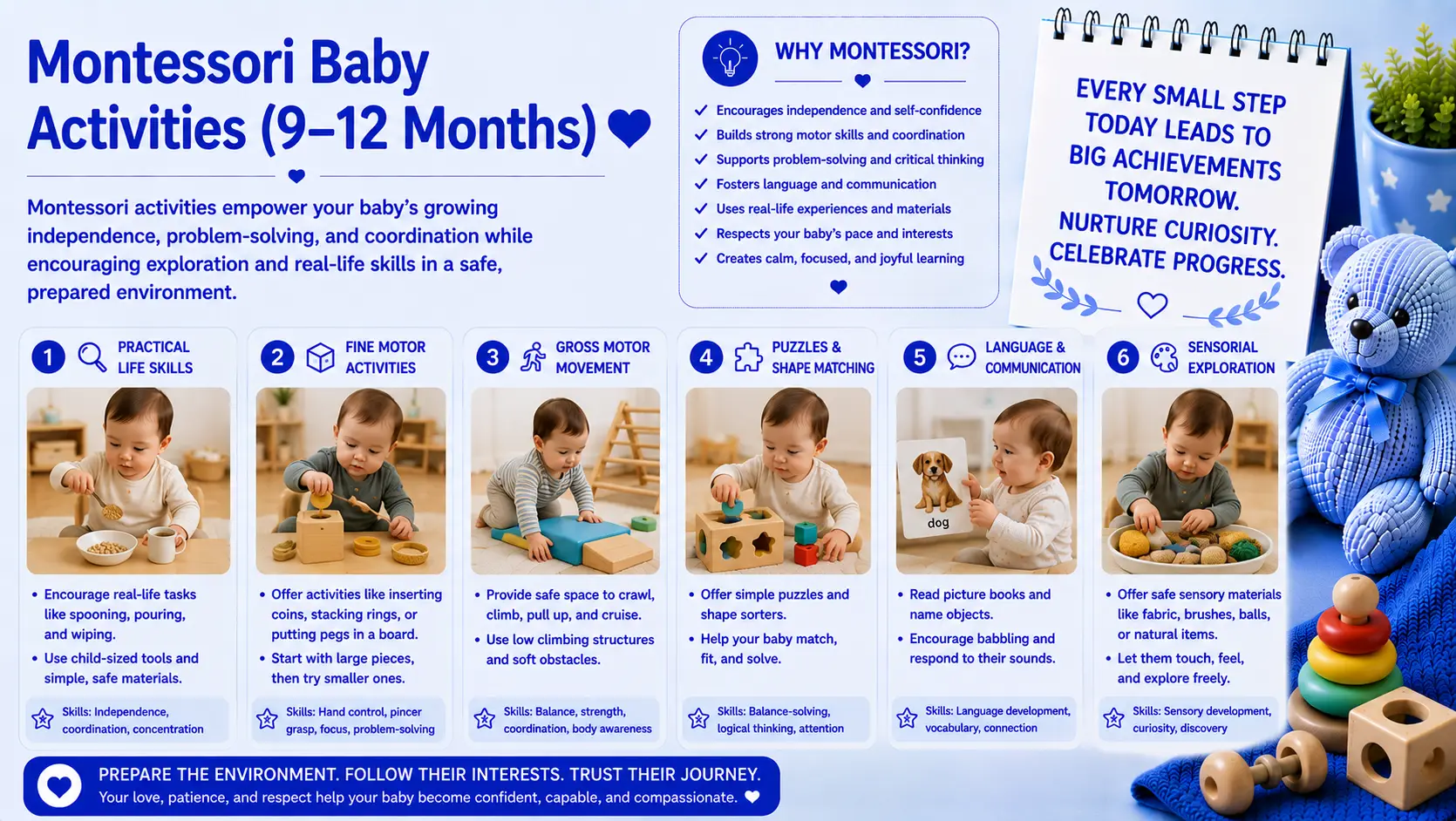
Between 9 and 12 months, babies become true explorers on the move. Many crawl confidently, pull to stand, cruise along furniture, and begin practicing early walking skills. Fine motor control sharpens as the grasp becomes more precise, pointing appears, and interest grows in opening, closing, posting, and simple problem-solving. This stage is perfect for Montessori activities that support movement, hand-eye coordination, emerging independence, and language—all while keeping things simple and responsive to the child’s pace.

Montessori activities for 9-12 months build on earlier foundations. The focus shifts toward greater freedom of movement, refined “in and out” work, and the first glimpses of practical life skills such as self-feeding and exploring containers. The best setups invite the baby to practice what they are already driven to do rather than directing them with flashy toys or rigid lessons.

What Babies Are Working On at This Age

Contents hide
1 What Babies Are Working On at This Age
2 Effective Montessori-Inspired Activities
3 Preparing the Space
4 FAQ
4.1 What are the best Montessori activities for 9-12 months?
4.2 When should I introduce a push wagon or walker wagon?
4.3 Do babies this age still need treasure baskets?
4.4 How can I support practical life skills at 9-12 months?
4.5 Is it normal if my baby prefers movement over shelf activities?

Observe your child closely. Common developmental threads include:

Movement and gross motor skills: Crawling, pulling up, cruising, kneeling, and early standing or walking. Safe, open floor space and low furniture matter more than any single toy.

Hand-eye coordination and refined grasp: Transferring objects, posting items into holes or boxes, pulling pieces from puzzles, and using the pincer or more controlled whole-hand grasp.

Object permanence and cause-and-effect: Understanding that things still exist when hidden and discovering that actions produce predictable results.

Language and social connection: Pointing, babbling with more intent, responding to names of objects, and enjoying books and conversation.

Early practical life: Interest in self-feeding, opening and closing lids or drawers, and helping with simple daily routines.

Activities that match these interests tend to hold attention and feel satisfying.

Effective Montessori-Inspired Activities

Movement opportunities and cruising setups Create safe pathways for cruising by placing low, stable furniture or cushions at reachable heights. A pull-up bar with a mirror nearby lets babies practice standing while watching their movements. Soft balls or larger rolling toys encourage crawling after objects. Once a baby pulls to stand independently, a push wagon (weighted with books if needed to slow it down) offers an exciting challenge. In Montessori practice, wait until the child gets into the position themselves rather than placing them there. These experiences support balance, strength, and confidence.

Object permanence box with drawer Building on simpler ball-drop versions, the box with a drawer adds the discovery of opening to retrieve the ball. Babies practice intentional release, then explore the drawer mechanism. This remains a favorite for many children well into the second year and strengthens concentration and problem-solving.

Simple puzzles and imbucare (posting) work Large-knob puzzles with 3–5 pieces allow babies to pull pieces out and explore them (mouthing is still common). Putting them back often comes later. Imbucare boxes or peg boxes with large, easy-to-grasp pieces invite repeated posting and removing. Cubes or rings on a vertical dowel extend earlier stacking practice—first removing, later attempting to replace. These refine grasp and coordination without pressure.

Ball hammering and open-close exploration A simple ball hammering toy (often used first with the palm rather than a hammer) provides satisfying cause-and-effect. Baskets filled with containers that open and close—lidded boxes, jars with easy lids, or fabric pouches—encourage fine motor practice and curiosity. Many families create “open-and-close treasure baskets” using safe household items.

Practical life beginnings Offer opportunities for self-feeding with soft finger foods and a small spoon or open cup when ready. Involve the baby in simple routines: handing a washcloth during bath time, helping place a diaper in the bin, or exploring a low shelf of everyday objects. These moments foster independence and a sense of contribution.

Language and sensory connection Continue rich conversation and reading. Simple language baskets with a few related objects (for example, animals or household items) paired with clear naming support vocabulary. Soft musical instruments, books with realistic images, and outdoor time for observing the real world keep sensory and aural development active.

Many of these Montessori baby activities for 9-12 months can be created with items already at home or a few carefully chosen wooden materials. Rotate based on interest and keep the number of options limited so the environment feels calm and inviting.

Preparing the Space

A prepared environment at this age prioritizes safety and accessibility. Clear floor space for movement, low shelves or baskets the baby can reach while sitting or kneeling, and secure furniture for cruising are foundational. Limit materials to a few at a time and observe what draws repeated attention. Natural materials continue to offer richer feedback than plastic. Always supervise, check for small parts, and childproof thoughtfully so the baby can explore with as much freedom as possible.

Follow the child’s lead. If they are deeply focused on cruising or dumping and filling, protect that concentration. Short periods of independent exploration mixed with responsive interaction work better than long structured sessions.

These approaches help 9- to 12-month-olds build coordination, confidence, and curiosity through meaningful, self-directed activity. The real magic lies in observation and offering just the right challenge at the right moment.

FAQ

What are the best Montessori activities for 9-12 months?

Movement setups for pulling up and cruising, object permanence boxes (especially with drawers), large-knob puzzles, posting or imbucare boxes, push wagons once the baby stands independently, open-and-close containers, and early self-feeding opportunities rank among the most useful. Soft balls and simple language-rich interactions also support development well.

When should I introduce a push wagon or walker wagon?

Wait until the baby pulls to stand and shows interest in moving while upright. Weight the wagon if needed so it does not roll too quickly. Never place a baby in a standing position they cannot achieve independently.

Do babies this age still need treasure baskets?

Yes, though the contents often evolve. Open-and-close containers, larger objects for two-handed carrying, or themed sets that invite dumping and filling remain engaging and support fine motor and cognitive growth.

How can I support practical life skills at 9-12 months?

Offer safe opportunities for self-feeding, involve the baby in simple daily routines (handing items, exploring a low cleaning cloth or brush), and provide containers that open and close. These build independence and coordination without formal lessons.

Is it normal if my baby prefers movement over shelf activities?

Completely normal. Gross motor development often takes priority at this age. Provide safe space for crawling, cruising, and pulling up, and keep a few fine-motor materials available for when the baby chooses them. Following the child’s interest is a core Montessori principle.


Author

DrAdam

Dr. Adam. Obstetrician and Gynecologist

Follow Me
Other Articles
Previous

Montessori Baby Activities (6–9 Months)

Next

DIY Montessori Activities

No Comment! Be the first one.

Leave a Reply Cancel reply

Your email address will not be published. Required fields are marked *

What is Did You Search?

The “Did You Search” website was created for all mothers and families. Just search to find all your needs about your children.

Links

  • about
  • contact
  • privacy policy
  • medical disclaimer
  • sitemap
Copyright 2026 — DidYouSearch. All rights reserved.