
You don’t need a shelf full of expensive wooden materials to raise a curious, capable kid. Some of the best Montessori activities for toddlers and preschoolers come from things already sitting in your kitchen drawer — a spoon, a pitcher, a few dried beans. The Montessori method was built on the idea that children learn through hands-on, purposeful work, and that philosophy translates beautifully into DIY projects you can put together in an afternoon.
Below is a practical, age-friendly guide to creating Montessori activities at home, organized the way a real Montessori classroom is: practical life, sensorial, fine motor, and language.
What Makes an Activity “Montessori,” Anyway?
Before grabbing the glue gun, it helps to know what separates a Montessori-inspired activity from a regular busy-box toy. Montessori materials are usually:
Purposeful – tied to a real skill (pouring, buttoning, sorting) rather than pure entertainment
Self-correcting – the child can see for themselves if something’s “wrong,” without needing a parent to intervene
Simple and uncluttered – one skill per activity, presented on a tray or in a basket
Made from natural materials where possible, though this isn’t a strict rule for DIY versions
Keeping these four ideas in mind will help anything you build actually function like a Montessori material, not just look like one.
Practical Life Activities (The Easiest Place to Start)
Practical life work is the heart of Montessori at home, and it’s also the cheapest to set up because it uses everyday objects.
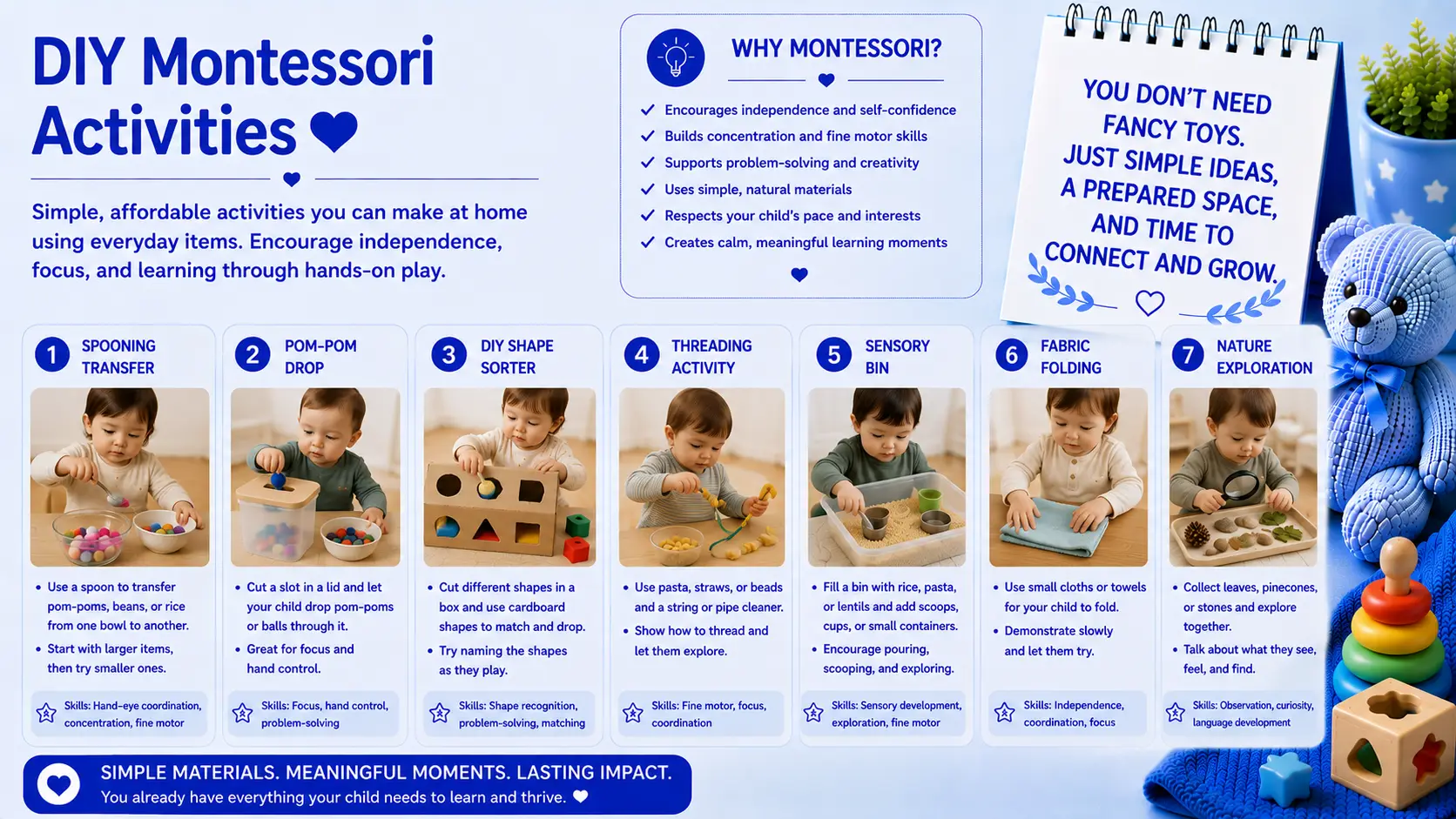
Pouring and transferring. Set two small pitchers or cups on a tray, fill one partway with water, rice, or dried beans, and let your toddler practice pouring it from one container into the other. This single activity builds concentration, hand-eye coordination, and the fine motor control needed for writing later on.
Spooning and scooping. Two bowls, a spoon, and any dry grain (rice, lentils, oats) make a simple transferring activity that’s perfect for toddlers ages 18 months and up.
Dressing frames. An old shirt or a piece of fabric stitched onto a cardboard frame becomes a homemade buttoning, zipping, or lacing board — a favorite for building independence in dressing.
Flower arranging. Give your child a few small flowers, a tiny vase, and a damp cloth. It’s a gentle, low-pressure way to practice precision and care for the environment.
Chore-based tasks. Washing a table, sweeping with a child-sized broom, or folding washcloths all count as practical life work. Kids genuinely enjoy “real” jobs more than pretend ones.
Sensorial and Fine Motor Activities
Sensorial materials help children refine what they see, hear, and touch, while fine motor work strengthens the tripod grasp needed for handwriting.
DIY sensory bins. Fill a shallow bin with rice, dried pasta, or sand, and hide small objects or letters inside for your child to find.
Sound matching. Fill small containers (film canisters or spice jars work well) in pairs with items like rice, beans, and bells. Children shake and match the pairs that sound the same.
Object permanence box. For babies and young toddlers, cut a hole in a small box lid and let them push a ball through and retrieve it — a classic homemade version of a Montessori infant material.
Clothespin activities. Clipping clothespins around the edge of a bowl or basket is one of the simplest ways to build the pincer grip.
Language and Early Math at Home
Language baskets. Gather a handful of small objects (a toy dog, a spoon, a button) in a basket, and name and describe each one with your child. This is an easy, no-prep way to build vocabulary.
Sequencing cards. Print a series of photos showing a process, like planting a seed or making a sandwich, and have your child arrange them in order.
Homemade number rods. Cut dowels or use LEGO Duplo blocks in increasing lengths to teach number recognition and quantity — a budget-friendly stand-in for traditional Montessori number rods.
Sandpaper letters. Cut letters out of sandpaper or fine-grit paper and glue them to cardstock so your child can trace them with their fingers while learning letter sounds.
Tips for Setting Up Montessori Activities at Home
Rotate, don’t overwhelm. One or two activities per shelf is plenty; swap them out weekly based on interest.
Observe before introducing something new. Watch what your child gravitates toward before adding more materials.
Demonstrate once, then step back. Show the activity slowly and silently, then let your child explore without correction.
Prioritize safety. Use non-toxic paint and glue, sand down rough edges, and always supervise activities involving small parts.
Match the activity to the child’s stage, not just their age — readiness varies more than birthdays do.
Final Thoughts
The beauty of DIY Montessori activities is that they don’t require a big budget or a Pinterest-perfect playroom — just a bit of intention. Start with one or two practical life activities, watch how your child responds, and build from there. Over time, these small, repeatable tasks add up to real independence, focus, and confidence.
FAQ
What age should I start Montessori activities at home?
Many practical life and sensorial activities, like pouring or object permanence boxes, can start as early as 6–12 months. Most families find toddlerhood (18 months to 3 years) is when Montessori-style activities really click.
Do I need special Montessori materials to do this at home?
No. While authentic wooden Montessori materials are lovely, most core skills — pouring, sorting, buttoning, matching — can be taught with household items like pitchers, spoons, buttons, and containers.
How long should a Montessori activity session last?
Follow your child’s lead rather than a clock. Toddlers might engage for just a few minutes, while preschoolers can concentrate on one activity for 20–30 minutes if it interests them.
What’s the difference between Montessori toys and regular toys?
Montessori materials typically isolate one skill, are self-correcting, and use natural materials, while many mainstream toys are multi-function, battery-powered, or designed purely for entertainment rather than skill-building.
Can Montessori activities help with school readiness?
Yes. Activities that build focus, fine motor control, and self-regulation — like pouring, sorting, and sequencing — are strongly linked to later success with reading, writing, and math in early schooling.