
Walk down any toy aisle and you’ll see two very different worlds colliding: rows of flashing, battery-powered gadgets next to a smaller, quieter shelf of plain wooden blocks and stacking rings. Parents researching Montessori toys vs. traditional toys are usually trying to answer one practical question — is the extra cost and simplicity actually worth it, or is this just clever marketing?
The honest answer is that both types of toys can support a child’s development, but they do it in very different ways. Here’s a breakdown of what separates them, backed by how each is actually designed.
The Core Philosophy Behind Each
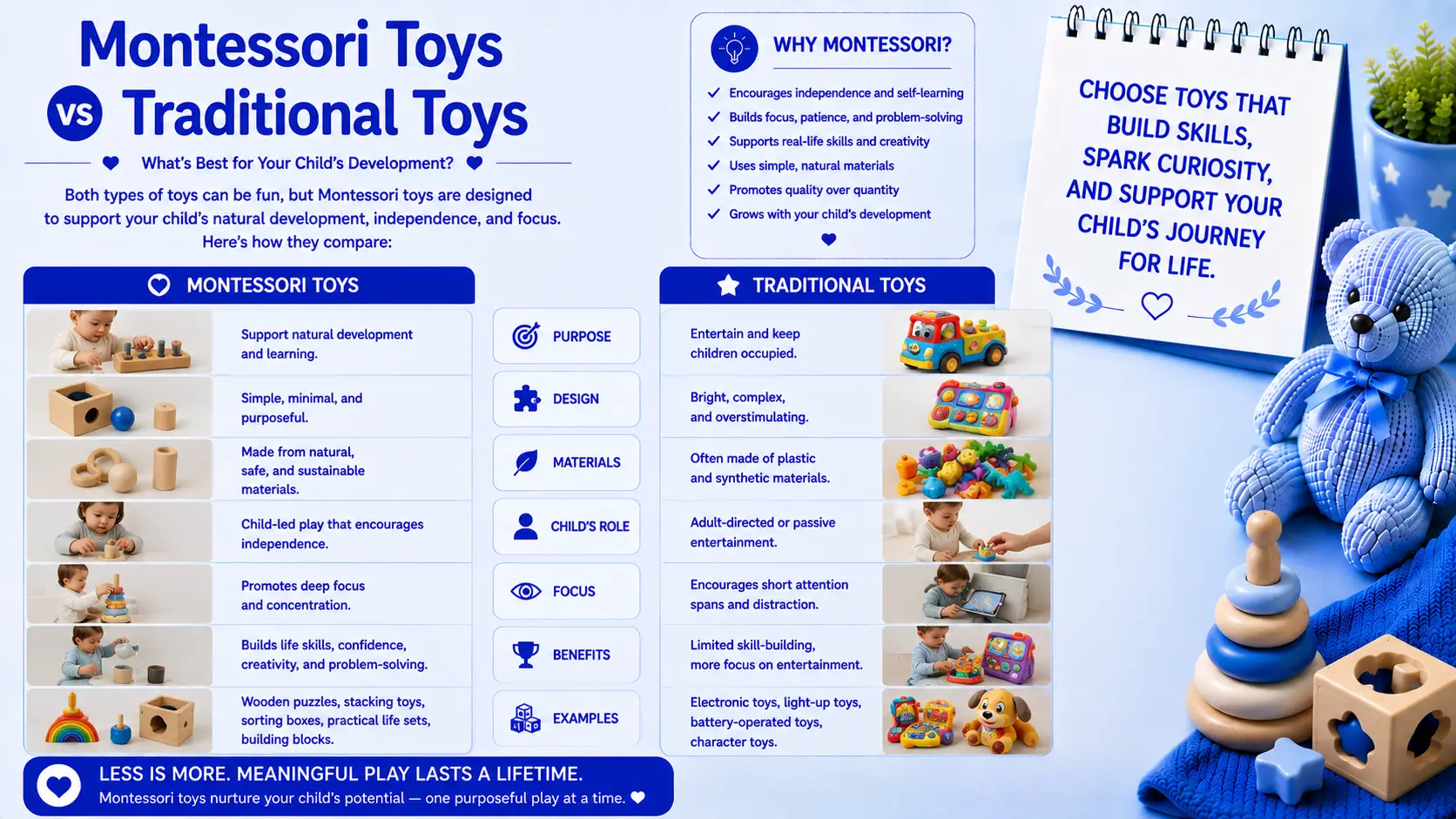
Montessori toys are built around the educational approach developed by Dr. Maria Montessori over a century ago. The guiding idea is simple: children learn best through hands-on, self-directed exploration, not passive entertainment. A Montessori toy is designed to isolate one skill — stacking, sorting, pouring, matching — so a child can master it through repetition at their own pace.
Traditional toys, on the other hand, are generally designed first for engagement and fun. That’s not a criticism; it’s just a different goal. A truck with lights and sound effects, an action figure, or a talking stuffed animal is meant to capture attention and spark imaginative or fantasy play, not necessarily to teach a specific skill.
Materials: Wood and Fabric vs. Plastic and Electronics
One of the most obvious differences is what the toys are made of. Montessori toys typically favor natural, non-toxic materials — wood, cotton, wool, metal, and glass for older children. These materials tend to be more durable, often safer for teething babies, and generally considered more environmentally friendly than plastic.
Traditional toys lean heavily on brightly colored plastic and, frequently, batteries. This makes them cheaper to produce and easier to design with lights, sounds, and moving parts, but it also means shorter lifespans and, for some families, environmental concerns about plastic waste.
Open-Ended Play vs. Single-Purpose Play
This is arguably the biggest functional difference. Montessori toys are largely open-ended — a set of wooden rings, a shape sorter, or simple blocks doesn’t have one “correct” outcome. The child decides how to use them, which encourages creativity, problem-solving, and independent thinking.
Many traditional toys, by contrast, have a single, prescribed function. Press the button and the toy sings a song; the outcome is the same every time. That’s not inherently bad — cause-and-effect toys can support learning for infants — but it does mean less room for a child to direct their own play.
Sensory Stimulation: Calm Focus vs. High Stimulation
Because Montessori toys are intentionally simple, they tend to encourage slow, focused, repetitive play. A toddler carefully placing rings on a post, or transferring pom-poms with tongs, is practicing concentration and fine motor control in a calm, controlled way.
Traditional toys with lights, sounds, and music can be exciting and genuinely fun, but they can also overstimulate young children, making it harder to focus on any one part of the toy. This is one reason many pediatric and early-childhood experts recommend limiting flashing, noisy toys for infants and toddlers in favor of quieter, sensory-rich alternatives.
Skill-Building Focus
Montessori toys are usually designed with a specific developmental goal in mind:
Fine motor skills – bead threading, lacing cards, tongs and tweezers activities
Problem-solving – puzzles, shape sorters, nesting toys
Sensory awareness – toys with varied textures, weights, and materials
Independence – toys a child can use and put away without adult help
Traditional toys build a different, equally valuable skill set. Board games teach turn-taking and social cooperation. Dress-up sets and action figures support imaginative and fantasy play. Building sets like classic construction toys can encourage spatial reasoning. The developmental value is real — it’s just aimed at different outcomes.
Do You Have to Choose One or the Other?
Not at all. Most Montessori-informed parents don’t ban traditional toys outright — they simply lean toward more open-ended, natural options where possible and rotate toys to keep things fresh rather than overwhelming a shelf with everything at once. A blended toy box, with some Montessori-style wooden puzzles alongside a favorite stuffed animal or board game, is completely normal and often the most realistic approach for real families.
The best strategy is usually to watch what your child naturally gravitates toward. If they’re drawn to repetitive, focused tasks, lean into more open-ended materials. If they love imaginative or social play, traditional toys that support that are just as valuable.
Final Thoughts
Montessori toys and traditional toys aren’t really competitors — they’re built for different kinds of play. Montessori toys emphasize simplicity, natural materials, and self-directed skill-building, while traditional toys often prioritize entertainment, imagination, and social play. Rather than picking a side, most families find the sweet spot is a thoughtful mix, guided by what actually holds their child’s attention.
FAQ
Are Montessori toys worth the extra cost compared to traditional toys?
Many parents find they are, thanks to their durability and long play life, but it depends on your budget and priorities. You don’t need an entirely Montessori toy box to see benefits — even a few open-ended, natural-material toys can make a difference.
Can traditional toys still be educational?
Yes. Board games, building sets, and dress-up play all build real skills like social cooperation, spatial reasoning, and imaginative thinking — they’re just designed around different goals than Montessori materials.
What age is best to start introducing Montessori toys?
Montessori toys can be introduced from infancy, since even simple materials like wooden rattles or grasping toys support early sensory and motor development.
Do Montessori toys need to be made of wood to count as “Montessori”?
Not strictly. What matters most is that the toy is simple, open-ended, and encourages a specific skill through hands-on exploration — natural materials are common but not an absolute requirement.
Is it bad for a child to only play with traditional, battery-operated toys?
Occasional use isn’t harmful, but relying heavily on highly stimulating, single-purpose toys can limit opportunities for open-ended, self-directed play. Balancing them with simpler, open-ended toys tends to support more well-rounded development.