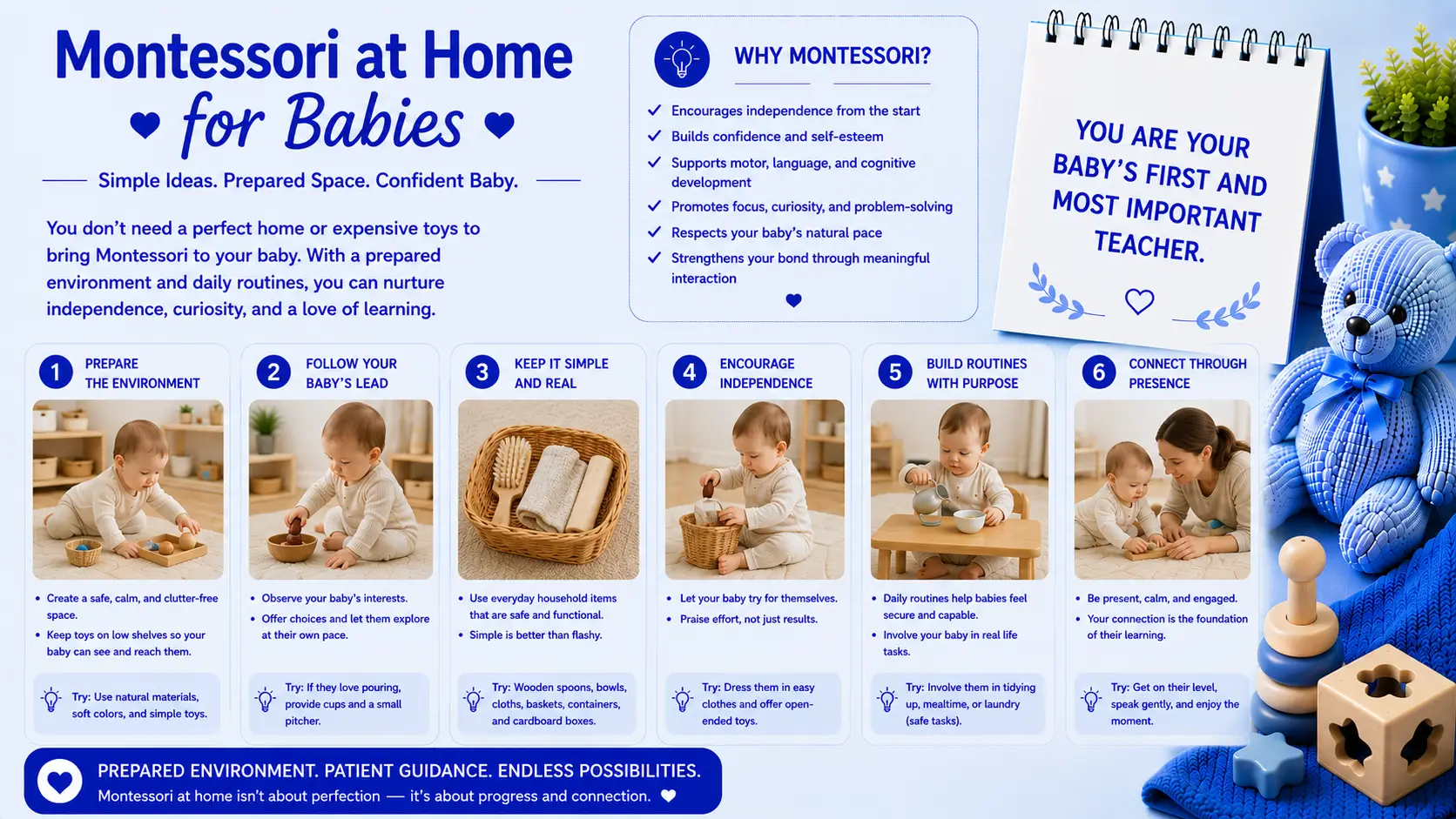

Montessori isn’t just a preschool philosophy — it actually starts at birth. Long before a baby can walk or talk, the Montessori method encourages parents to treat them as capable, curious little people who deserve a prepared, respectful environment. If you’re wondering how to bring Montessori at home for infants, the good news is that it’s less about buying special gear and more about rethinking the space around your baby.
Here’s a practical, room-by-room guide to setting up a Montessori-inspired home for your baby, from the newborn stage through the first year.
What Does “Montessori for Babies” Actually Mean?
Maria Montessori believed babies are born ready to learn, not blank slates waiting to be entertained. The core principles that guide Montessori infant care are:
Respect for the child – treating even a newborn as a capable individual, not a passive object to be managed
Freedom of movement – giving babies uninterrupted space to move, roll, and explore rather than confining them to swings, bouncers, or containers
A prepared environment – a home set up at the baby’s level, with simple, accessible materials
Following sensitive periods – noticing what your baby is naturally drawn to at each stage and supporting that interest
None of this requires an expensive nursery overhaul. Most of it comes down to small, intentional choices.
Setting Up a Montessori Sleep Space
One of the most talked-about Montessori baby setups is the floor bed — essentially a firm mattress placed directly on the floor instead of in a crib. The idea is to let babies move freely, roll over, and eventually get in and out of bed on their own once they’re mobile, rather than being confined behind bars. Most families introduce a floor bed once a baby transitions out of a bassinet, often around 2 months old, always in a fully baby-proofed room.
If a full floor bed feels like too big a leap, even a simple, low, firm mattress in a safe, gated space follows the same principle.
Creating a Movement Area
Freedom of movement is central to Montessori at home for babies. Instead of relying on swings, bouncy seats, or containers that restrict movement, Montessori encourages open floor time on a firm, flat surface like a rug or play mat. This allows babies to fully develop the muscle strength and coordination needed for rolling, crawling, and eventually walking, at their own pace and without interference.
A simple movement area typically includes:
A firm mat or rug to define the space
A low, wall-mounted mirror positioned at floor level so baby can see themselves as they move
One or two simple toys, like grasping beads or a wooden rattle, placed within reach
Baby gates can actually be useful here, not to restrict your baby, but to safely define the boundaries of their independent play space.
Low Shelves and Simple Toys
Once a baby starts reaching and grasping, a small, low shelf with two or three simple, natural-material toys makes a big difference. Instead of a toy bin overflowing with plastic gadgets, Montessori favors rotating a small selection of toys that match the baby’s current stage, such as:
Wooden rattles and grasping toys
Fabric or wooden balls
Simple stacking rings
High-contrast black-and-white cards for very young infants, since newborns can only focus on high-contrast patterns in the first few months
Keeping the selection small helps babies focus, rather than being overwhelmed by choice.
The Feeding and Changing Areas
Montessori principles apply to everyday caregiving routines too. For the feeding area, whether breastfeeding or bottle-feeding, the goal is a calm, comfortable space free of screens and distractions, with everything you need within arm’s reach so you can stay present during this bonding time.
For changing time, many Montessori families narrate what they’re doing (“I’m going to lift your legs now”) to build early language skills and respect, even before a baby can respond verbally.
Respecting Your Baby’s Pace
A less tangible but equally important part of Montessori at home is simply slowing down. Rather than immediately jumping in to solve a problem, comfort a fuss, or hand over a toy, Montessori parents are encouraged to pause and observe first, giving the baby a chance to work through small challenges independently. Over time, this builds confidence, patience, and a genuine sense of agency, even in very young infants.
Do You Need Special Montessori Baby Gear?
Not necessarily. While there’s a whole market of Montessori-branded nursery products, the philosophy itself is really about principles, not products: freedom of movement, simple and accessible materials, and treating your baby as a capable participant in their own development. A secondhand wooden rattle and a floor mat can go just as far as an expensive designer nursery set.
Final Thoughts
Bringing Montessori at home for babies doesn’t require a full nursery renovation or a shelf of specialty toys. It starts with small shifts: giving your baby room to move, simplifying their toy selection, and slowing down enough to let them explore at their own pace. These small, consistent choices in the first year lay the groundwork for the independence and confidence Montessori is known for.
FAQ
At what age can I start Montessori at home?
You can start from birth. Simple practices like offering high-contrast cards, uninterrupted floor time, and a calm, screen-free feeding space are all appropriate for newborns.
Is a Montessori floor bed safe for babies?
Yes, when the room is properly baby-proofed. Floor beds are generally introduced around 2 months old, once a baby has outgrown a bassinet, and are placed in a safe, gated space.
Do I need to buy special Montessori toys for my baby?
No. What matters most is simplicity and natural materials, not a specific brand. Everyday items like wooden spoons or fabric balls can work just as well as store-bought Montessori toys.
How is Montessori different from traditional baby care?
Montessori emphasizes freedom of movement and independence over containment, favoring open floor time instead of swings or bouncers, and encouraging babies to problem-solve rather than immediately intervening.
Can I do Montessori at home if my baby also goes to daycare?
Absolutely. Many families blend the two, applying Montessori principles like a simplified toy shelf or a calm feeding routine at home, regardless of what their daycare setting looks like.