
When installing a car seat, parents often face a simple-looking question: Should I use LATCH or the vehicle seat belt?
The answer may be surprising.
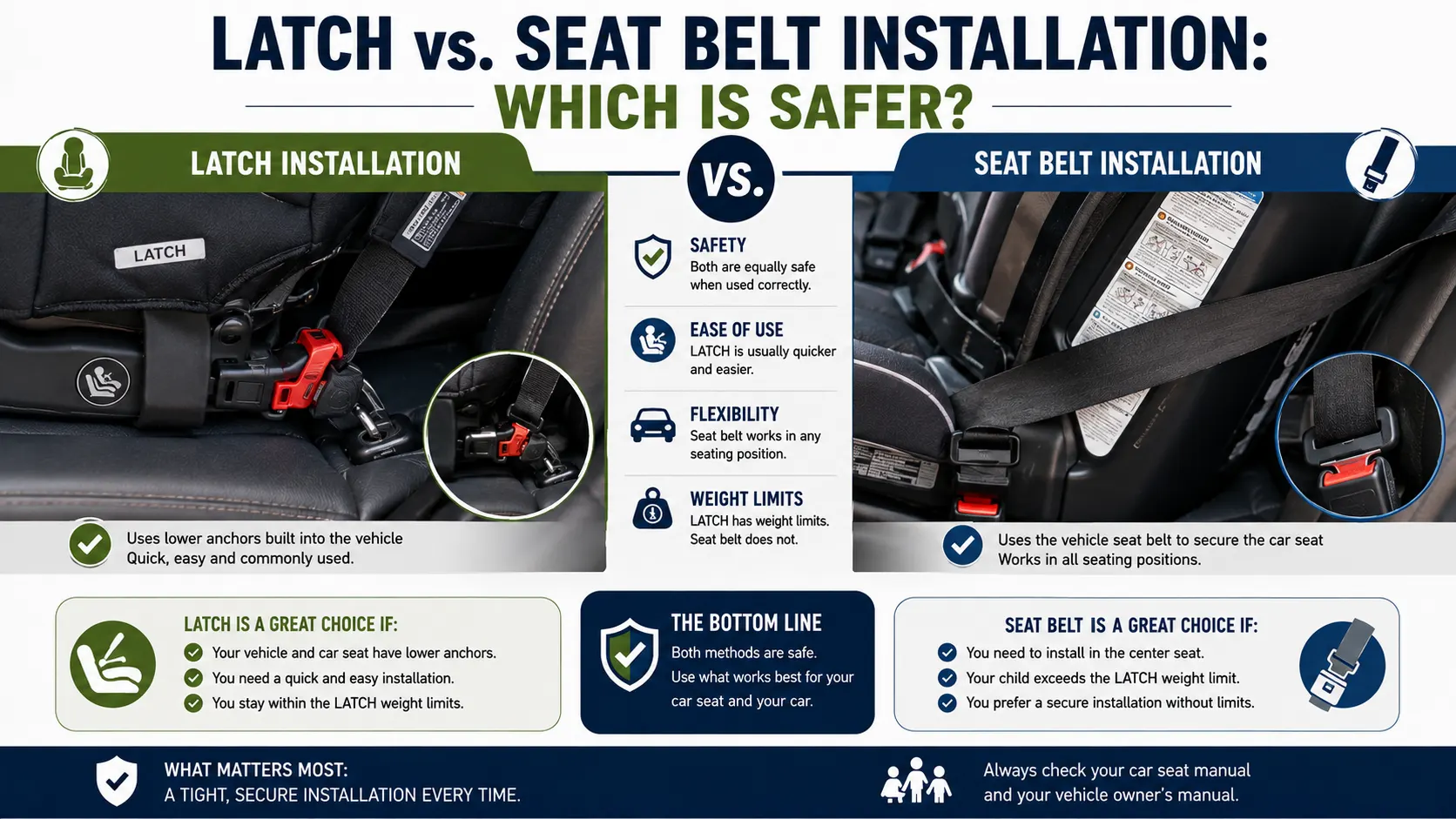
Neither installation method is automatically safer simply because it uses a particular type of attachment. Both LATCH and seat belt installation can be safe when used correctly and according to the car seat and vehicle manufacturer’s instructions.
The more important question is which method is approved for your specific car seat and vehicle, fits your chosen seating position, and allows you to achieve a secure installation.
LATCH can make installation easier in some vehicles, while a seat belt may be the better option in others. As children grow, weight limits can also affect which installation method you should use.
This guide compares LATCH vs. seat belt installation so you can understand the differences, advantages, limitations, and most common mistakes.
Important: Always follow the instructions for your specific car seat and vehicle. Installation rules can vary by manufacturer and model.
LATCH vs. Seat Belt: Quick Answer
Neither LATCH nor seat belt installation is universally safer.
Both methods are designed to secure an appropriate child restraint when installed correctly.
The best option is the one that:
- Is approved by your car seat manufacturer
- Is compatible with your vehicle
- Is allowed in your chosen seating position
- Is within applicable weight limits
- Can be installed tightly and correctly
- Allows you to follow all manufacturer instructions
NHTSA recommends using either the vehicle seat belt or the lower anchors for installation unless the specific manufacturers allow a particular combined method.
For forward-facing seats, the top tether is an additional component that may be required or recommended by the manufacturers.
What Is LATCH?
LATCH stands for Lower Anchors and Tethers for CHildren.
The system was developed to provide dedicated attachment points for compatible child restraints instead of requiring the vehicle seat belt to secure the car seat.
LATCH consists of two primary components:
Lower Anchors
Lower anchors are metal bars located in the space between the vehicle’s seat cushion and seat back.
A compatible car seat can connect to these anchors using lower-anchor connectors.
Top Tether
The top tether connects a forward-facing child restraint to a designated tether anchor in the vehicle.
The tether helps limit forward movement of the car seat and child’s head during a crash.
An important distinction is that the top tether isn’t simply an alternative to the seat belt. For a forward-facing installation, it works as part of the overall restraint system and should be used according to the car seat and vehicle instructions.
What Is Seat Belt Installation?
Seat belt installation uses the vehicle’s own seat belt to secure the car seat.
Depending on the car seat and vehicle, the seat belt may be routed through a designated belt path and locked using the vehicle’s belt-locking mechanism or a feature built into the car seat.
The exact process varies.
Some vehicles have seat belts that can be locked by pulling the belt all the way out and allowing it to retract. Other combinations may rely on a built-in lock-off on the car seat.
That’s why you should never assume the installation method from another vehicle will work the same way in yours.
LATCH vs. Seat Belt: Key Differences
| Feature | LATCH | Seat Belt |
|---|---|---|
| Uses vehicle seat belt | No | Yes |
| Uses lower anchors | Yes | No |
| Requires compatible vehicle anchors | Yes | No |
| Can be used in every seating position | No | Not necessarily |
| Weight limits apply | Yes | Manufacturer-specific requirements still apply |
| Can be used for rear-facing installation | Yes, if approved | Yes, if approved |
| Can be used for forward-facing installation | Yes, if approved | Yes, if approved |
| Top tether may be used | Yes | Yes |
| Installation can be easier for some users | Often | Sometimes |
| Correct installation is essential | Yes | Yes |
The important takeaway is that the presence of LATCH does not automatically make it the better choice.
Is LATCH Safer Than a Seat Belt?
Not necessarily.
When installed correctly and used within the manufacturer’s requirements, both LATCH and seat belt installation are designed to securely restrain the car seat.
The biggest safety issue isn’t necessarily which system you choose. It’s whether the car seat is properly installed and used.
NHTSA’s guidance emphasizes following the manufacturer’s instructions and checking that the installed seat does not move more than approximately one inch side-to-side or front-to-back when tested at the belt path.
A perfectly installed seat belt installation is preferable to a poorly installed LATCH installation—and vice versa.
Why Proper Installation Matters More Than LATCH vs. Seat Belt
Imagine two identical car seats.
Car Seat A: Installed with LATCH incorrectly, with loose straps and incorrect positioning.
Car Seat B: Installed with the vehicle seat belt correctly, following every manufacturer instruction.
The fact that Car Seat A uses LATCH does not make it safer.
The same is true in reverse.
The goal isn’t to choose the system that sounds more advanced. The goal is to achieve a correct, secure installation.
That’s why parents should focus on:
- Correct seating position
- Correct belt path or lower-anchor attachment
- Proper tightening
- Correct recline angle when applicable
- Correct tether use
- Correct harness fit
- Compliance with weight and height limits
LATCH Installation: Advantages
LATCH can have several practical advantages.
1. It Can Be Easier to Understand
For some parents, connecting the lower anchors feels more straightforward than learning how to lock a vehicle seat belt.
This can make installation less intimidating, particularly for first-time parents.
2. It Can Make a Tight Installation Easier
In some vehicle and car seat combinations, lower anchors make it easier to achieve the required tightness.
The installation still needs to pass the appropriate movement check.
3. It Provides Dedicated Attachment Points
Instead of routing a seat belt through the car seat, LATCH connects directly to dedicated lower anchors.
For some parents, this makes the installation process more intuitive.
4. It Can Be Convenient for Frequent Reinstallation
If you regularly move a compatible car seat between vehicles with compatible LATCH systems, lower anchors can be convenient.
However, convenience should never override the manufacturer’s weight limits or installation instructions.
LATCH Installation: Limitations
LATCH isn’t perfect for every situation.
1. Lower Anchors Aren’t Available Everywhere
Not every seating position has lower anchors.
A vehicle may have lower anchors in the left and right rear seating positions but not in the center.
2. Weight Limits Apply
One of the biggest reasons parents need to pay attention to LATCH is weight limits.
Lower-anchor systems have limits established by the applicable vehicle and car seat manufacturers.
As your child gets heavier, you may need to transition from lower-anchor installation to seat-belt installation.
NHTSA advises parents to follow the child restraint and vehicle manufacturer’s instructions regarding lower-anchor weight limits.
3. LATCH May Not Be the Best Fit for Your Vehicle
A lower-anchor installation can sometimes be difficult depending on the shape of the vehicle seat, anchor location, or design of the car seat.
If you cannot achieve a proper installation using LATCH, another approved installation method may work better.
Seat Belt Installation: Advantages
Seat belt installation has several important advantages.
1. It Is Widely Available
Vehicle seat belts are available in seating positions where lower anchors may not be.
This gives parents more flexibility when choosing an approved seating position.
2. It Doesn’t Depend on Lower-Anchor Weight Limits
Once a child reaches the applicable lower-anchor limit, a seat belt installation may be the appropriate alternative, depending on the car seat and vehicle instructions.
3. It Can Work in Older Vehicles
Older vehicles may not have the same LATCH hardware found in newer vehicles.
Seat belts allow compatible child restraints to be installed in many vehicles that don’t have lower anchors.
4. It Can Be Used in the Center Position in Some Vehicles
A center seating position may be desirable because it places a child farther from the sides of the vehicle.
However, you cannot assume that LATCH is available in the center.
If the vehicle and car seat manufacturers permit installation there, the vehicle seat belt may be the appropriate method.
Always verify the center position in your vehicle and car seat manuals.
Seat Belt Installation: Limitations
Seat belt installation can also have challenges.
1. Seat Belts Work Differently Between Vehicles
Different vehicles use different seat-belt locking systems.
A parent who knows how to install a car seat in one vehicle may not know how the belt locks in another.
2. Incorrect Belt Routing Can Make the Installation Unsafe
Car seats often have specific belt paths for rear-facing and forward-facing installation.
Using the wrong path can compromise the installation.
3. Parents Sometimes Don’t Lock the Belt Correctly
Simply buckling the seat belt doesn’t necessarily mean the car seat is securely installed.
You must follow the locking procedure specified by the vehicle or car seat manufacturer.
Which Is Easier: LATCH or Seat Belt?
There is no universal answer.
For some parents, LATCH is easier because the lower-anchor connectors are straightforward to attach.
For others, the seat belt provides a simpler or more secure installation—particularly in a seating position where the lower anchors aren’t available or once the child reaches the applicable lower-anchor weight limit.
The best method is the one you can install correctly and consistently.
If you can achieve a secure installation using either method, both may be appropriate if allowed by the manufacturer.
Can You Use LATCH and the Seat Belt Together?
Usually, no.
One of the most common misconceptions is that using both systems must automatically make the car seat safer.
It doesn’t.
NHTSA recommends using either the lower anchors or the seat belt unless the specific car seat manufacturer and vehicle manufacturer permit a combined installation.
Do not combine the two systems simply because it seems like “more is better.”
Always follow the instructions for your exact model.
What About the Top Tether?
This is where the comparison can become confusing.
The top tether is not simply another alternative to the lower anchors or seat belt.
For a forward-facing car seat, the tether connects the top of the car seat to a designated vehicle tether anchor.
It helps limit forward movement of the car seat and child’s head in a crash.
A forward-facing car seat may therefore use:
Seat belt + top tether
or
Lower anchors + top tether
depending on the manufacturer’s instructions.
The tether should be attached to the vehicle’s designated tether anchor—not a cargo hook or another attachment point that merely looks similar.
Does LATCH Have a Weight Limit?
Yes.
This is one of the most important differences parents need to understand.
Lower anchors are not intended to be used indefinitely simply because your child still fits the car seat.
The applicable lower-anchor weight limit depends on the specific car seat and vehicle requirements.
As your child grows, check the manufacturer’s instructions to determine whether you need to switch to a seat-belt installation.
This is particularly important for forward-facing seats because children may eventually exceed the permitted lower-anchor weight limit while still being small enough to use the harnessed car seat.
Is Seat Belt Installation Better for Older or Heavier Children?
It can be the appropriate choice when the child has exceeded the lower-anchor weight limit.
That does not mean the seat belt is inherently safer.
Instead, the installation method changes because the lower-anchor system has a defined weight limit.
Always check the current instructions for your exact car seat and vehicle before changing installation methods.
Which Is Better for a Rear-Facing Car Seat?
Both methods can be appropriate for rear-facing installation when permitted by the manufacturer.
The more important factors are:
- Correct rear-facing orientation
- Correct recline angle
- Correct belt path or lower-anchor attachment
- Proper tightening
- Appropriate seating position
- Correct use of the car seat’s infant insert or other approved components
NHTSA recommends keeping children rear-facing as long as possible until they reach the maximum height or weight allowed by the car seat manufacturer.
Which Is Better for a Forward-Facing Car Seat?
Again, either method may be appropriate.
However, forward-facing installation introduces another important component: the top tether.
When permitted by the car seat and vehicle manufacturers, NHTSA recommends using the tether with forward-facing car seats because it helps limit forward movement during a crash.
The installation might therefore be:
Seat belt + tether
or:
Lower anchors + tether
The exact setup depends on your product and vehicle.
LATCH vs. Seat Belt for the Center Seat
The center rear seat can be an attractive choice because it places the child away from the vehicle’s sides.
But there’s an important catch:
You cannot assume that the center position has LATCH.
Some vehicles allow lower anchors in the center. Others don’t.
Some vehicles may permit the use of anchors from adjacent positions for a center installation, while others specifically prohibit it.
Never improvise.
Check the vehicle owner’s manual and car seat manual to determine whether the center position is approved and which installation method can be used there.
If the center position doesn’t support LATCH but does permit child-restraint installation with the seat belt, the seat belt may be the appropriate option.
What If LATCH and Seat Belt Both Work in My Car?
If both installation methods are approved and you can achieve a secure installation with either one, choose the method that works best for you.
Consider:
- Which method gives you the tightest installation?
- Which one is easier for you to install correctly?
- Which method is approved for your child’s current weight?
- Which one is compatible with your preferred seating position?
- Will you need to reinstall the seat frequently?
- Which method can you repeat correctly every time?
If one method is significantly easier for you to install correctly, that can be an important practical advantage.
How to Know if Either Installation Is Correct
Regardless of whether you use LATCH or a seat belt, perform the same basic checks.
1. Check the Correct Installation Path
Make sure the seat belt or lower-anchor strap follows the manufacturer’s specified path.
2. Check for Excessive Movement
Hold the car seat at the belt path and move it side to side and front to back.
NHTSA recommends that the seat should not move more than approximately 1 inch in either direction at the belt path.
3. Check the Recline Angle
For rear-facing seats, verify the manufacturer’s required recline angle.
4. Check the Tether
For forward-facing seats, verify that the tether is attached correctly when required/permitted.
5. Check the Harness
The car seat can be installed perfectly and still be used incorrectly if the child isn’t properly secured.
Make sure:
- Harness straps are flat.
- Harness straps are at the correct height.
- Harness is snug.
- Chest clip is at approximately armpit level.
Common LATCH and Seat Belt Mistakes
Avoid these common errors:
LATCH Mistakes
- Assuming every seating position has lower anchors
- Ignoring lower-anchor weight limits
- Attaching connectors incorrectly
- Using lower anchors after exceeding the applicable weight limit
- Assuming LATCH is automatically safer
- Using LATCH and the seat belt together when not permitted
Seat Belt Mistakes
- Using the wrong belt path
- Failing to lock the seat belt correctly
- Leaving slack in the belt
- Assuming simply buckling the belt is enough
- Installing in an unapproved seating position
Mistakes With Both Systems
- Forgetting the top tether for forward-facing use
- Not checking the one-inch movement test
- Failing to read the vehicle manual
- Failing to read the car seat manual
- Assuming the installation method from another vehicle applies to your current vehicle
LATCH vs. Seat Belt: Which Should You Choose?
Here’s a simple decision framework.
Choose LATCH if:
- Your car seat allows it.
- Your vehicle has compatible lower anchors.
- Your chosen seating position is approved.
- Your child is within the applicable lower-anchor weight limit.
- You can achieve a secure installation.
Choose the Seat Belt if:
- Your vehicle doesn’t have compatible lower anchors in that position.
- Your child has exceeded the applicable lower-anchor weight limit.
- The manufacturer specifies seat-belt installation.
- The seat belt allows you to achieve a secure installation.
- You want to use an approved seating position that doesn’t have LATCH.
Choose Neither Until You Check the Manual if:
- You aren’t sure whether the seating position is approved.
- You don’t know the lower-anchor weight limit.
- The belt path is unclear.
- The seat won’t tighten correctly.
- The tether anchor location is uncertain.
- Your car seat and vehicle instructions appear to conflict.
In these situations, don’t improvise.
The Most Important Rule: Correct Installation Wins
If you remember only one thing from this comparison, remember this:
LATCH isn’t automatically safer than a seat belt, and a seat belt isn’t automatically safer than LATCH.
The safest installation is the one that is:
- Approved for your car seat
- Approved for your vehicle
- Appropriate for your child’s current size
- Within the applicable weight limits
- Properly tightened
- Installed in an approved seating position
- Used with the required tether and other components
- Repeated correctly every time
A method you can install correctly is more useful than a method you choose simply because you believe it is “safer.”
When Should You Switch From LATCH to a Seat Belt?
You may need to switch when:
- Your child reaches the applicable lower-anchor weight limit.
- Your car seat manufacturer instructs you to switch.
- Your vehicle manufacturer specifies a different requirement.
- You move the seat to a position without compatible lower anchors.
- The LATCH installation cannot achieve the required fit.
Don’t wait until your child is too large for the entire car seat.
A child can remain within the car seat’s harness height and weight limits while already exceeding the lower-anchor limit.
That’s why the two limits should be treated separately.
Should You Have Your Installation Checked?
If you’re unsure whether you’ve installed the seat correctly, getting hands-on assistance is a good idea.
NHTSA recommends having child restraints checked by a trained Child Passenger Safety Technician if you need help with installation or use. Many inspection services are free, and some areas offer virtual assistance.
A technician can help determine whether:
- Your seating position is appropriate
- Your LATCH installation is correct
- Your seat belt installation is correct
- Your tether is attached properly
- Your car seat is tight enough
- Your child’s harness fits correctly
Final Verdict: LATCH vs. Seat Belt
So, which is safer—LATCH or seat belt installation?
There isn’t one universal winner.
Both can provide a safe installation when used correctly and within the manufacturer’s requirements.
LATCH may be easier for some parents, while a seat belt may offer more flexibility across different seating positions and vehicle types. As children grow, lower-anchor weight limits can also make seat-belt installation the appropriate choice.
The most important factor is not whether you chose LATCH or the seat belt.
It’s whether you installed the car seat correctly.
Before every major change—such as switching vehicles, changing the direction of the seat, or reaching a weight limit—check the car seat and vehicle manuals again.
And if you’re not confident in your installation, have it checked by a certified Child Passenger Safety Technician.
Continue exploring: browse the full Baby Safety hub.
Frequently Asked
Common Questions