Skip to content
DidYouSearch DidYouSearch
  • did you search?
  • Baby Plus+
    • Baby Activities
      • Arts & Crafts
      • Indoor Activities
      • Montessori
      • Music
      • Outdoor Activities
      • Reading
      • Sensory Play
      • Tummy Time
    • Baby Development
      • Brain Development
      • Cognitive Development
      • Emotional Development
      • Fine Motor Skills
      • Growth Milestones
      • Monthly Milestones
      • Motor Skills
      • Physical Development
      • Social Development
      • Speech Development
    • Baby Feeding
      • Allergies
      • Baby Led Weaning
      • Bottle Feeding
      • Breast feeding
        • Breastfeeding Diet
        • Breastfeeding Positions
        • Latch Problems
        • Low Milk Supply
        • Mastitis
        • Pumping Schedule
        • Weaning
      • Burping
      • Cluster Feeding
      • Feeding Schedule
      • Formula Feeding
        • Formula Amount
        • Formula Brands
        • Formula Comparison
        • Formula Preparation
        • Formula Storage
      • Hydration
      • Pumping
      • Solid Foods
    • Baby Gear Reviews
      • Best Baby Carrier
      • Best Baby Monitor
      • Best Baby Strollers
      • Best Bottles
      • Best Breast Pump
      • Best Car Seat
      • Best Cribs
      • Best Diapers
      • Best Formula
      • Best Toys
    • Baby Growth
      • Growth Spurts
      • Height Charts
      • Monthly Growth
      • Percentiles
      • Weight Charts
    • Baby Health
      • Allergies
      • Cold
      • Constipation
      • Cough
      • Diarrhea
      • Ear Infection
      • Fever
      • Flu
      • Pediatric Visits
      • Rashes
      • Teething
      • Vaccines
      • Vomiting
    • Baby Nutrition
      • Dairy
      • Drinks
      • Eggs
      • Fish
      • Fruits
      • Healthy Recipes
      • Meat
      • Snacks
      • Vegetables
      • Vitamins
    • Baby Products
      • Baby Carriers
      • Bassinets
      • Bottles
      • Breast Pumps
      • Car Seats
      • Cribs
      • Diaper Bags
      • High Chairs
      • Monitors
      • Strollers
      • Swings
      • Toys
      • Walkers
    • Baby Recipes
      • BLW Recipes
      • Breakfast
      • Dinner
      • Finger Foods
      • Lunch
      • Purees
      • Snacks
    • Baby Safety
      • Baby Proofing
      • Car Seats
      • Choking Hazards
      • CPR
      • Home Safety
      • Poison Prevention
      • Safe Sleep
      • Sun Protection
      • Water Safety
  • Baby Names
    • Boy Names
    • Girl Names
    • American baby boy names
    • American baby girl names
    • Biblical Names
    • Middle Names
    • Modern Names
    • Short Names
    • Unique Names
    • Unisex Names
  • Recommended
    • Baby Shopping
      • Baby Registry
      • Budget Baby Shopping
      • Hospital Bag
      • Must Have Products
      • Newborn Checklist
      • Nursery Ideas
    • Baby Sleep
      • Bedtime Routine
      • Co Sleeping
      • Crib Safety
      • Nap Schedules
      • Night Wakings
      • Sleep Environment
      • Sleep Products
      • Sleep Regression
      • Sleep Training
      • Wake Windows
      • White Noise
    • Childcare
      • Daycare
      • Babysitters
      • Kindergarten
      • Nannies
      • Preschool
    • Newborn Care
      • Nail Care
      • Baby Hygiene
      • Bathing
      • Crying
      • Diapering
      • Ear Care
      • Eye Care
      • Skin Care
      • Soothing Techniques
      • Temperature
      • Umbilical Cord
    • Special Needs
      • Premature Babies
      • Autism Signs
      • Developmental Delays
      • Down Syndrome
      • NICU
      • Twins
    • Seasonal Baby Care
      • Spring
      • Summer
      • Travel
      • Fall
      • Holidays
      • Winter
  • Parenting
    • Bonding
    • Discipline
    • Emotional Intelligence
    • First Time Parents
    • Gentle Parenting
    • Positive Parenting
    • Routines
    • Single Parents
    • Working Parents
  • Pregnancy
    • Pregnancy Complications
    • Labor & Delivery
    • Postpartum Recovery
    • Pregnancy Exercises
    • Pregnancy Medications
    • Pregnancy Nutrition
    • Pregnancy Sleep
    • Pregnancy Symptoms
    • Pregnancy Tests
    • Pregnancy Vitamins
    • Pregnancy Weeks
  • Toddler
    • Preschool
    • Speech
    • Tantrums
    • Toddler Food
    • Toddler Sleep
    • Behavior
    • Independence
    • Learning
    • Potty Training
  • Traveling with Baby
    • Road Trips
    • Beach
    • Camping
    • Flying
    • Hotels
    • Packing Lists
  • did you search?
  • Baby Plus+
    • Baby Activities
      • Arts & Crafts
      • Indoor Activities
      • Montessori
      • Music
      • Outdoor Activities
      • Reading
      • Sensory Play
      • Tummy Time
    • Baby Development
      • Brain Development
      • Cognitive Development
      • Emotional Development
      • Fine Motor Skills
      • Growth Milestones
      • Monthly Milestones
      • Motor Skills
      • Physical Development
      • Social Development
      • Speech Development
    • Baby Feeding
      • Allergies
      • Baby Led Weaning
      • Bottle Feeding
      • Breast feeding
        • Breastfeeding Diet
        • Breastfeeding Positions
        • Latch Problems
        • Low Milk Supply
        • Mastitis
        • Pumping Schedule
        • Weaning
      • Burping
      • Cluster Feeding
      • Feeding Schedule
      • Formula Feeding
        • Formula Amount
        • Formula Brands
        • Formula Comparison
        • Formula Preparation
        • Formula Storage
      • Hydration
      • Pumping
      • Solid Foods
    • Baby Gear Reviews
      • Best Baby Carrier
      • Best Baby Monitor
      • Best Baby Strollers
      • Best Bottles
      • Best Breast Pump
      • Best Car Seat
      • Best Cribs
      • Best Diapers
      • Best Formula
      • Best Toys
    • Baby Growth
      • Growth Spurts
      • Height Charts
      • Monthly Growth
      • Percentiles
      • Weight Charts
    • Baby Health
      • Allergies
      • Cold
      • Constipation
      • Cough
      • Diarrhea
      • Ear Infection
      • Fever
      • Flu
      • Pediatric Visits
      • Rashes
      • Teething
      • Vaccines
      • Vomiting
    • Baby Nutrition
      • Dairy
      • Drinks
      • Eggs
      • Fish
      • Fruits
      • Healthy Recipes
      • Meat
      • Snacks
      • Vegetables
      • Vitamins
    • Baby Products
      • Baby Carriers
      • Bassinets
      • Bottles
      • Breast Pumps
      • Car Seats
      • Cribs
      • Diaper Bags
      • High Chairs
      • Monitors
      • Strollers
      • Swings
      • Toys
      • Walkers
    • Baby Recipes
      • BLW Recipes
      • Breakfast
      • Dinner
      • Finger Foods
      • Lunch
      • Purees
      • Snacks
    • Baby Safety
      • Baby Proofing
      • Car Seats
      • Choking Hazards
      • CPR
      • Home Safety
      • Poison Prevention
      • Safe Sleep
      • Sun Protection
      • Water Safety
  • Baby Names
    • Boy Names
    • Girl Names
    • American baby boy names
    • American baby girl names
    • Biblical Names
    • Middle Names
    • Modern Names
    • Short Names
    • Unique Names
    • Unisex Names
  • Recommended
    • Baby Shopping
      • Baby Registry
      • Budget Baby Shopping
      • Hospital Bag
      • Must Have Products
      • Newborn Checklist
      • Nursery Ideas
    • Baby Sleep
      • Bedtime Routine
      • Co Sleeping
      • Crib Safety
      • Nap Schedules
      • Night Wakings
      • Sleep Environment
      • Sleep Products
      • Sleep Regression
      • Sleep Training
      • Wake Windows
      • White Noise
    • Childcare
      • Daycare
      • Babysitters
      • Kindergarten
      • Nannies
      • Preschool
    • Newborn Care
      • Nail Care
      • Baby Hygiene
      • Bathing
      • Crying
      • Diapering
      • Ear Care
      • Eye Care
      • Skin Care
      • Soothing Techniques
      • Temperature
      • Umbilical Cord
    • Special Needs
      • Premature Babies
      • Autism Signs
      • Developmental Delays
      • Down Syndrome
      • NICU
      • Twins
    • Seasonal Baby Care
      • Spring
      • Summer
      • Travel
      • Fall
      • Holidays
      • Winter
  • Parenting
    • Bonding
    • Discipline
    • Emotional Intelligence
    • First Time Parents
    • Gentle Parenting
    • Positive Parenting
    • Routines
    • Single Parents
    • Working Parents
  • Pregnancy
    • Pregnancy Complications
    • Labor & Delivery
    • Postpartum Recovery
    • Pregnancy Exercises
    • Pregnancy Medications
    • Pregnancy Nutrition
    • Pregnancy Sleep
    • Pregnancy Symptoms
    • Pregnancy Tests
    • Pregnancy Vitamins
    • Pregnancy Weeks
  • Toddler
    • Preschool
    • Speech
    • Tantrums
    • Toddler Food
    • Toddler Sleep
    • Behavior
    • Independence
    • Learning
    • Potty Training
  • Traveling with Baby
    • Road Trips
    • Beach
    • Camping
    • Flying
    • Hotels
    • Packing Lists
Close

Search

Home/Baby Activities/Music/Music and Brain Development
Music

Music and Brain Development

By DrAdam
August 13, 2026 5 Min Read
0

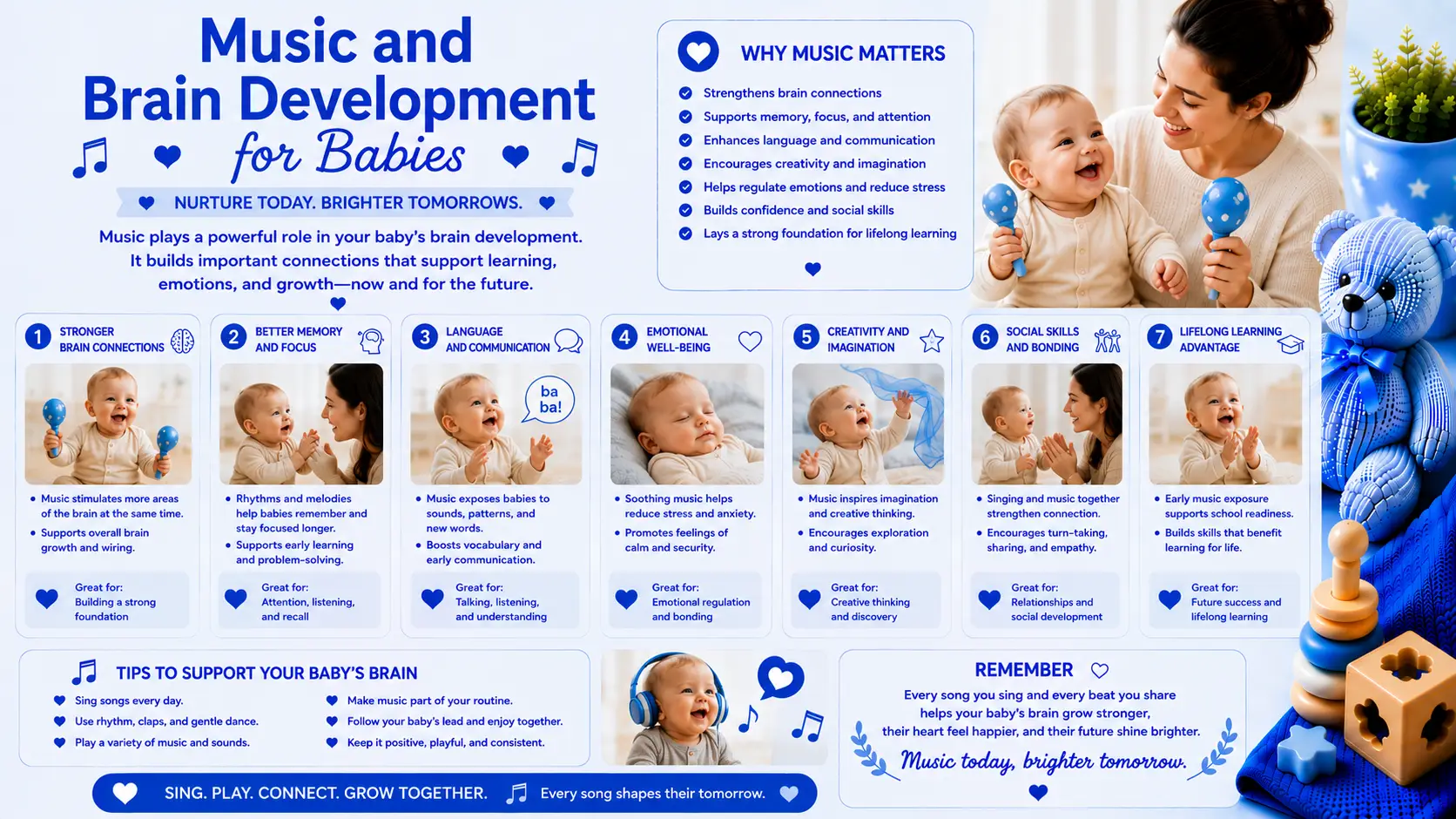
Few things engage the brain quite like music. Whether it’s a lullaby soothing a fussy baby or a favorite song that instantly lifts your mood, music has a unique ability to activate the brain in ways few other experiences can. Over the past two decades, neuroscience research has increasingly confirmed what many parents, educators, and musicians have long suspected: music doesn’t just entertain the brain — it actively shapes it.

This growing body of research on music and brain development spans everything from infant auditory processing to long-term cognitive benefits in children who study an instrument. Here’s what the science actually shows, how it applies at different life stages, and simple ways to put it into practice.

How Music Affects the Brain

Contents hide
1 How Music Affects the Brain
2 Music and Brain Development in Babies and Young Children
3 The Cognitive Benefits of Music Training
4 Music, Emotion, and the Brain
5 Practical Ways to Support Brain Development Through Music
6 Final Thoughts
7 FAQ
7.1 Does listening to music actually change brain development?
7.2 At what age does music start affecting brain development?
7.3 Does learning an instrument make kids smarter?
7.4 Can music help with learning disabilities?
7.5 Is classical music better for brain development than other genres?

Music is a uniquely complex sensory experience. Unlike most single-sense activities, engaging with music activates widespread, interconnected regions of the brain — from the auditory cortex, which processes sound, to areas involved in movement, memory, and emotion. This means that listening to or making music isn’t a passive experience for the brain; it’s a full-brain workout.

Neuroscientists have found that music shapes both brain structure and brain function. Neural oscillations — the brain’s natural rhythmic electrical activity — actually synchronize with musical rhythms, which may help explain why humans across virtually every culture respond so strongly to beat and melody. Functional imaging studies (using tools like EEG and fMRI) consistently show that music engages emotional processing centers, motor regions, and memory networks simultaneously, offering insight into why music can feel so emotionally powerful and memorable.

Music and Brain Development in Babies and Young Children

The earliest years of life are a critical period for brain development, and music appears to play a meaningful role during this window. Babies are born with billions of neurons, and during the first years of life, those neurons form the connections that shape how the brain will process information for the rest of life. Repeated exposure to music — through singing, listening, and movement — helps strengthen music-related neural pathways during this formative stage.

One of the most compelling findings comes from a landmark study out of USC’s Brain and Creativity Institute, which found that children enrolled in a music training program showed faster maturation of the brain’s auditory pathway compared to children without music instruction. This faster auditory development was linked to more accurate sound processing — a skill closely tied to language development and reading readiness.

Other research has found that young infants are capable of processing relational information in music, such as pitch patterns and rhythm, suggesting that musical learning begins far earlier than most people realize — even in the womb, in some cases.

The Cognitive Benefits of Music Training

Beyond infancy, sustained engagement with music — such as learning an instrument — has been linked to measurable cognitive benefits. Researchers have found that music training is associated with stronger-than-average language and mathematical skills, along with higher IQ scores in some studies. Differences have also been observed in the brain structures of trained musicians compared to non-musicians, particularly in regions related to hearing and motor coordination.

Music training has even shown promise for children with learning disabilities, with research suggesting that structured music lessons can enhance cognitive function in this population. The proposed mechanism is that music engages memory, attention, and problem-solving simultaneously, creating a kind of cross-training effect that benefits broader cognitive skills — not just musical ability.

Music, Emotion, and the Brain

Music’s effect on the brain isn’t limited to cognitive skills — it also plays a powerful role in emotional processing. Studies using brain imaging have found that emotional responses to music correlate with activity in the brain’s paralimbic regions, the same areas involved in processing reward and emotional significance. This helps explain why a favorite song can trigger such a strong emotional reaction, and why a calming lullaby can so effectively soothe a distressed baby.

This emotional connection also has practical, everyday applications. A gentle, quiet melody can calm the nervous system, while an upbeat, energetic song can boost mood and motivation — both because music taps directly into the brain’s emotional processing centers rather than requiring conscious effort to “feel” a certain way.

Practical Ways to Support Brain Development Through Music

You don’t need formal music training to take advantage of music’s brain benefits. Simple, everyday practices can make a meaningful difference:

Sing and talk to babies often. Infant-directed singing exposes babies to rhythm, tone, and repetition — all of which support early language development.

Introduce musical instruments early. Even simple shakers or drums allow children to explore cause-and-effect, rhythm, and motor coordination.

Consider formal music lessons. For children old enough to begin instrument training, sustained music education has been linked to stronger auditory processing and cognitive skills over time.

Use music intentionally for mood. Calming music can support relaxation and sleep, while upbeat music can support focus and energy during active play or exercise.

Make music a shared experience. Whether it’s singing together, dancing, or attending a concert, shared musical experiences add a social and emotional dimension that benefits brain development at any age.

Final Thoughts

The connection between music and brain development is one of the most well-supported findings in neuroscience — and one of the most accessible to put into practice. From the earliest days of infancy through school-age music training, engaging with music offers real, measurable benefits for language, cognition, emotional regulation, and beyond. You don’t need to be a musician to benefit — simply making music a regular part of daily life, through singing, listening, or play, is enough to support a growing brain.

FAQ

Does listening to music actually change brain development?

Yes. Research shows that music engages and shapes both brain structure and function, with consistent exposure — especially during childhood — linked to stronger auditory processing and neural connectivity.

At what age does music start affecting brain development?

Music appears to influence brain development from infancy, and some research suggests babies begin processing musical patterns even before birth.

Does learning an instrument make kids smarter?

Music training has been associated with stronger language and math skills and higher IQ scores in some studies, though results vary and music education offers many benefits beyond raw cognitive gains.

Can music help with learning disabilities?

Some research suggests music lessons can enhance cognitive function in children with learning disabilities, though outcomes vary by individual and should be discussed with an educator or specialist.

Is classical music better for brain development than other genres?

Some studies suggest classical music may offer short-term improvements in spatial reasoning, but overall brain benefits from music are linked more to active engagement and consistent exposure than to any single genre.

Author

DrAdam

Dr. Adam. Obstetrician and Gynecologist

Follow Me
Other Articles
Previous

Rhythm Activities for Babies

Next

Lullabies That Help Babies Sleep

No Comment! Be the first one.

Leave a Reply Cancel reply

Your email address will not be published. Required fields are marked *

What is Did You Search?

The “Did You Search” website was created for all mothers and families. Just search to find all your needs about your children.

Links

  • about
  • contact
  • privacy policy
  • medical disclaimer
  • sitemap
Copyright 2026 — DidYouSearch. All rights reserved.