

Watch a baby bounce in your arms the moment a familiar song comes on, and you’re witnessing something remarkable: their brain and body already working together to keep time with music. Rhythm activities for babies tap into this natural instinct, giving little ones a fun, low-pressure way to build the skills that support language, movement, and focus later on. Around five or six months old, many babies begin actively moving in time with music — a skill researchers call “entrainment” — and the activities you introduce now help strengthen that connection.
You don’t need musical training to get started. Below, we’ll cover why rhythm matters for baby development, the best rhythm activities by age, and simple ways to work rhythm into your daily routine.
Why Rhythm Activities Matter for Baby Development
Rhythm is more than a musical concept — it’s a foundational building block for how babies listen, move, and eventually communicate. When a baby claps along to a song or bounces to a beat, they’re doing real cognitive work: training working memory, practicing self-control, and building the neural pathways that later support language and reading.
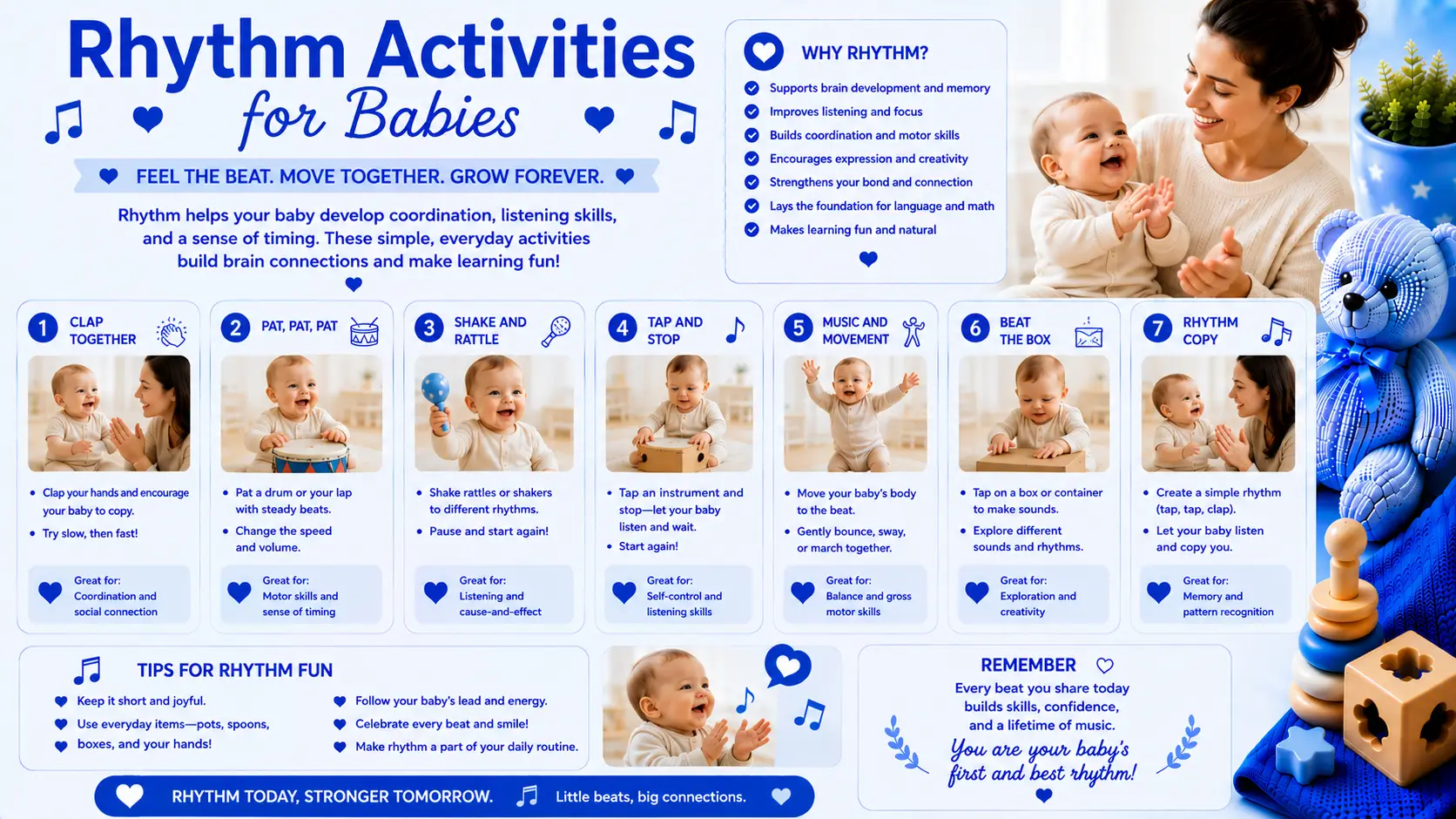
Rhythm activities for babies support:
Language development. The steady, predictable patterns in rhythm mirror the patterns found in speech, helping babies tune in to syllables and sound structure.
Motor coordination. Clapping, bouncing, and tapping to a beat build both gross and fine motor skills as babies learn to synchronize movement with sound.
Focus and self-regulation. Activities like freeze games (where movement stops when the music does) help babies practice impulse control and sustained attention.
Social-emotional bonding. Rhythm is naturally interactive — clapping games, echo patterns, and shared movement build connection between baby and caregiver.
It’s worth noting that babies won’t master precise beat-matching right away. Research on early motor development suggests that accurate rhythmic synchronization is typically a milestone reached closer to 30 months, not sooner — so there’s no need to worry if your baby’s movements look more like enthusiastic wiggling than perfect timing. That’s exactly what’s expected at this age.
Best Rhythm Activities for Babies by Age
Newborns to 6 Months
At this stage, rhythm activities are mostly about exposure and gentle association-building.
Rock or sway to a steady beat. Hold your baby and rock gently in time with a slow song — this introduces rhythm through your own body movement.
Tap or pat while singing. Gently pat your baby’s back or tummy in time with a lullaby to connect touch with rhythm.
Use a slow, consistent tempo. Babies respond best to steady, predictable rhythms around 60–80 beats per minute at this age — think slow, calm lullabies rather than fast-paced songs.
6 to 12 Months
As babies gain more control over their hands and core, they can begin participating more directly.
Clap their hands together. Gently guide your baby’s hands to clap along with a song, helping them feel the connection between sound and motion.
Pot-and-spoon drumming. Let your baby bang a wooden spoon on a pot or bowl — the varied tactile and auditory feedback supports both timing and sound discrimination.
Bounce to the beat. Hold your baby securely on your lap and bounce gently in time with music, gradually varying the tempo to explore fast and slow.
12 to 24 Months
Once toddlers are moving independently, rhythm play becomes more interactive and game-based.
March to the beat. Put on a song with a strong, clear beat and march around the room together, lifting knees high and stomping in time.
Freeze dance. Dance together, then stop completely when the music pauses — a favorite game that builds listening skills and self-control.
Call-and-response clapping. Clap a simple two- or three-beat pattern and encourage your toddler to copy it back. Keep patterns short and celebrate every attempt, even imperfect ones.
Rhythm walks. Tap out a steady beat while walking to the bath, the car, or the dinner table — weaving rhythm into daily transitions rather than treating it as a separate activity.
Simple Tips for Rhythm Play
Keep sessions short. For babies and toddlers, 10 to 15 minutes of focused, engaged rhythm play is ideal — stop while they’re still enjoying it, not after they’ve lost interest.
Start slow, then build tempo. Introduce a steady, slower beat before speeding things up, so babies can process the pattern before it changes.
Use everyday objects. Pots, spoons, empty containers, and even your own hands are all you need — no special toys required.
Weave rhythm into routines. A clean-up song with a steady beat, a rhythmic march to bath time, or tapping out syllables during a snack all count as meaningful rhythm exposure.
Celebrate the attempt, not the accuracy. Babies and toddlers are exploring, not performing — enthusiasm matters far more than hitting the beat perfectly.
Watch for cues. If your baby seems disengaged, try a slower tempo or more whole-body movement before introducing hands or instruments. If they seem overstimulated, shorten the session.
Final Thoughts
Rhythm activities for babies don’t require any special skill or equipment — just a willingness to clap, bounce, tap, and sway together. Every echoed clap, every bounce to a beat, and every freeze-and-go game is quietly building the neural foundation for language, movement, and focus. Start small, stay consistent, and let your baby’s natural sense of rhythm guide the way.
FAQ
At what age do babies start responding to rhythm?
Babies typically begin moving in time with music around 5 to 6 months old, a phenomenon known as entrainment, though they’re responsive to sound and rhythm from birth.
What are good rhythm activities for babies who can’t sit up yet?
Gentle rocking, swaying, and patting in time with music are great options for younger babies who aren’t yet moving independently.
Do babies need to keep a perfect beat for rhythm activities to help?
No. Accurate rhythmic synchronization is typically a milestone reached closer to 30 months, so imperfect movement at younger ages is completely normal and still developmentally valuable.
What household items work well for rhythm play?
Pots and wooden spoons, empty containers, and simple hand claps are all effective, no-cost tools for introducing rhythm to babies and toddlers.
How long should rhythm activities last for babies and toddlers?
Around 10 to 15 minutes of focused play is ideal. It’s better to end while your child is still engaged than to continue past the point of interest.