
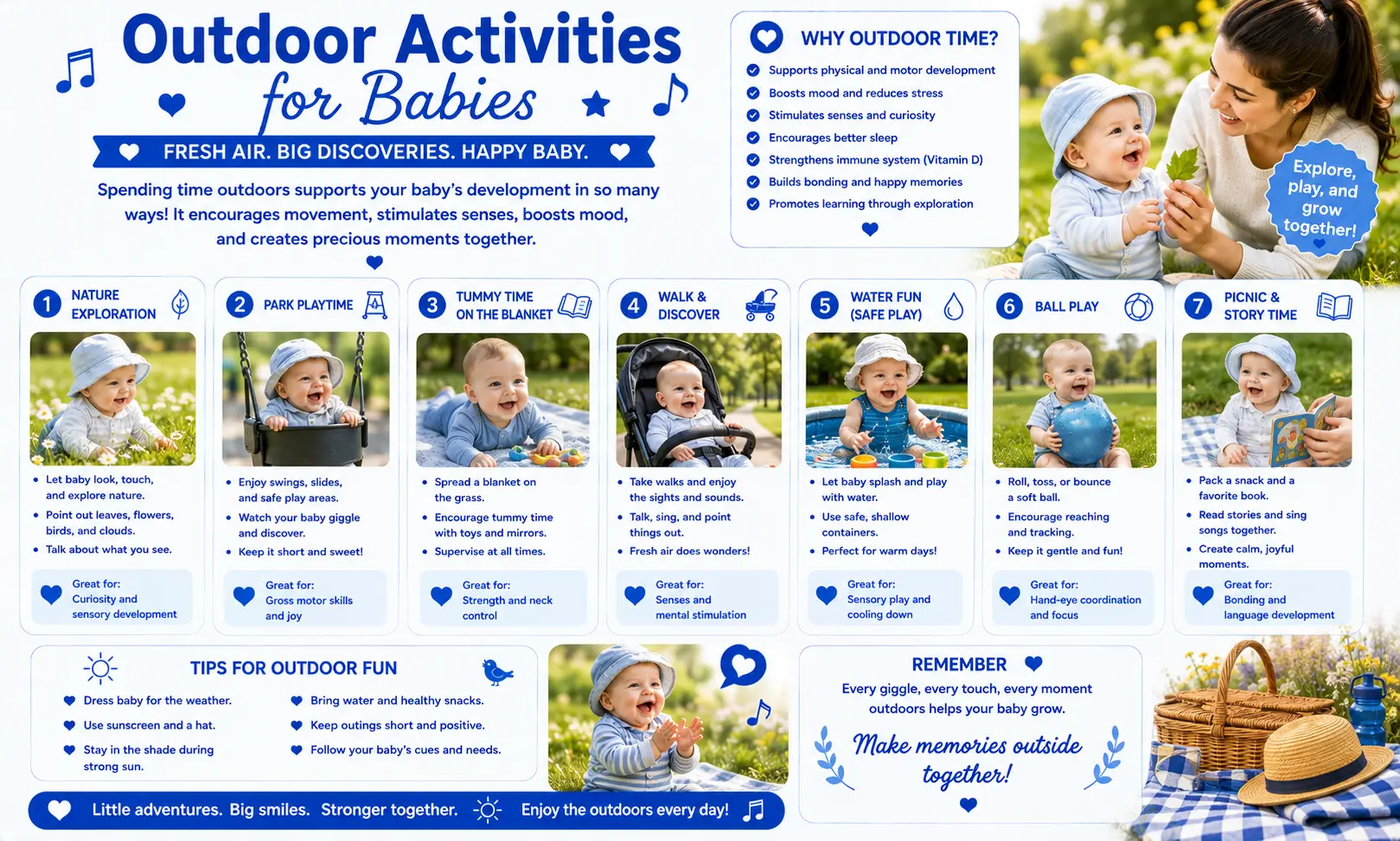

There’s something almost magical about watching a baby experience the outdoors for the first time. The feel of grass on bare feet, the sound of birds overhead, the way sunlight filters through leaves — it’s all brand new. And the good news for tired parents everywhere? Outdoor activities for babies don’t need to be elaborate, expensive, or perfectly planned. Some of the best outdoor play for infants happens with nothing more than a blanket, a few minutes, and a patch of grass.
Getting outside isn’t just a nice way to pass the time, either. Fresh air and sensory play support a baby’s physical, cognitive, and emotional development in ways that indoor play simply can’t replicate. Below, you’ll find a mix of easy, low-cost outdoor activities for babies and toddlers, along with some practical tips to keep the whole outing safe and enjoyable.
Why Outdoor Play Matters for Babies
Before diving into activity ideas, it helps to understand why outdoor time is worth prioritizing, even for very young infants.
Sensory development. Grass, sand, wind, and sunlight give babies a variety of textures, sounds, and sights that stimulate their senses far more than a living room ever could.
Motor skill development. Crawling on uneven grass, reaching for leaves, or kicking their feet in the open air helps strengthen the same muscles used for walking and coordination later on.
Better sleep and mood. Many parents notice that a fussy baby calms down almost instantly once they’re outside. Natural light exposure also helps regulate a baby’s circadian rhythm, which can support more consistent naps and nighttime sleep.
Bonding time. Outdoor activities give parents and babies a shared experience away from screens and household distractions — a simple stroll can be just as bonding as a structured activity.
10 Easy Outdoor Activities for Babies
Go for a Stroller or Carrier Walk
Even babies as young as a few weeks old can enjoy a walk outdoors in a stroller or baby carrier. The movement, fresh air, and changing scenery are naturally soothing, and it’s one of the easiest ways to fit outdoor time into a busy day.
Try Tummy Time on a Blanket Outside
Tummy time doesn’t have to happen only indoors. Laying a blanket down in the shade and letting your baby practice lifting their head while surrounded by new sights and sounds adds an extra layer of sensory stimulation to a familiar exercise.
Explore Textures in Nature
Let your baby touch grass, soft leaves, smooth stones, or sand (with supervision, of course). This kind of open-ended sensory play helps babies build an early understanding of the world around them.
Blow Bubbles Together
Bubbles are a favorite for a reason. Babies love watching them float and pop, and reaching or swatting at them helps develop hand-eye coordination and visual tracking.
Have an Outdoor Picnic
Bring a blanket, some soft finger foods if your baby has started solids, and enjoy a meal or feeding session outside. It’s a simple change of scenery that both of you will enjoy.
Visit the Playground
Even if your baby isn’t climbing yet, they’ll love watching older kids play, feeling the gentle motion of a baby swing, or simply sitting on the grass and taking it all in.
Water Play in a Shallow Bin
On a warm day, fill a shallow tray or bin with a small amount of water and a few safe toys. Supervised water play is a favorite sensory activity and a great way to cool off.
Take a Nature Walk
Point out trees, birds, clouds, or passing dogs as you walk. Narrating what you see helps build early language skills, even before your baby can respond.
Dance and Move Outside
Put on some music and gently bounce, sway, or twirl with your baby in your arms. This kind of rhythmic movement supports balance and the vestibular system.
Let Them Nap or Feed Outdoors
Sometimes the simplest activity is the best one. Letting your baby nap in a shaded stroller or nursing outside offers a change of environment without requiring any extra effort.
Outdoor Safety Tips for Babies
Outdoor play should always be paired with a few basic safety precautions:
Avoid peak sun hours (typically 10 a.m. to 4 p.m.) when the sun’s rays are strongest.
Dress for the weather, using layers, a wide-brimmed hat, and lightweight, breathable fabrics.
Use sunscreen appropriately. Babies under 6 months should be kept in the shade and covered with clothing rather than sunscreen; pediatrician-approved sunscreen is generally recommended starting at 6 months.
Watch for bugs and allergens, especially in tall grass or wooded areas.
Supervise closely during any water or textured sensory play.
Final Thoughts
You don’t need a big backyard, fancy gear, or a detailed itinerary to give your baby the benefits of outdoor play. A short walk around the block, ten minutes of tummy time on the grass, or an afternoon nap under a shady tree all count. The goal isn’t perfection — it’s simply getting outside together, even in small doses, on a regular basis.
FAQ
At what age can babies start doing outdoor activities?
Babies can enjoy outdoor time from just a few weeks old, typically in a stroller or carrier. As they grow more alert and mobile, activities like tummy time outside, sensory play, and nature walks become appropriate around 3 to 6 months.
How long should a baby stay outside?
There’s no strict rule, but many pediatricians suggest starting with short outings of 15 to 30 minutes and adjusting based on weather, temperature, and your baby’s comfort level.
Is sunscreen safe for babies?
For babies under 6 months, it’s best to rely on shade and protective clothing rather than sunscreen. After 6 months, a pediatrician-approved, mineral-based sunscreen formulated for infants is generally considered safe for exposed skin.
What outdoor activities are best for newborns?
For newborns, gentle activities like stroller walks, outdoor naps, and quiet time on a blanket in the shade are ideal. Newborns don’t need stimulating activities so much as fresh air and a change of scenery.
Can outdoor play help with a baby’s sleep?
Yes. Exposure to natural daylight helps regulate a baby’s internal clock, and the fresh air combined with physical activity can contribute to more settled naps and nighttime sleep.