
Action songs — the kind paired with claps, bounces, and silly hand motions — are more than just a way to fill the minutes before naptime. For babies, songs with movement combine two powerful learning tools at once: sound and physical action. That combination engages multiple parts of a developing brain simultaneously, making action songs one of the simplest, most effective ways to support your baby’s growth while having genuine fun together.
Here’s why action songs matter, the best ones to try with your baby, and simple tips for making the most of them.
Why Action Songs Matter for Babies
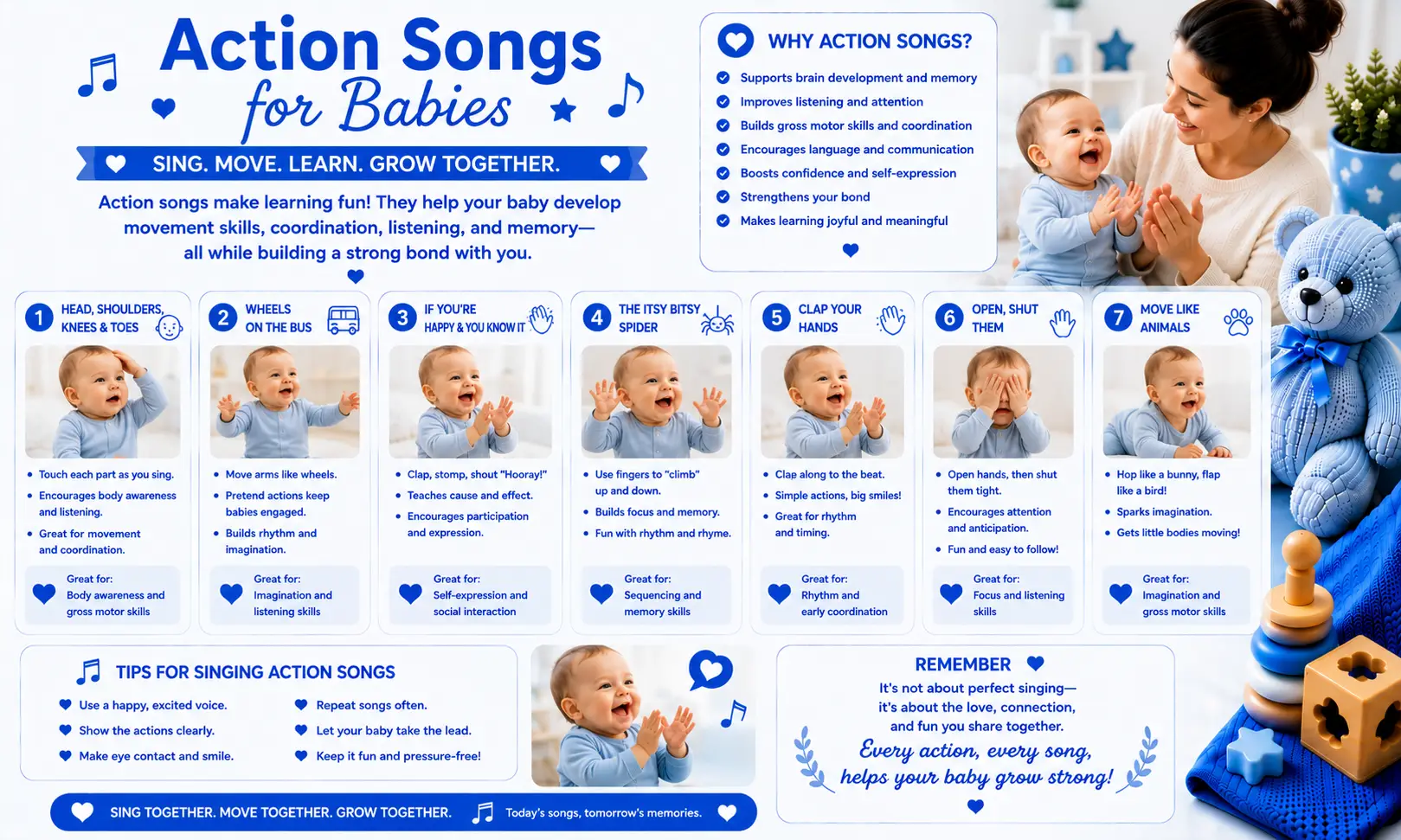
Combining movement with music isn’t just entertaining — it’s developmentally rich. When babies bounce, clap, or wiggle along to a song, they’re building strong bones and muscles while also learning coordination and new motor skills. Movement paired with sound activates different areas of the brain at once, reinforcing learning in a way that either activity alone doesn’t achieve as effectively.
Action songs specifically support:
Motor skill development. Bouncing, clapping, and gesture-based movements help babies build both gross motor skills (whole-body movement) and fine motor skills (hand and finger coordination).
Listening and concentration. Songs that require an action response, like clapping at a certain word, help babies practice listening closely and build early attention span.
Language development. Gestures paired with words strengthen the connection between sound and meaning, which is especially valuable before babies can speak. Songs with movement also promote speech and language learning as toddlers grow.
Bonding. Singing and moving together is an inherently interactive, face-to-face experience that strengthens the connection between parent and baby.
Emotional expression. Action songs give babies an early, playful outlet to express excitement, energy, or silliness through movement.
Best Action Songs for Babies
“Pat-a-Cake”
A true classic, this clapping song helps babies build hand coordination as you gently guide their hands together in rhythm with the familiar rhyme. It’s one of the earliest and most effective action songs to introduce, often starting as soon as your baby can sit up with support.
“Itsy Bitsy Spider”
Known for its finger-crawling motion, this song is excellent for fine motor skill development, as babies work to imitate the “climbing” gesture with their fingers.
“If You’re Happy and You Know It”
This interactive favorite invites babies to clap, stomp, or shout as directed by the lyrics, making it a great choice for practicing listening skills and following simple cues.
“Head, Shoulders, Knees, and Toes”
A wonderful way to introduce body-part vocabulary, this song encourages babies to touch or point to different parts of their body as you sing, building both language and coordination.
“Wheels on the Bus”
With repetitive verses and built-in hand motions (like turning an imaginary steering wheel or opening and closing “doors” with your hands), this song offers endless opportunities for gesture-based play.
“Row, Row, Row Your Boat”
Perfect for a gentle rocking or bouncing motion, this simple, rhythmic song pairs naturally with rocking your baby on your lap or in your arms.
“Clap Your Hands”
A simple, repetitive song built entirely around the clapping motion, making it an easy, low-pressure way to reinforce a skill babies are actively developing.
“I’m a Little Teapot”
Slightly more advanced but still fun for babies to watch and eventually imitate, this song introduces sequential movement (pointing, forming shapes with the arms, and tipping to the side).
Tips for Using Action Songs with Your Baby
Start with gentle guidance. For younger babies, gently move their hands, arms, or legs through the motions rather than expecting independent participation.
Repeat often. Babies build familiarity through repetition, and the more they hear a song, the more likely they are to anticipate — and eventually attempt — the actions themselves.
Slow it down at first. Babies need extra time to process both the words and the movements, so a slower pace can help, especially when introducing a new song.
Use exaggerated expressions. Big smiles, animated gestures, and playful tone all help capture and hold your baby’s attention during action songs.
Let your baby lead sometimes. If your baby seems more interested in a particular motion or repeats a favorite gesture, follow their lead and give them space to explore it.
Incorporate songs into routines. Action songs can double as helpful tools for transitions, like a clean-up song or a wiggly song before bath time, making daily routines more predictable and fun.
When Babies Start Joining In
Younger babies mostly watch, listen, and have their hands or feet gently guided through the motions. As coordination improves, usually somewhere between 6 and 12 months, babies often start attempting simple actions on their own, like clapping or reaching. By the toddler years, many children begin doing full action sequences independently, often requesting their favorite songs by name or gesture. Every baby develops at their own pace, so there’s no need to worry if your baby isn’t joining in immediately — repeated, playful exposure is what matters most.
Final Thoughts
Action songs for babies are a simple, joyful way to combine music and movement into meaningful developmental play. Whether you’re gently guiding tiny hands through “Pat-a-Cake” or bouncing along to “Row, Row, Row Your Boat,” these small daily moments build coordination, listening skills, and language — all while creating memories you’ll both cherish.
FAQ
What are the best action songs for young babies?
Simple, repetitive songs like “Pat-a-Cake,” “Itsy Bitsy Spider,” and “Row, Row, Row Your Boat” are great starting points, since they pair easy motions with a slow, predictable rhythm.
At what age can babies start participating in action songs?
Babies typically begin attempting simple actions, like clapping, between 6 and 12 months, though younger babies can still benefit from having their hands or feet gently guided through the motions.
Do action songs actually help with development?
Yes. Action songs support motor skills, listening and concentration, language development, and bonding by combining movement and music in an engaging way.
How can I help my baby follow along with action songs?
Start by gently guiding their movements, use a slower pace and exaggerated expressions, and repeat favorite songs often to build familiarity.
Can action songs help with daily routines?
Absolutely. Many parents use action songs for transitions like clean-up time or getting ready for a bath, since the predictable rhythm and movement can make routines smoother and more enjoyable.