
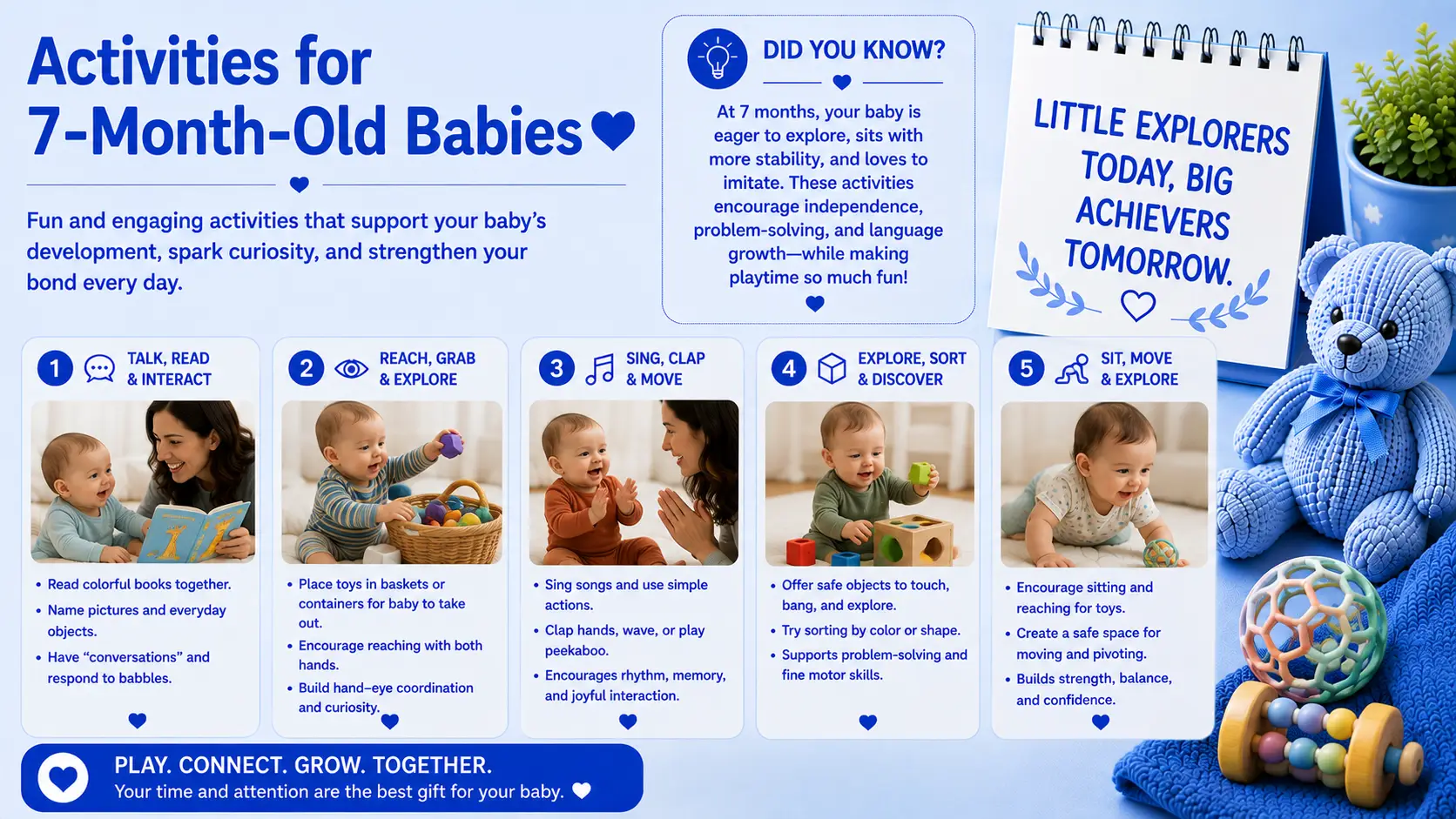

Seven months is a big month for movement. Many babies are now sitting independently (or getting close), rolling both ways with ease, and starting to scoot, creep, or even crawl toward whatever catches their eye. Babbling is picking up too — expect a lot more “bah-bah” and “dah-dah” — and your baby’s personality is really starting to shine through. This is a great stage to introduce activities for 7-month-old babies that match their new mobility, curiosity, and growing social awareness.
Here’s a practical, research-based roundup of ideas, organized by the skills they support.
Motor and Mobility Activities
At seven months, most babies are actively working on getting from point A to point B — whether that’s rolling, scooting, creeping on their belly, or true hands-and-knees crawling.
Reach-to-crawl games. Place a favorite toy just out of reach during floor time. This motivates rolling, scooting, and eventually crawling, while building arm and core strength.
Obstacle play. Prop up cushions or roll up a towel for your baby to crawl over or around. It’s a simple way to build coordination and confidence with movement.
Supported standing. If your baby shows interest in pulling up, let them practice standing while holding your fingers or a sturdy piece of furniture (always supervised).
Balloon batting. A large, inflated balloon (kept well out of mouth-range) is great for practicing reaching, batting, and tracking a moving object — just supervise closely for safety.
Sensory Play Ideas
Sensory exploration remains one of the most searched activity types for this age, and seven-month-olds are ready for slightly more complex textures and materials than they were a month ago.
Treasure basket play. Fill a basket with safe household objects of varied texture and weight — a wooden spoon, a soft scarf, a metal measuring cup. Letting your baby choose and explore builds sensory discrimination.
Water and ice play. Let your baby touch an ice cube in a bowl (supervised) or splash in a shallow tray of water. This introduces early concepts like temperature and texture change.
Textured fabric exploration. Lay out a few different fabrics — fleece, silk, corduroy — and let your baby crawl or roll across them to feel the differences.
Outdoor sensory time. Grass, sand, and leaves offer rich sensory input. Let your baby touch and explore outside (with close supervision to keep small items out of their mouth).
Cognitive and Problem-Solving Activities
Object permanence continues to develop strongly around this age, and cause-and-effect games remain some of the best tools for supporting it.
Peekaboo, with variations. Cover your face with a blanket or your hands, or hide a toy under a cloth and help your baby “find” it.
“Where’s the toy?” Partially hide an object under a cup or blanket while your baby watches, then encourage them to search for it.
Stacking and nesting toys. Soft blocks, stacking cups, or nesting bowls support fine motor skills and early problem-solving as your baby figures out how pieces fit together.
Toy drums or shakers. Simple percussion toys teach cause and effect (banging makes noise) while also supporting rhythm and coordination.
Language and Social-Emotional Activities
Babbling is in full swing at seven months, and many babies also start showing early signs of stranger or separation anxiety as their social awareness deepens.
Babble “conversations.” When your baby babbles a sound like “bah,” repeat it back (“bah-bah-bah”) to keep the exchange going. This back-and-forth mimics real conversation and supports speech development.
Animated reading time. Read board books in an expressive voice, pointing at pictures and naming what you see. Babies this age respond well to tone and facial expression.
Name familiar faces. Point to photos of family and friends and say their names — a simple way to build vocabulary and connection.
Puppet or sock play. A simple puppet can help your baby practice social engagement and may ease early wariness around new people.
A Simple Daily Rhythm
There’s no need for a rigid schedule, but many families find a loose rotation works well: active floor time and crawling practice earlier in the day, sensory or outdoor play midday, and quieter reading or babbling games before naps and bedtime. As always, follow your baby’s mood and energy level rather than the clock.
FAQ
Should my 7-month-old be crawling yet?
Not necessarily. Babies reach mobility milestones at different rates — some scoot or roll to get around before they crawl, and others don’t crawl until closer to 9–10 months. If you have concerns, check in with your pediatrician.
What are the best toys for a 7-month-old?
Stacking cups, soft blocks, textured board books, rattles, and simple shakers or drums are great choices. Toys that encourage reaching, grasping, and transferring objects between hands are especially useful at this stage.
How can I help my 7-month-old with babbling and early speech?
Repeat the sounds your baby makes back to them to create a “conversation,” read aloud often, and narrate everyday activities. This back-and-forth exchange is one of the most effective ways to support early language development.
Is it normal for my 7-month-old to be wary of strangers?
Yes. Stranger and separation anxiety often emerge around this age as babies become more socially aware and attached to familiar caregivers. It usually settles down over the following months.
How much tummy time or floor play does a 7-month-old need?
Most 7-month-olds benefit from multiple short sessions of supervised floor time throughout the day, giving them plenty of chances to practice sitting, reaching, and crawling. Follow your baby’s cues and let them rest when they show signs of tiring.