
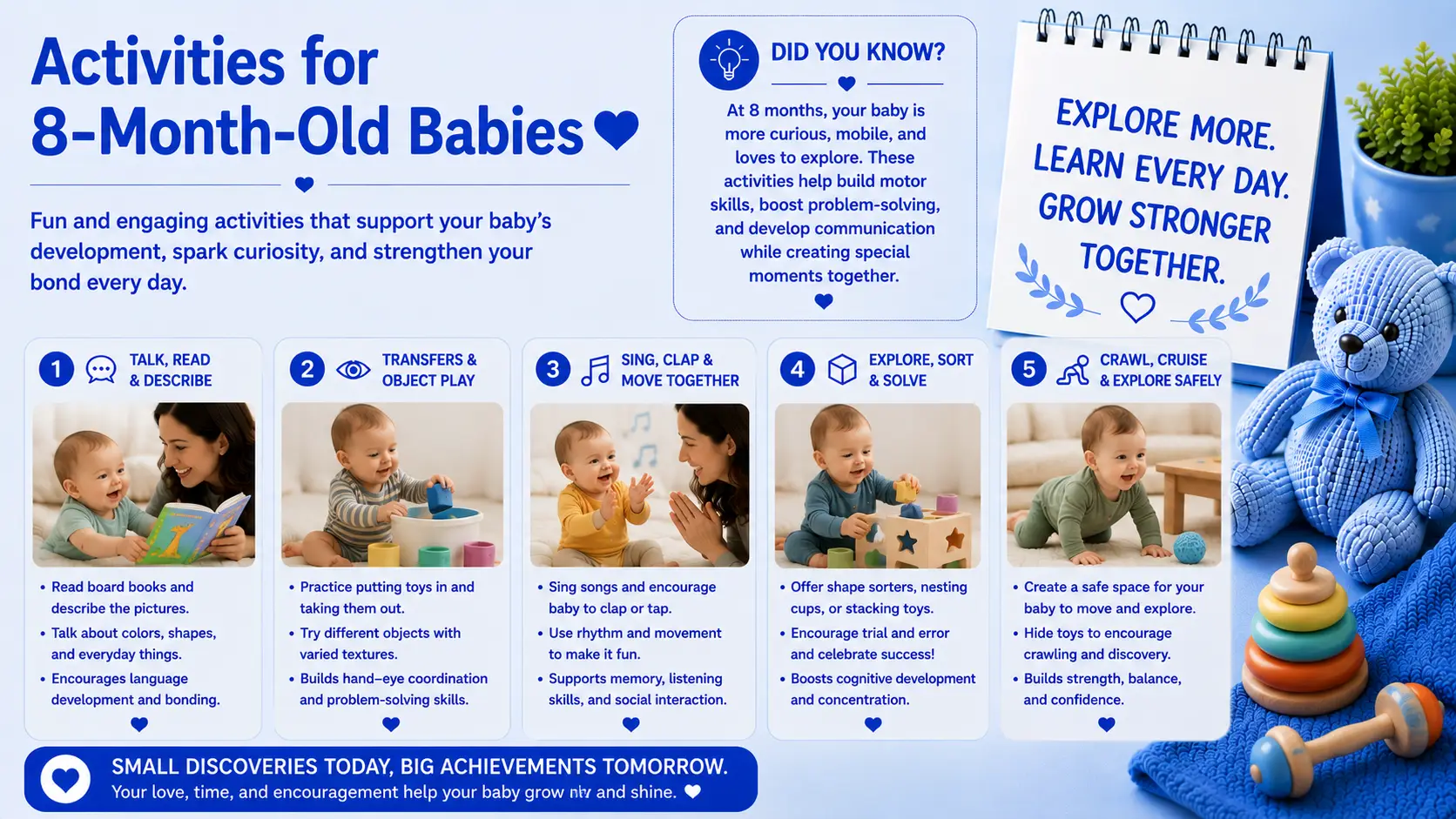

Eight months brings a real leap in independence. Many babies are sitting confidently on their own, crawling (or scooting fast) toward whatever interests them, and starting to pull up to standing on furniture. Fine motor skills are sharpening too — you may notice your baby picking up small pieces of food with a thumb-and-finger “pincer grasp.” Add in more babbling, simple gestures like waving, and a growing understanding of words like “no,” and it’s clear this is a month full of change. Here are practical, research-based activities for 8-month-old babies to match all this new growth.
Motor and Mobility Activities
Crawling, cruising, and pulling to stand are the big physical themes at eight months.
Furniture cruising practice. Encourage your baby to pull up on a sturdy, low piece of furniture and take sideways steps while holding on. This builds the leg strength needed for eventual walking.
Crawling tunnels and obstacle courses. Use blankets draped over chairs, couch cushions, or a play tunnel to create simple obstacles for your baby to crawl over, under, or through. This strengthens muscles and builds spatial awareness.
Retrieval games. Ask your baby to crawl over and get a toy from across the room, or hand it to you and ask for it back. It’s a simple, effective way to encourage movement and early following-directions skills.
Standing practice with support. Let your baby practice standing while holding your hands or a stable surface for a few seconds at a time — great preparation for the cruising and walking stages ahead.
Fine Motor and Self-Feeding Activities
Around eight months, many babies are refining their pincer grasp — the ability to pick up small objects using the thumb and forefinger.
Finger-food practice. Offer soft, baby-safe finger foods like small pieces of banana, avocado, or well-cooked pasta to encourage the pincer grasp (always supervised, and appropriately sized to reduce choking risk).
Container play. Give your baby a container and a few soft blocks or balls to put in and take out. This builds fine motor coordination and an early understanding of “in” and “out.”
Stacking and knocking down. Soft stacking blocks let your baby practice grasping, stacking, and — everyone’s favorite part — knocking the tower down.
Banging and sorting toys. Toys that encourage banging two objects together or dropping shapes into a container support hand-eye coordination and early cause-and-effect learning.
Cognitive and Problem-Solving Activities
Object permanence is typically well established by eight months, which makes hiding games especially fun and effective.
Advanced peekaboo and hide-and-seek. Hide a toy under a blanket or behind a pillow and encourage your baby to find it — a great way to reinforce that things (and people) still exist even when out of sight.
Simple sorting play. Offer a shape sorter or basket of objects your baby can group, dump, and refill.
“Where did it go?” games. Move a toy from one hand to the other behind your back and ask your baby to guess which hand it’s in.
Cause-and-effect toys. Push-button toys, pop-up toys, or anything with a simple, predictable reaction help your baby connect their actions to an outcome.
Language and Social-Emotional Activities
Babbling, gestures, and separation anxiety often intensify around this age as your baby’s communication and social understanding grow.
Mimic and respond to babbling. Repeat your baby’s sounds back to them and treat it like a real conversation — this reinforces that communication is a two-way exchange.
Teach simple gestures. Wave “bye-bye,” clap hands, or shake your head “no” while narrating what you’re doing. Babies this age are increasingly able to imitate these actions.
Name everyday objects. Point to and label things around the house during daily routines — this steadily builds receptive vocabulary, even before your baby can talk.
Consistent goodbye routines. If your baby shows distress at separations, a short, warm, and consistent goodbye ritual can help ease anxiety over time.
A Simple Daily Rhythm
A loose routine tends to work well at this stage: active crawling and standing practice in the morning, fine motor or self-feeding activities around mealtimes, and quieter games like peekaboo or reading before naps and bedtime. As always, let your baby’s mood and energy guide the pace.
FAQ
What milestones should an 8-month-old be hitting?
Many 8-month-olds can sit unsupported, crawl or scoot, pull up to standing, use a pincer grasp, babble frequently, and respond to their name. Every baby develops at their own pace, so these are general guides rather than strict deadlines.
What are good toys for an 8-month-old?
Stacking blocks, shape sorters, push-button cause-and-effect toys, and containers for filling and dumping are all great choices that match this stage’s fine motor and problem-solving skills.
How can I help my baby with the pincer grasp?
Offering appropriately sized soft finger foods and small (supervised) objects to pick up gives your baby plenty of practice using their thumb and forefinger together.
Is it normal for my 8-month-old to be clingy or upset when I leave the room?
Yes, separation anxiety commonly peaks around this age as babies understand object permanence and form stronger attachments. Consistent, calm goodbye routines can help.
My 8-month-old isn’t crawling yet — should I be worried?
Not necessarily. Some babies scoot, roll, or skip crawling altogether and move straight to pulling up and cruising. If you have concerns about your baby’s mobility or development, check in with your pediatrician.