
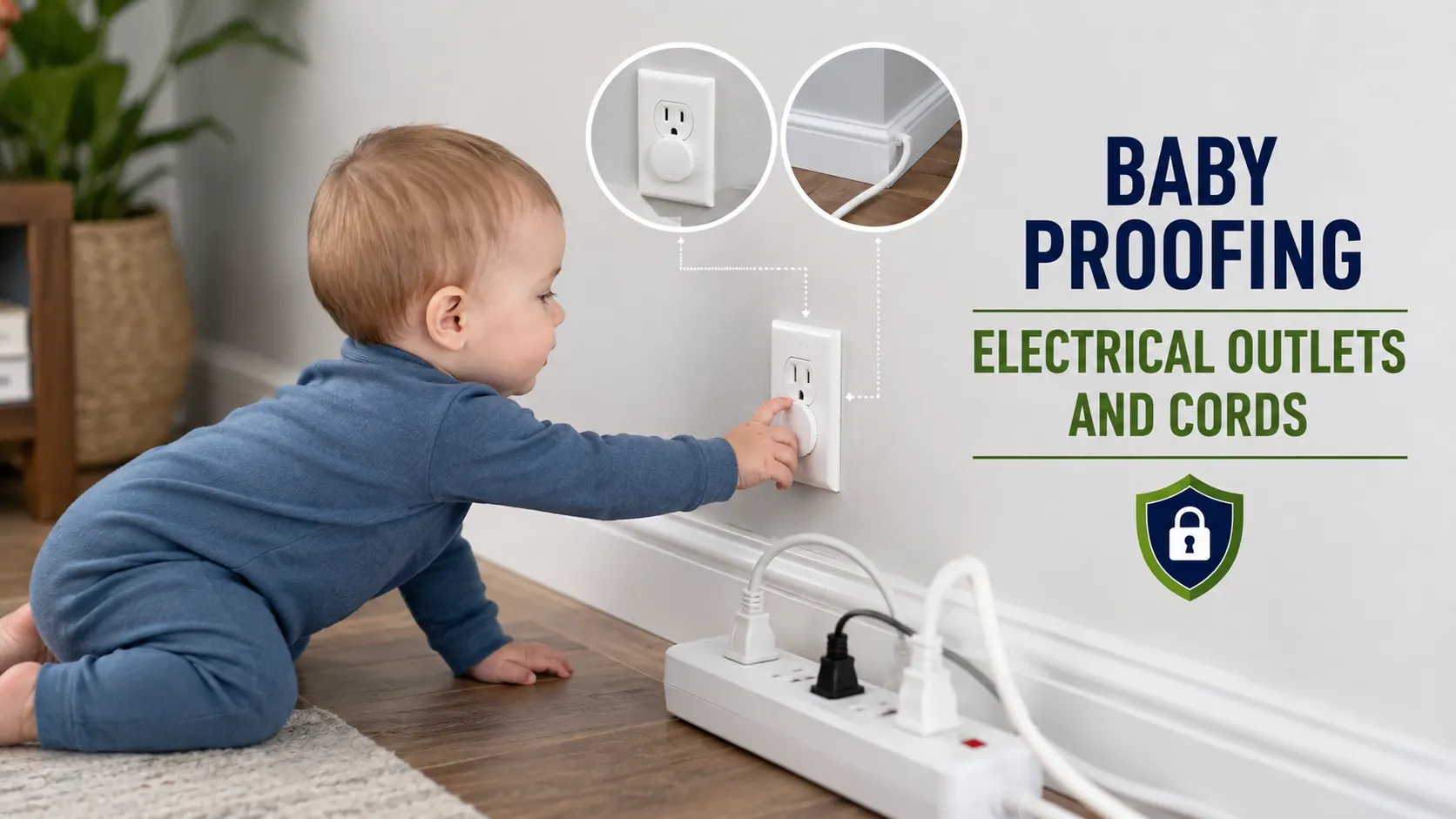

Most electrical baby-proofing guides list the same handful of products — outlet covers, cord shorteners, power strip covers — without helping you decide which option is actually worth it for your situation. This guide covers that decision directly: when a simple cover is enough, when it’s worth replacing an outlet entirely, and the cord and power strip hazards that get missed even by parents who’ve covered every outlet in the house.
Why This Matters
<cite index=”14-1″>The U.S. Consumer Product Safety Commission estimates that thousands of children visit emergency rooms every year due to electrical socket injuries.</cite> Cords carry a separate risk: <cite index=”17-1″>a meaningful share of electrical injuries in children happen from biting a cord, and cords with a lot of extra slack are especially high-risk</cite> for this reason, independent of the outlet itself.
Outlet Covers vs. Tamper-Resistant Receptacles: Which Do You Actually Need?
This is the decision most guides skip entirely, jumping straight to “buy covers” without explaining the tradeoffs.
Plastic Plug Caps (the Cheapest, Least Reliable Option)
<cite index=”17-2,17-3″>These small plastic caps are convenient but don’t offer strong protection on their own, and can create a false sense of security — a two-year-old can often remove one in under 10 seconds.</cite> They’re also a standalone choking hazard once removed, since they’re small enough to fit in a baby’s mouth. Treat these as a temporary, travel-only solution rather than a primary home safety measure.
Sliding Plate or Box Covers (A Better DIY Option)
These stay attached to the outlet permanently and slide or hinge open only when a plug is inserted with deliberate pressure. <cite index=”14-2″>Sliding outlet covers or box covers generally offer more secure protection against small fingers than loose plug caps.</cite> This is the right middle-ground option for most households — effective, no electrician needed, and nothing small to become a separate hazard.
Tamper-Resistant Receptacles (TRRs) — The Permanent Fix
<cite index=”14-3″>Tamper-resistant receptacles are highly effective because they have internal shutters that prevent anything from being inserted into just one slot — both slots need equal pressure applied at the same time, which a baby can’t do with a single object like a fork or key.</cite> Check your outlets first: some homes already have these built in, identifiable by small shutter flaps visible inside the slots. If yours don’t, <cite index=”15-1″>an electrician can install tamper-resistant outlets for higher-risk rooms like the kitchen and bathroom</cite>, or throughout the home if you want a permanent, cover-free solution.
Bottom line: sliding covers are a good default for most outlets; TRR replacement is worth the cost for a home where you want a permanent, maintenance-free fix, especially in high-traffic rooms, and is worth strongly considering if you’re already having any other electrical work done.
Room-by-Room Outlet and Cord Checklist
Living Room
- Cover or replace any outlet at or below a crawling or standing baby’s reach
- Secure TV, lamp, and electronics cords along the wall with cord raceways or clips, rather than leaving them loose across the floor
- Use a power strip cover on any exposed power strip, especially ones on the floor
Kitchen
- Cover outlets near counters that a climbing toddler could eventually reach
- Unplug and store small appliances (toasters, kettles) with their cords wrapped, not dangling over a counter edge where a baby could pull them down
- Check under-cabinet or backsplash outlets, which are easy to overlook
Bedrooms and Nursery
- Cover outlets near the crib or changing table
- Keep any cords (baby monitor, sound machine, lamp) well out of reach of the crib, since cord entanglement risk is separate from the shock/bite risk covered in this guide
- Secure cords from any bedside electronics along the wall or baseboard
Bathroom
- Confirm outlets are GFCI-protected (most bathroom outlets are required to be), which adds a layer of shock protection beyond a physical cover
- Unplug and store hair tools between uses rather than leaving them plugged in near water
Garage and Basement
<cite index=”17-4″>Garage outlets are easy to overlook just because they’re less visible, but they’re not any less of a hazard</cite> once a baby has access to the space. Cover or restrict access the same as any other room.
Home Office
- Cords behind desks and near power strips are often the most tangled, hardest-to-manage cluster in the house — prioritize cord raceways or a cord management box here specifically
- Keep this room gated or closed off if full cord management isn’t realistic yet
Cord Safety Beyond the Outlet Itself
- Shorten cords with a cord shortener, cord wind-up clip, or by securing excess length with a zip tie — don’t just tuck loose slack out of sight, since a baby can still pull and unwind it.
- Route cords through a cord cover or raceway along the baseboard rather than leaving them exposed across open floor.
- Keep cords out of crib and bassinet reach entirely — this is a strangulation risk separate from the shock or biting risk, and no amount of “shortening” makes a cord safe within reach of a sleeping baby.
- Unplug small appliances when not in use. <cite index=”21-1″>Even when a device isn’t powered on, electricity still flows to the cord and outlet while it’s plugged in</cite>, so unplugging fully (not just switching off) removes that risk.
- For long-term extension cord use, consider a permanent fix. <cite index=”17-5″>If you find yourself relying on an extension cord long-term, having an electrician install an additional permanent outlet is safer than continuing to manage a long-term cord workaround.</cite>
Power Strips: A Frequently Underestimated Hazard
Power strips combine two risks in one object — multiple exposed outlet slots at floor level, and a cluster of cords a baby can grab and pull. <cite index=”21-2″>Keeping power strips hidden behind furniture, mounted to the underside of a desk, or covered with a dedicated power strip safety cover</cite> addresses both risks at once. Plug covers for any unused slots on the strip are worth adding as well, since a partially-used power strip still has open slots exposed.
Baby Proofing Outlets and Cords While Traveling
Hotels, rentals, and relatives’ homes are rarely baby-proofed to your standard. <cite index=”18-1,20-1″>Carrying a few plug covers and a roll of tape lets you quickly cover accessible outlets and tape down loose cords wherever you’re staying</cite>, without needing to bring bulkier permanent solutions on a trip.
When to Stop Baby Proofing Outlets
<cite index=”14-4″>Most parents can begin removing outlet covers once a child is between about 3 and 5 years old, depending on the child’s individual maturity and impulse control</cite> — and only after directly teaching electrical safety rules and confirming the child consistently follows them, not just based on age alone. Tamper-resistant receptacles, if you have them, don’t need to be “removed” the way covers do, since their protection doesn’t rely on a child not being tempted to defeat it.
The Bottom Line
The right outlet solution depends on how permanent you want the fix to be — sliding covers are an effective, no-electrician-needed default, while tamper-resistant receptacles are worth the investment for a lasting, cover-free solution in high-traffic rooms. Don’t stop at the outlet itself: cord slack, power strips, and garage or under-counter outlets are the parts of this hazard most parents baby-proof last, if at all.
Continue exploring: browse the full Baby Safety hub.
Frequently Asked
Common Questions