Skip to content
DidYouSearch DidYouSearch
  • did you search?
  • Baby Plus+
    • Baby Activities
      • Arts & Crafts
      • Indoor Activities
      • Montessori
      • Music
      • Outdoor Activities
      • Reading
      • Sensory Play
      • Tummy Time
    • Baby Development
      • Brain Development
      • Cognitive Development
      • Emotional Development
      • Fine Motor Skills
      • Growth Milestones
      • Monthly Milestones
      • Motor Skills
      • Physical Development
      • Social Development
      • Speech Development
    • Baby Feeding
      • Allergies
      • Baby Led Weaning
      • Bottle Feeding
      • Breast feeding
        • Breastfeeding Diet
        • Breastfeeding Positions
        • Latch Problems
        • Low Milk Supply
        • Mastitis
        • Pumping Schedule
        • Weaning
      • Burping
      • Cluster Feeding
      • Feeding Schedule
      • Formula Feeding
        • Formula Amount
        • Formula Brands
        • Formula Comparison
        • Formula Preparation
        • Formula Storage
      • Hydration
      • Pumping
      • Solid Foods
    • Baby Gear Reviews
      • Best Baby Carrier
      • Best Baby Monitor
      • Best Baby Strollers
      • Best Bottles
      • Best Breast Pump
      • Best Car Seat
      • Best Cribs
      • Best Diapers
      • Best Formula
      • Best Toys
    • Baby Growth
      • Growth Spurts
      • Height Charts
      • Monthly Growth
      • Percentiles
      • Weight Charts
    • Baby Health
      • Allergies
      • Cold
      • Constipation
      • Cough
      • Diarrhea
      • Ear Infection
      • Fever
      • Flu
      • Pediatric Visits
      • Rashes
      • Teething
      • Vaccines
      • Vomiting
    • Baby Nutrition
      • Dairy
      • Drinks
      • Eggs
      • Fish
      • Fruits
      • Healthy Recipes
      • Meat
      • Snacks
      • Vegetables
      • Vitamins
    • Baby Products
      • Baby Carriers
      • Bassinets
      • Bottles
      • Breast Pumps
      • Car Seats
      • Cribs
      • Diaper Bags
      • High Chairs
      • Monitors
      • Strollers
      • Swings
      • Toys
      • Walkers
    • Baby Recipes
      • BLW Recipes
      • Breakfast
      • Dinner
      • Finger Foods
      • Lunch
      • Purees
      • Snacks
    • Baby Safety
      • Baby Proofing
      • Car Seats
      • Choking Hazards
      • CPR
      • Home Safety
      • Poison Prevention
      • Safe Sleep
      • Sun Protection
      • Water Safety
  • Baby Names
    • Boy Names
    • Girl Names
    • American baby boy names
    • American baby girl names
    • Biblical Names
    • Middle Names
    • Modern Names
    • Short Names
    • Unique Names
    • Unisex Names
  • Recommended
    • Baby Shopping
      • Baby Registry
      • Budget Baby Shopping
      • Hospital Bag
      • Must Have Products
      • Newborn Checklist
      • Nursery Ideas
    • Baby Sleep
      • Bedtime Routine
      • Co Sleeping
      • Crib Safety
      • Nap Schedules
      • Night Wakings
      • Sleep Environment
      • Sleep Products
      • Sleep Regression
      • Sleep Training
      • Wake Windows
      • White Noise
    • Childcare
      • Daycare
      • Babysitters
      • Kindergarten
      • Nannies
      • Preschool
    • Newborn Care
      • Nail Care
      • Baby Hygiene
      • Bathing
      • Crying
      • Diapering
      • Ear Care
      • Eye Care
      • Skin Care
      • Soothing Techniques
      • Temperature
      • Umbilical Cord
    • Special Needs
      • Premature Babies
      • Autism Signs
      • Developmental Delays
      • Down Syndrome
      • NICU
      • Twins
    • Seasonal Baby Care
      • Spring
      • Summer
      • Travel
      • Fall
      • Holidays
      • Winter
  • Parenting
    • Bonding
    • Discipline
    • Emotional Intelligence
    • First Time Parents
    • Gentle Parenting
    • Positive Parenting
    • Routines
    • Single Parents
    • Working Parents
  • Pregnancy
    • Pregnancy Complications
    • Labor & Delivery
    • Postpartum Recovery
    • Pregnancy Exercises
    • Pregnancy Medications
    • Pregnancy Nutrition
    • Pregnancy Sleep
    • Pregnancy Symptoms
    • Pregnancy Tests
    • Pregnancy Vitamins
    • Pregnancy Weeks
  • Toddler
    • Preschool
    • Speech
    • Tantrums
    • Toddler Food
    • Toddler Sleep
    • Behavior
    • Independence
    • Learning
    • Potty Training
  • Traveling with Baby
    • Road Trips
    • Beach
    • Camping
    • Flying
    • Hotels
    • Packing Lists
  • did you search?
  • Baby Plus+
    • Baby Activities
      • Arts & Crafts
      • Indoor Activities
      • Montessori
      • Music
      • Outdoor Activities
      • Reading
      • Sensory Play
      • Tummy Time
    • Baby Development
      • Brain Development
      • Cognitive Development
      • Emotional Development
      • Fine Motor Skills
      • Growth Milestones
      • Monthly Milestones
      • Motor Skills
      • Physical Development
      • Social Development
      • Speech Development
    • Baby Feeding
      • Allergies
      • Baby Led Weaning
      • Bottle Feeding
      • Breast feeding
        • Breastfeeding Diet
        • Breastfeeding Positions
        • Latch Problems
        • Low Milk Supply
        • Mastitis
        • Pumping Schedule
        • Weaning
      • Burping
      • Cluster Feeding
      • Feeding Schedule
      • Formula Feeding
        • Formula Amount
        • Formula Brands
        • Formula Comparison
        • Formula Preparation
        • Formula Storage
      • Hydration
      • Pumping
      • Solid Foods
    • Baby Gear Reviews
      • Best Baby Carrier
      • Best Baby Monitor
      • Best Baby Strollers
      • Best Bottles
      • Best Breast Pump
      • Best Car Seat
      • Best Cribs
      • Best Diapers
      • Best Formula
      • Best Toys
    • Baby Growth
      • Growth Spurts
      • Height Charts
      • Monthly Growth
      • Percentiles
      • Weight Charts
    • Baby Health
      • Allergies
      • Cold
      • Constipation
      • Cough
      • Diarrhea
      • Ear Infection
      • Fever
      • Flu
      • Pediatric Visits
      • Rashes
      • Teething
      • Vaccines
      • Vomiting
    • Baby Nutrition
      • Dairy
      • Drinks
      • Eggs
      • Fish
      • Fruits
      • Healthy Recipes
      • Meat
      • Snacks
      • Vegetables
      • Vitamins
    • Baby Products
      • Baby Carriers
      • Bassinets
      • Bottles
      • Breast Pumps
      • Car Seats
      • Cribs
      • Diaper Bags
      • High Chairs
      • Monitors
      • Strollers
      • Swings
      • Toys
      • Walkers
    • Baby Recipes
      • BLW Recipes
      • Breakfast
      • Dinner
      • Finger Foods
      • Lunch
      • Purees
      • Snacks
    • Baby Safety
      • Baby Proofing
      • Car Seats
      • Choking Hazards
      • CPR
      • Home Safety
      • Poison Prevention
      • Safe Sleep
      • Sun Protection
      • Water Safety
  • Baby Names
    • Boy Names
    • Girl Names
    • American baby boy names
    • American baby girl names
    • Biblical Names
    • Middle Names
    • Modern Names
    • Short Names
    • Unique Names
    • Unisex Names
  • Recommended
    • Baby Shopping
      • Baby Registry
      • Budget Baby Shopping
      • Hospital Bag
      • Must Have Products
      • Newborn Checklist
      • Nursery Ideas
    • Baby Sleep
      • Bedtime Routine
      • Co Sleeping
      • Crib Safety
      • Nap Schedules
      • Night Wakings
      • Sleep Environment
      • Sleep Products
      • Sleep Regression
      • Sleep Training
      • Wake Windows
      • White Noise
    • Childcare
      • Daycare
      • Babysitters
      • Kindergarten
      • Nannies
      • Preschool
    • Newborn Care
      • Nail Care
      • Baby Hygiene
      • Bathing
      • Crying
      • Diapering
      • Ear Care
      • Eye Care
      • Skin Care
      • Soothing Techniques
      • Temperature
      • Umbilical Cord
    • Special Needs
      • Premature Babies
      • Autism Signs
      • Developmental Delays
      • Down Syndrome
      • NICU
      • Twins
    • Seasonal Baby Care
      • Spring
      • Summer
      • Travel
      • Fall
      • Holidays
      • Winter
  • Parenting
    • Bonding
    • Discipline
    • Emotional Intelligence
    • First Time Parents
    • Gentle Parenting
    • Positive Parenting
    • Routines
    • Single Parents
    • Working Parents
  • Pregnancy
    • Pregnancy Complications
    • Labor & Delivery
    • Postpartum Recovery
    • Pregnancy Exercises
    • Pregnancy Medications
    • Pregnancy Nutrition
    • Pregnancy Sleep
    • Pregnancy Symptoms
    • Pregnancy Tests
    • Pregnancy Vitamins
    • Pregnancy Weeks
  • Toddler
    • Preschool
    • Speech
    • Tantrums
    • Toddler Food
    • Toddler Sleep
    • Behavior
    • Independence
    • Learning
    • Potty Training
  • Traveling with Baby
    • Road Trips
    • Beach
    • Camping
    • Flying
    • Hotels
    • Packing Lists
Close

Search

Home/Baby Safety/Baby Proofing/How to Anchor Furniture to Prevent Tip-Over Accidents
Baby ProofingBaby Safety

How to Anchor Furniture to Prevent Tip-Over Accidents

By Ali
August 3, 2026 6 Min Read
0

Furniture tip-overs are one of the most serious and most preventable hazards in a home with a mobile baby or toddler, and the fix is a straightforward weekend project. This guide walks through the full process — including two situations most tutorials skip: what to do when a stud doesn’t line up with where you need to anchor, and how to do this safely as a renter who can’t drill into walls freely.

Why This Matters More Than It Might Seem

Contents hide
1 Why This Matters More Than It Might Seem
2 What You’ll Need
3 Step-by-Step: Anchoring Furniture to a Wall Stud (Best Option)
4 What to Do When a Stud Doesn’t Line Up With Your Furniture
5 Anchoring on Non-Drywall Walls (Plaster, Brick, Concrete)
6 Anchoring as a Renter
7 Special Cases
7.1 Stacked Furniture (a Hutch on Top of a Dresser, or a Bookshelf Topper)
7.2 TVs
7.3 Wide or Extra-Heavy Furniture
8 Common Mistakes to Avoid
9 Maintenance: How Often to Re-Check Anchors
10 The Bottom Line
11 Frequently Asked
12 Common Questions

Furniture and TV tip-overs are a significant cause of injury to young children, largely because furniture with drawers, shelves, or handles gives a climbing toddler exactly the footholds they need to pull themselves up — and once enough weight shifts forward, even furniture that looks stable can come down fast. <cite index=”8-1″>Safety experts note that furniture used to be considered safe from tipping if it was wider than it was tall, but that guidance has changed — every piece should be anchored regardless of its dimensions, since a climbing child can still cause it to tip.</cite> <cite index=”8-1″>Furniture with drawers or shelves is especially important to secure, since these features make climbing easier, and knobs can help a child climb as well.</cite>

Newer dressers sold after late 2023 are built to resist tipping better due to updated safety regulations, but <cite index=”9-2,9-3″>the advice to anchor bookcases, dressers, and TV stands to the wall still applies, especially since so much older furniture on the market doesn’t meet the newer standard.</cite>

What You’ll Need

  • A furniture anchor kit (metal strap-and-bracket style, not plastic)
  • A stud finder
  • A drill and appropriate drill bits
  • A pencil for marking
  • A tape measure
  • Wall anchors rated for your wall type, for situations where a stud isn’t available (see below)

<cite index=”7-1″>Metal anchors, such as L-shaped brackets, are generally recommended over plastic, since plastic can become brittle over time and fail.</cite> <cite index=”7-1″>It’s also worth watching for counterfeit or knockoff anchor products sold online and sticking with known, tested brands even if they cost a little more.</cite>

Step-by-Step: Anchoring Furniture to a Wall Stud (Best Option)

  1. Find the stud. <cite index=”10-1,10-2″>Use a stud finder, moving it horizontally across the wall until it identifies the edges of a stud — studs are typically spaced about 16 inches apart.</cite> Mark both edges of the stud lightly in pencil so you know its full width, not just one point.
  2. Position the furniture where you actually want it before marking anything on the furniture itself — moving it later means redoing this step.
  3. Mark the anchor point on the wall, ideally centered on the stud rather than near its edge, <cite index=”10-1″>since anchoring to the center of a stud provides more stability than anchoring near an edge.</cite>
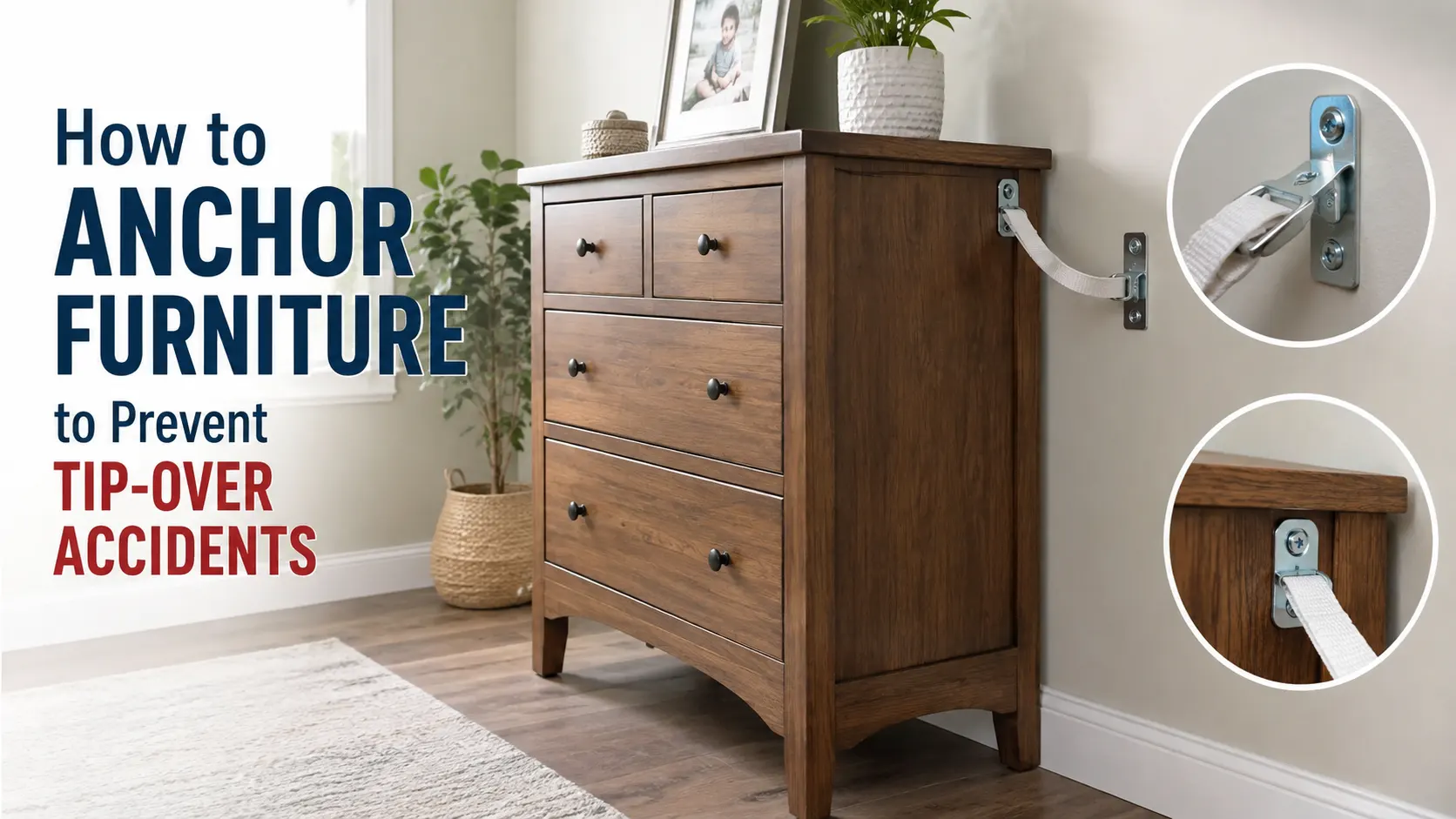
  4. Attach the furniture-side bracket first. <cite index=”11-1″>Make sure the restraint is installed into a solid part of the furniture — the back panel of many dressers and bookshelves is thin particleboard or veneer, not solid enough to hold weight, so look for a solid rail, the top lip, or a reinforced point instead.</cite>
  5. Attach the wall-side bracket into the stud, driving screws fully into solid wood rather than just through drywall.
  6. Connect the strap between the two brackets, and adjust so the furniture sits flush against the wall with the strap under slight tension, not loose.
  7. Use at least two anchor points per piece of furniture. <cite index=”11-1″>Plan on at least two restraints per piece, and add more for wider furniture, since a single anchor point isn’t enough to prevent tipping under sideways or angled force.</cite>
  8. Do a strength test. Once installed, apply firm, steady pressure to the top of the furniture the way a climbing toddler might, and confirm it doesn’t shift or pull away from the wall.

What to Do When a Stud Doesn’t Line Up With Your Furniture

This is one of the most common real-world problems, and most tutorials skip it entirely. Studs are fixed in the wall roughly every 16 inches, but your furniture’s ideal anchor point often doesn’t land on one.

  • Shift the furniture slightly if there’s any flexibility in its placement, so the anchor point lines up with a stud.
  • Use a horizontal mounting rail or plate designed for anchor kits, which spans across the wall and lets you screw into a stud at any point along its length, even if that point isn’t directly behind the furniture’s designated anchor spot.
  • Use heavy-duty drywall anchors rated for the expected load (toggle bolts or similar) if no stud is reachable at all — check the weight rating against your furniture’s actual weight, since standard plastic drywall anchors are not rated for this kind of sustained, direction-changing force.
  • Avoid relying on adhesive-only anchors as your sole attachment method on drywall without a stud — these are best used as a secondary reinforcement, not the primary hold point.

Anchoring on Non-Drywall Walls (Plaster, Brick, Concrete)

  • Plaster walls: studs still exist behind plaster in most homes; a stud finder calibrated for the wall thickness works, but go slowly, since plaster is more prone to cracking around a drilled hole than drywall.
  • Brick or concrete walls: use masonry anchors rated for the load, and a masonry drill bit — standard wood screws and drywall anchors won’t hold in these materials.
  • Uncertain wall type: if you’re not sure what’s behind the wall, a small test hole in an inconspicuous spot (like inside a closet) can confirm the material before you commit to a visible anchor point.

Anchoring as a Renter

  • Ask first — many leases allow small, patchable holes for safety equipment like furniture anchors, even when larger modifications aren’t permitted; landlords are often willing to make an exception for child safety.
  • Use furniture-to-furniture anchoring where possible — securing a bookshelf to an adjacent, heavier piece of furniture (rather than the wall) can reduce tip risk in situations where wall drilling isn’t an option, though it’s a secondary solution, not as reliable as a wall stud anchor.
  • Choose furniture placement strategically — positioning tall, climbable furniture in a corner (anchored to two walls if possible) or away from areas your baby spends unsupervised time reduces risk even before any hardware goes in.
  • Patch and touch up on move-out — anchor screw holes are small and easy to fill with spackle, generally a minor and low-cost fix compared to the safety benefit.

Special Cases

Stacked Furniture (a Hutch on Top of a Dresser, or a Bookshelf Topper)

<cite index=”11-1″>Anchor the top piece to the base piece first, and then anchor the base piece to the wall</cite> — a stacked piece anchored only to the wall, with nothing securing it to the furniture below it, can still slide or tip independently.

TVs

Mount flat-screen TVs directly to the wall when possible, or use an anti-tip strap or bracket kit designed specifically for TVs if wall-mounting isn’t an option — a flat-screen TV is lighter than older models but still substantial enough to cause serious injury if pulled down.

Wide or Extra-Heavy Furniture

Use more than the standard two anchor points — a wide dresser or a heavily-loaded bookshelf needs anchors distributed across its width, not just at one central point, to resist tipping from any angle a child might pull from.

Common Mistakes to Avoid

  1. Using the plastic straps or cable ties furniture sometimes ships with. These are frequently not rated for the sustained, repeated force of a climbing child and are one of the most common anchor failure points.
  2. Anchoring into the furniture’s thin back panel instead of a solid rail or structural point — the anchor can pull straight through particleboard under real force.
  3. Using only one anchor point on furniture that’s wide or heavy.
  4. Never re-checking anchors after installation. <cite index=”10-3″>Anchoring hardware should be periodically checked for wear or damage, and furniture should occasionally be gently pulled on to confirm it remains firmly secured.</cite>
  5. Assuming a heavier piece of furniture doesn’t need anchoring. Weight alone doesn’t prevent tipping — a determined, climbing toddler can shift even substantial furniture enough to cause it to fall.

Maintenance: How Often to Re-Check Anchors

  • Every 3–6 months, do a firm strength-test pull on each anchored piece.
  • After any furniture rearrangement, re-anchor before your baby has access to the room again — moving furniture even slightly can compromise a previously solid anchor point.
  • After any home renovation or wall work near an anchored piece, confirm the anchor point wasn’t disturbed.
  • Immediately if you notice any visible wear, looseness, or damage to straps, brackets, or screws — don’t wait for the next scheduled check.

The Bottom Line

Anchoring furniture properly comes down to a few non-negotiables: metal hardware over plastic, anchoring into solid wood on both the furniture and the wall (a stud whenever possible), at least two anchor points per piece, and a recurring strength-test check rather than a one-time install-and-forget approach. When a stud doesn’t line up or drilling isn’t an option, there are still solid alternatives — the goal is making sure every anchor point actually holds under real force, not just installing something that looks secure.

Continue exploring: browse the full Baby Safety hub.

Frequently Asked

Common Questions

Yes — the older guideline that only tall, narrow furniture needs anchoring is outdated. A climbing child can still cause wide furniture to tip, especially pieces with drawers, shelves, or handles that make climbing easier.
Use a horizontal mounting plate that spans to reach a stud at another point along its length, or use heavy-duty drywall anchors rated for the expected load if no stud is reachable at all. Avoid relying on adhesive-only anchors as your sole attachment point.
Furniture-to-furniture anchoring and strategic placement can reduce risk, but a proper wall anchor is the most reliable method. Many landlords will allow small, patchable holes for child safety equipment specifically, so it's worth asking directly.
At least two anchor points per piece, with more added for wider or heavier furniture, since a single anchor point isn't enough to resist tipping from every angle a child might pull from.
Author

Ali

Digital Marketing enthusiast with a passion for SEO, web design, analytics, and creative problem-solving.

Follow Me
Other Articles
Previous

Baby Proofing Products That Are Actually Worth Buying

Next

Baby Proofing Electrical Outlets and Cords

No Comment! Be the first one.

Leave a Reply Cancel reply

Your email address will not be published. Required fields are marked *

What is Did You Search?

The “Did You Search” website was created for all mothers and families. Just search to find all your needs about your children.

Links

  • about
  • contact
  • privacy policy
  • medical disclaimer
  • sitemap
Copyright 2026 — DidYouSearch. All rights reserved.