
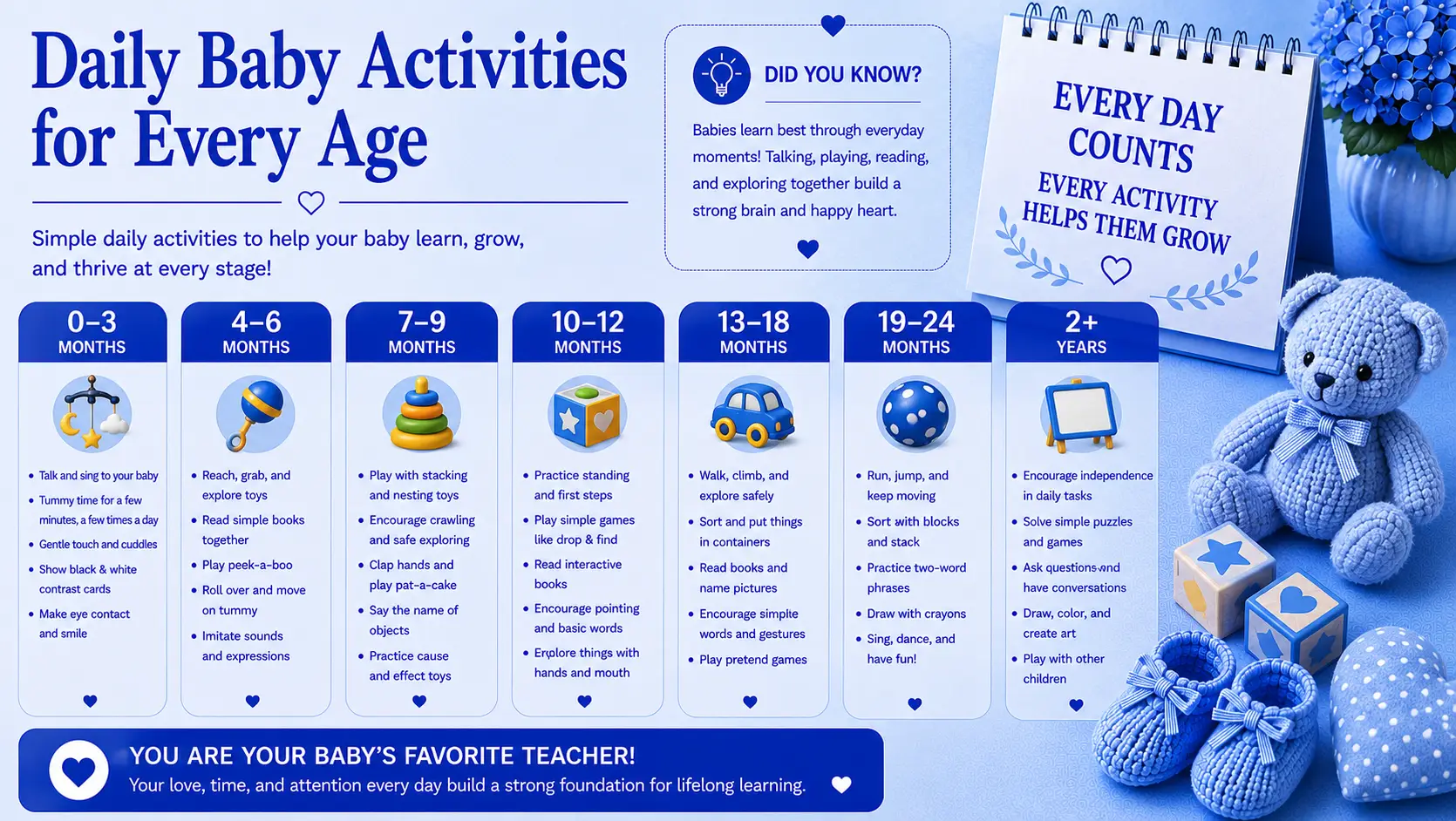

If you’ve ever ended a day with your baby wondering what you actually did together, you’re not alone. Babies don’t need a packed itinerary — they need a simple daily rhythm of connection, movement, and rest, repeated consistently. The classic “eat, play, sleep” cycle that most pediatric sleep experts recommend is really just a framework for fitting the right activities into each awake window.
Below is a practical, age-by-age breakdown of daily baby activities you can build into your everyday routine — no special equipment, no Pinterest-perfect setup required.
Why a Daily Routine (Not a Rigid Schedule) Matters
You don’t need an hour-by-hour schedule to give your baby structure. What matters most is a predictable rhythm: wake, feed, play, sleep, repeat. This rhythm helps babies feel secure, makes wake windows easier to manage, and gives you a natural container for daily developmental activities. As your baby’s awake windows stretch — from around 45 minutes as a newborn to 3+ hours by their first birthday — you’ll simply have more time to fill with age-appropriate play.
0–3 Months: Daily Activities for Newborns
At this stage, awake windows are short, so keep each activity to just a few minutes.
Tummy time — aim for a total of 15–30 minutes daily, broken into short sessions
Talking and narrating throughout diaper changes, feeds, and daily routines
Daily outdoor walk in the stroller or carrier for fresh air and gentle stimulation
High-contrast visual play — black-and-white cards or books for a few minutes at a time
Skin-to-skin time and infant massage during calm, wakeful moments
Singing or humming during every diaper change or feeding
3–6 Months: Daily Activities for Growing Babies
Awake windows lengthen to around 1.5–2 hours, giving you more room to rotate activities throughout the day.
Extended tummy time with a mirror or toy propped nearby
Reach-and-grasp play with rattles or textured toys
A daily “floor time” session on a play mat for rolling practice
Bath-time water play, even outside of bath time with a shallow supervised tub
Reading a board book at least once a day (bedtime is a great anchor point)
Music and movement — a few minutes of dancing or bouncing to songs
6–9 Months: Daily Activities for Sitting & Crawling Babies
With awake windows now around 2–3 hours, this is a great age to build in a few dedicated play blocks each day.
Sensory play — a rotating bin with rice, textured fabric, or safe household objects
Object permanence games like peekaboo or hiding a toy under a cup
Supervised self-feeding practice with soft finger foods
Crawling and obstacle play using pillows or furniture
Container play — filling and dumping toys into a basket
Outdoor time exploring grass, leaves, or a sandbox
9–12 Months: Daily Activities for Cruising & Almost-Walking Babies
By this age, many babies thrive on 2–3 solid play blocks a day, alternating active and calm activities.
Cruising practice along low furniture or a push toy
Stacking and knocking down blocks or cups
Simple shape sorters or knob puzzles
Daily “give and take” games, passing toys back and forth
Naming objects and pointing during walks or playtime
A wind-down activity before bed, like quiet reading or a lullaby
Building These Activities Into a Simple Daily Rhythm
You don’t need to schedule every minute — most parents find it easiest to anchor activities to natural transition points in the day:
Morning wake-up: talking, singing, a quick stretch or tummy time
After each feed: a short, active play session before the next nap
Midday: outdoor time or a longer sensory/motor activity
Late afternoon: calmer, low-stimulation play as the day winds down
Before bed: reading, cuddling, and a consistent bedtime routine
This kind of loose structure — rather than a strict, timed schedule — tends to work best for both newborns and older infants, since it flexes naturally with nap changes, growth spurts, and off days.
A Few Reminders
Follow your baby’s cues, not the clock. Overtired or overstimulated babies benefit more from rest than another activity.
Repetition is good. Babies often prefer doing the same activity multiple days in a row — it builds mastery and confidence.
You don’t need new toys constantly. Rotating a small set of toys keeps things fresh without needing to buy more.
Talk to your pediatrician about milestones if you have concerns; every baby develops at their own pace.
FAQ
How many activities should I do with my baby each day?
There’s no fixed number — most experts suggest a few short, varied activities spread across each awake window rather than back-to-back stimulation. Two to four intentional play sessions a day, mixed with everyday interaction, is plenty for most babies.
What is a good daily routine for a newborn?
Most newborns follow an “eat, play, sleep” cycle: feed, a brief period of calm awake activity like tummy time or talking, then sleep. This cycle typically repeats every 45 minutes to 2 hours in the first few months.
How long should tummy time be each day?
Pediatric guidelines generally recommend working up to 15–30 minutes of tummy time daily by around 7 weeks old, split into several short sessions rather than one long stretch.
Should baby activities change daily, or is repetition okay?
Repetition is not only okay, it’s beneficial. Babies build memory, confidence, and mastery through repeated exposure to the same activities, songs, and books — variety matters less than consistency at this age.
What’s the best daily activity for baby brain development?
Talking, reading, and responsive interaction consistently rank among the most effective daily activities for supporting cognitive and language development, often outperforming specific toys or structured “educational” play.