
In a baby’s first year, the brain forms new neural connections at a staggering rate — up to 1,000 every second during the first 1,000 days of life. That statistic gets thrown around a lot, but here’s what it actually means for parents: almost everything you already do with your baby — talking, singing, playing peekaboo, reading a board book — is wiring their brain for language, memory, and problem-solving.
You don’t need flashcards, “genius baby” kits, or a strict curriculum. What actually works, according to child development experts and pediatric researchers, is simple, repeated, responsive play. Below are the best baby brain development activities, organized by category, along with a few age-specific notes and answers to the questions parents search for most.
Talk, Narrate, and Read — Every Day
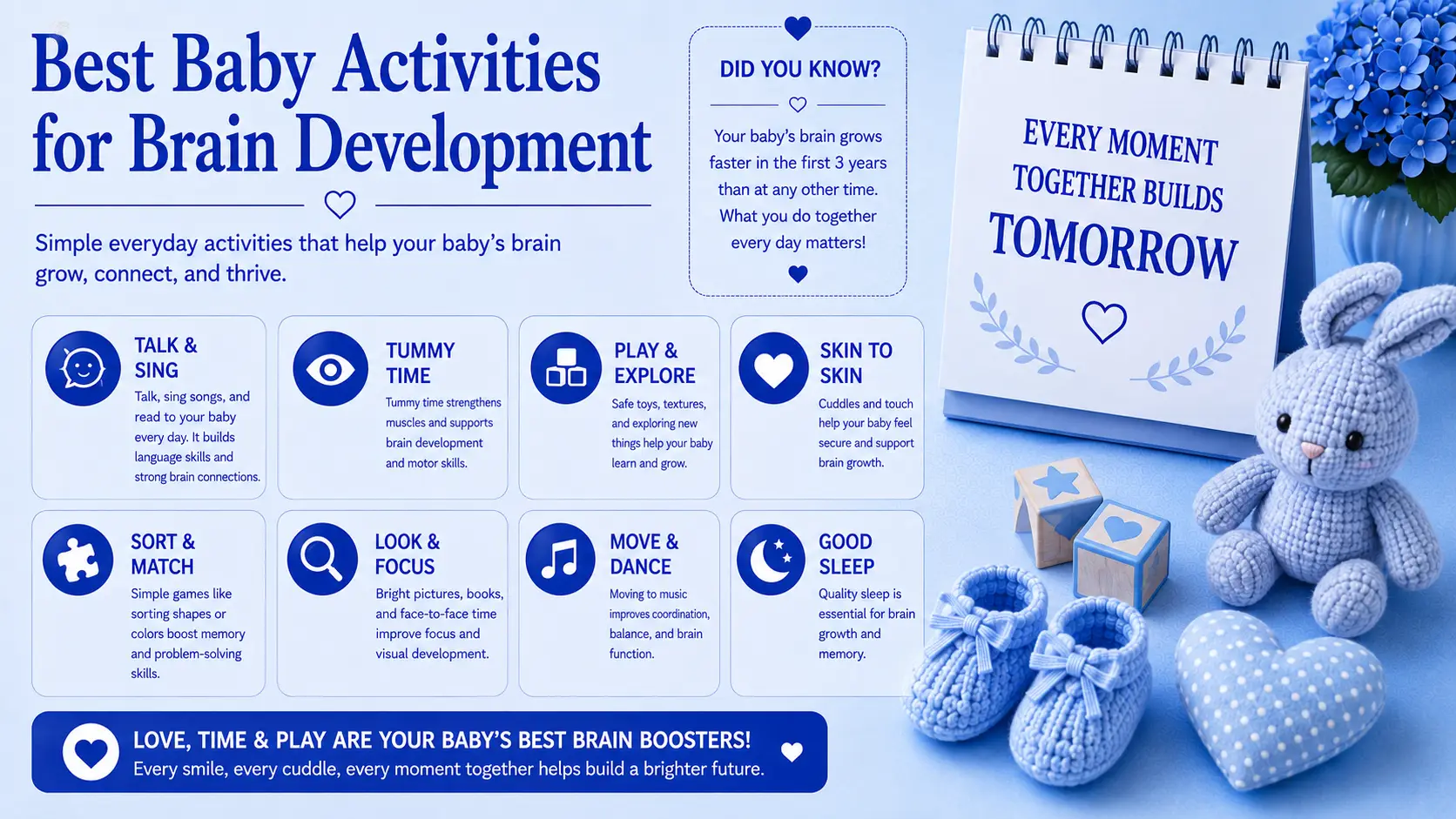
Language exposure is one of the single biggest drivers of cognitive development. You don’t need a script:
Narrate everyday routines (“Now we’re putting on your sock, one foot, two feet”)
Read aloud daily, even to newborns — board books with bold images and different textures work best
Respond to babbles and coos as if they’re real conversation; this “serve and return” interaction is what researchers say builds the brain’s language and social circuits
Sing nursery rhymes and repeat simple songs; repetition helps memory formation
Name objects, colors, and body parts throughout the day (“Where’s your nose? There it is!”)
Cause-and-Effect Play
Around 4–9 months, babies become fascinated by the idea that their actions make things happen. This is a cornerstone of early problem-solving.
Toys with buttons, switches, or levers that produce a sound or light
Rattles and shaker toys
Banging a spoon on a pot or bowl
Dropping toys from a highchair and watching what happens (frustrating for parents, great for baby’s brain)
Squeeze toys that squeak
Object Permanence & Memory Games
Around 7–8 months, babies start to understand that things still exist even when they can’t see them — a major cognitive milestone.
Peekaboo, in all its forms
Hiding a toy under a cloth or cup and asking, “Where did it go?”
Simple hide-and-seek with a favorite stuffed animal
Repeating the same bedtime routine to build anticipation and memory
Sensory Play
Sensory experiences build the neural pathways behind touch, taste, sound, and sight — and they’re some of the easiest activities to set up with household items.
Texture bins or touch-and-feel books
Water play at bath time with cups for pouring
Taste-safe textured foods for older infants exploring self-feeding
Scented, baby-safe play (mild vanilla, citrus)
Music with different tempos and instruments
Motor Skill & Movement Activities
Cognitive and physical development aren’t separate — every reach, roll, and crawl also builds thinking skills.
Daily tummy time (builds the strength needed for reaching and later crawling)
Stacking soft blocks or nesting cups
Crawling toward a rolling ball
Threading large, soft beads (for older infants, with supervision)
Pulling to stand and cruising along furniture
Mirror and Social Play
Mirror play helps babies begin to differentiate themselves from others — an early building block of self-awareness and social cognition.
Holding baby in front of a mirror and naming facial features
Making exaggerated facial expressions for baby to imitate
Clapping and simple “copy me” games
Waving hello and goodbye during daily routines
Age-by-Age Quick Reference
0–3 months: Talking, singing, tummy time, high-contrast visuals, skin-to-skin contact
4–6 months: Cause-and-effect toys, reaching and grasping, mirror play, textured books
7–9 months: Peekaboo, object permanence games, stacking, crawling exploration
10–12 months: Naming objects, simple puzzles, container play, early “give and take” games
Why Responsive Play Matters More Than “Educational” Toys
Research consistently points to one theme: it’s the interaction, not the product, that builds the brain. A caregiver who responds to a baby’s babble, follows their gaze, and narrates the world around them is doing more for cognitive development than any single toy could. Expensive gadgets and screen-based “learning” apps have not been shown to outperform simple, real-world, hands-on play with a responsive adult.
FAQ
What activities best support a baby’s brain development?
Talking and reading aloud, cause-and-effect toys, peekaboo and object permanence games, sensory play, and daily tummy time are consistently identified as the most effective activities for supporting infant cognitive development.
At what age does a baby’s brain develop the fastest?
Brain development is fastest during the first 1,000 days of life (birth to about age 2), with the first year alone seeing an especially rapid rate of new neural connections forming in response to sensory and social experiences.
Do educational baby toys actually improve brain development?
Most research suggests that responsive interaction — talking, playing, and reacting to your baby — has a greater impact on cognitive development than any specific toy or “educational” product. Simple household items often work just as well as branded toys.
How much should I read to my baby to support brain development?
Even a few minutes of reading aloud daily, starting from birth, is beneficial. Consistency matters more than duration — short, regular reading sessions support vocabulary and language development over time.
Can screen time help with baby brain development?
Pediatric guidelines generally recommend avoiding screen time for babies under 18–24 months, since hands-on, face-to-face interaction has been shown to support cognitive and language development far more effectively than passive screen exposure.