
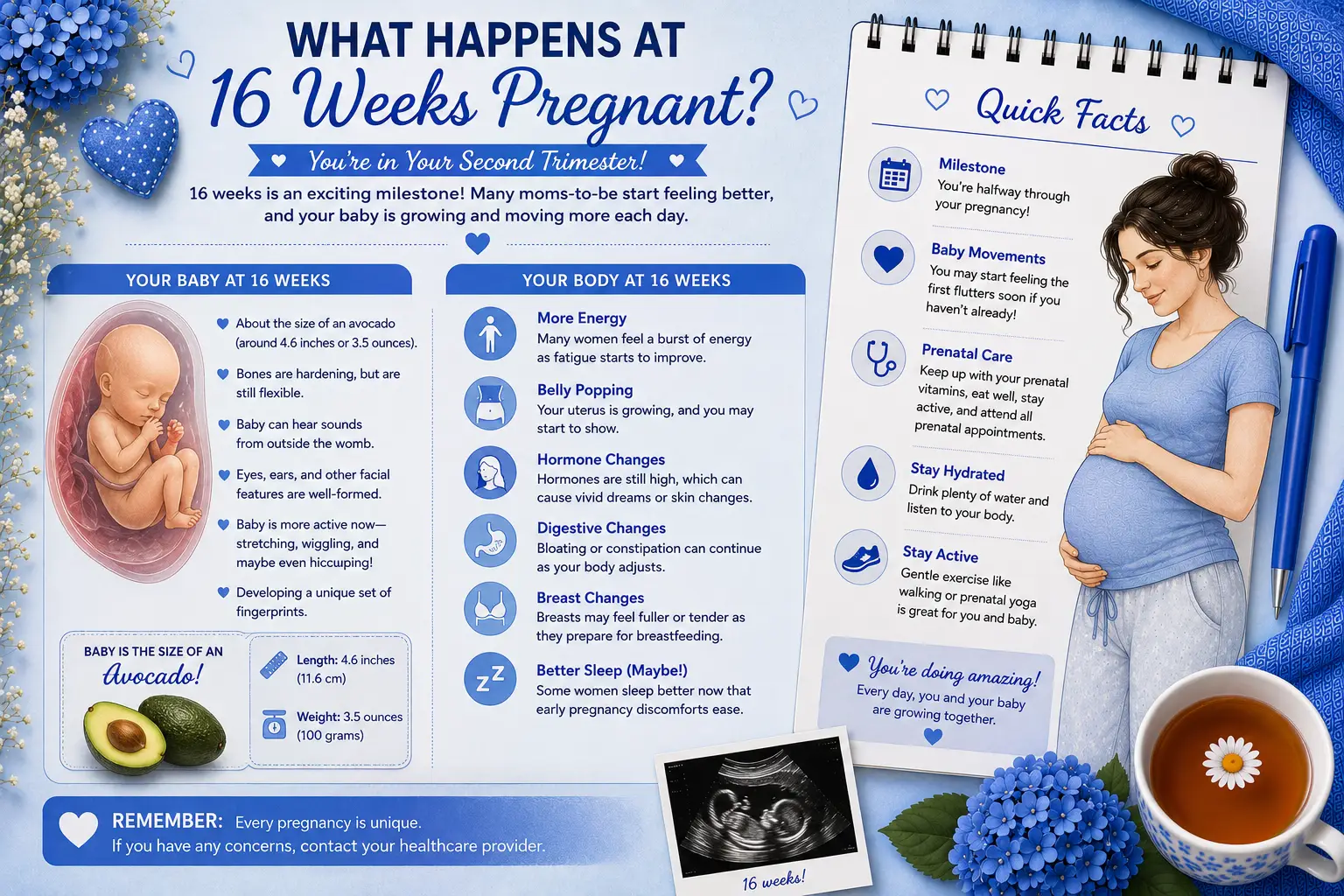

At 16 weeks pregnant, you’re settled into what many people call the “honeymoon period” of pregnancy — energy is returning, symptoms are easing, and your bump may finally be making an appearance. Here’s what’s going on with you and your baby this week.
Your Baby at 16 Weeks
Your baby is roughly the size of an avocado or peach — around 4 to 5 inches long. It’s a genuinely busy week for development:
Coordinated movement — arm and leg movements are becoming smoother and more purposeful, and tiny hands may even form fists
Facial expressions — your baby may be pulling little smiles or frowns at random, even though real emotional control is still months away
The head can now hold itself in a more upright position
Eyes and ears are moving closer to their final positions, and hearing may begin developing soon
Bones are continuing to harden
The liver and pancreas are producing secretions, more lung tissue is forming, and toenails are starting to appear
The nervous system is coordinating movement, heart rate, and breathing more effectively
Although you likely can’t feel it yet, your baby is active — sucking a thumb, playing with the umbilical cord, and even getting hiccups.
Common Symptoms at 16 Weeks Pregnant
Many people find the second trimester noticeably more comfortable than the first, and week 16 often reflects that shift:
Increased energy, as morning sickness continues to ease for most people
Increased appetite
A more visible baby bump, as the uterus continues expanding
Round ligament pain — mild cramping or a pulling sensation in the lower abdomen as the uterus stretches
Fuller breasts
“Pregnancy glow” — a flush and skin luminosity from increased blood flow and hormones
Nasal congestion
Constipation
Increased vaginal discharge
Symptoms vary widely from person to person, and it’s normal to feel great this week or to still be dealing with lingering first-trimester discomforts.
Feeling Your Baby Move (Quickening)
One of the most anticipated milestones around this stage is feeling your baby move for the first time, known as quickening. Most people first notice it somewhere between 16 and 20 weeks, though it can happen a bit later — closer to 20 to 24 weeks — especially in a first pregnancy. Early movements are often described as flutters, tiny pulses, or bubbles, and they’re easy to mistake for gas at first. If you’ve been pregnant before, you may recognize the sensation earlier since you already know what to look for.
Your Body at 16 Weeks Pregnant
Your uterus is expanding steadily, and your bump may show up any day now if it hasn’t already. Weight gain at this stage is generally in a healthy, moderate range, and some people notice early stretch marks as skin begins to stretch — a completely normal part of the process, even in areas that aren’t visibly growing yet.
Upcoming Milestones
Week 16 is a good time to start thinking ahead to some major appointments:
The anatomy scan, typically scheduled between 18 and 20 weeks, which checks your baby’s development in detail and can reveal the baby’s sex if you want to know
Prenatal classes or support groups, which many people start researching around now
If you have an ultrasound this week, external genitalia may occasionally be visible, though it’s not yet a reliable way to confirm sex
When to Call Your Doctor
Reach out to your provider if you experience heavy bleeding, severe abdominal pain, fever, fluid leakage, or a persistent severe headache — these warrant prompt evaluation regardless of how well the rest of the pregnancy is going.
Tips for Week 16
Increase fiber and fluid intake if constipation is an issue, and check with your provider before using any stool softener or laxative
Keep taking your prenatal vitamin
Ease into gentle activity now that energy is improving
Start building your support network — prenatal classes, parent groups, and your care team
FAQ
How big is a baby at 16 weeks pregnant?
About the size of an avocado or peach, roughly 4 to 5 inches long.
When do you feel the baby move at 16 weeks?
Most people feel first movements, or quickening, between 16 and 20 weeks, though it can take until 20–24 weeks, especially with a first pregnancy.
Should I be showing at 16 weeks pregnant?
Many people have a visible bump by 16 weeks, though timing varies by body type and whether it’s a first pregnancy. Not showing yet is still within the normal range.
Why do I have round ligament pain at 16 weeks?
As your uterus grows and stretches the ligaments supporting it, you may feel mild cramping or a pulling sensation in the lower abdomen — this is round ligament pain and is a normal part of second-trimester growth.
Can you find out the baby’s sex at 16 weeks?
Not reliably yet. While external genitalia may occasionally be glimpsed on an ultrasound around this time, sex is usually confirmed during the anatomy scan between 18 and 20 weeks.