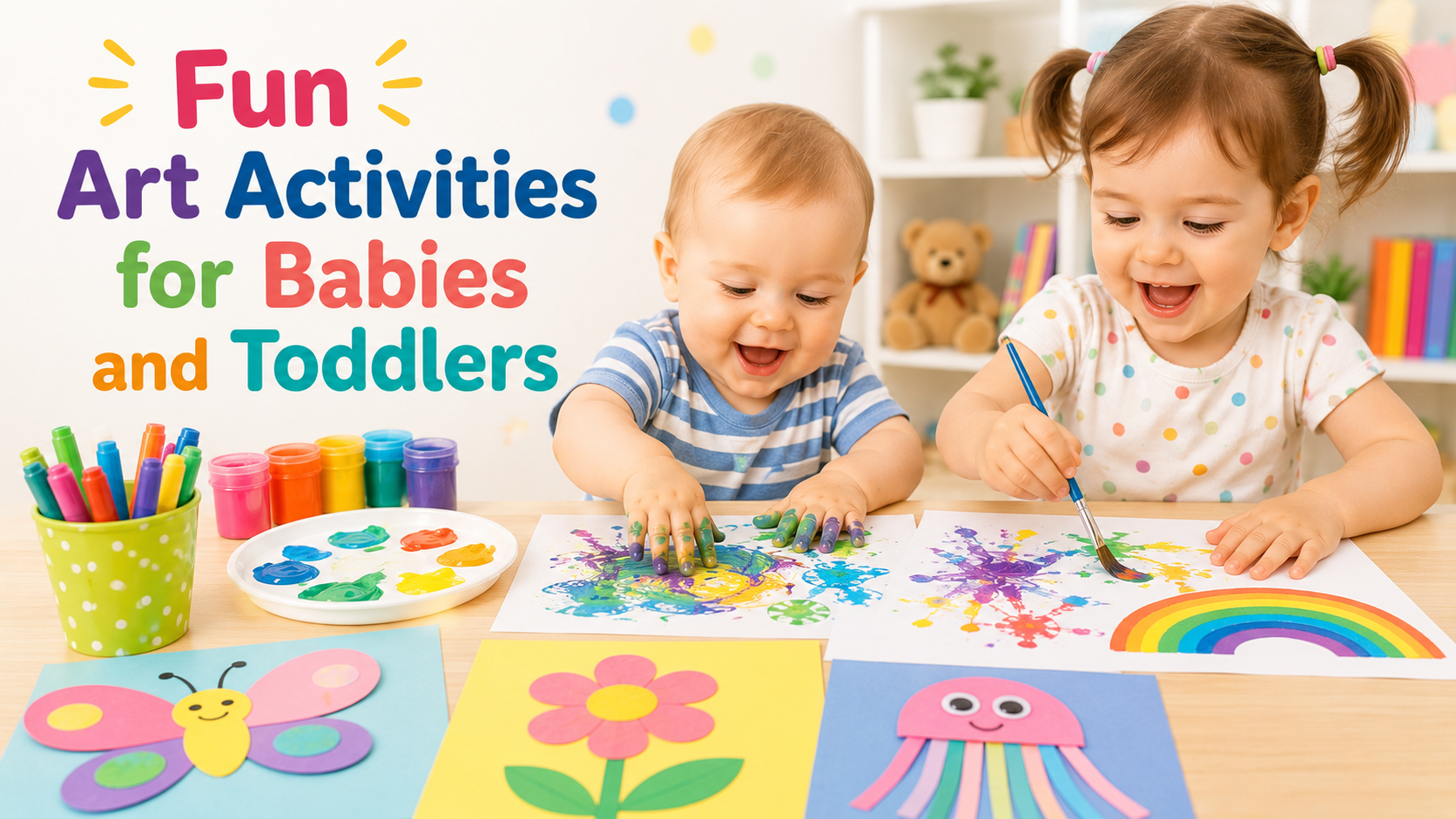

Doing art with one child is manageable. Doing it with a baby and a toddler at the same time — one who wants to focus and create, the other who wants to grab, mouth, and “help” — is a different challenge entirely. Most craft ideas online are written for a single age group, which is why they fall apart the moment a crawling baby gets within reach of a toddler’s carefully arranged project.
This guide is built specifically around that problem. Every activity below is either something both ages can genuinely do together, or a “parallel setup” that keeps a baby safely and happily occupied right next to an older sibling’s craft — without one wrecking the other’s.
Quick answer: The easiest combined activities are ones where the baby’s version is edible/sensory-based (like yogurt paint) while the toddler’s version uses real materials (like crayons or paint) at a separate station a few feet away — same activity, different execution, no conflict.
Two Ways to Combine Ages: Together vs. Parallel
There are really two different strategies here, and knowing which one you’re going for changes how you set up:
- Together activities — baby and toddler use the same materials, same space, same time. These work best when the materials are simple and safe enough for both ages (paint, big paper, water).
- Parallel activities — baby and toddler do a related but separate activity, side by side, so the toddler gets to focus without interruption while the baby stays engaged nearby. This works best when the toddler’s project uses small parts or requires concentration.
Neither approach is “better” — most parents end up switching between the two depending on the day and the specific project.
Safety Rules When Ages Are Mixed
The biggest risk in mixed-age crafting isn’t the activity itself — it’s a toddler’s materials ending up within a baby’s reach.
- Assume anything within your toddler’s arm’s reach is within your baby’s reach too, especially once your baby is crawling or cruising
- Small materials appropriate for a toddler (beads, pom-poms, small stickers) are still choking hazards for a baby under 3
- Set up the baby’s space first, then position the toddler’s materials on a raised surface (table, tray) out of the baby’s reach
- Keep a “toddler-only” bin of small-part supplies that’s put fully away, not just set down, when the activity ends
- Supervise both children directly — mixed-age sessions need more attention, not less, since both are moving at once
Activities Babies and Toddlers Can Truly Do Together
These use materials safe enough for the baby while still being engaging for the toddler.
1. Big Group Finger Painting Roll out a large sheet of craft paper on the floor. Both children finger paint on the same sheet — a toddler can make deliberate marks while a baby simply pats and smears.
2. Bubble Wrap Stomp-and-Press Tape a large sheet of painted bubble wrap to the floor. Toddlers can press it with hands or feet while a baby (if mobile) crawls over and pats it too.
3. Water Painting on Pavement Give both children a paintbrush and a cup of plain water to “paint” on an outdoor surface. Completely mess-free and safe for any age, including a baby who might try to taste the brush.
4. Shared Handprint Art Create a keepsake piece with both children’s handprints side by side — a genuinely bonding project, and simple enough that a baby only needs help holding still for a few seconds.
5. Contact Paper Collage Stick a large sheet of contact paper (sticky-side up) to a table. A toddler can arrange tissue paper deliberately while a baby presses on pieces without needing fine motor control.
6. Toddler-Made Contrast Cards for Baby A viral, genuinely useful idea: have your toddler draw simple black-and-white patterns with a marker, then use the finished cards as high-contrast visual stimulation for the baby during tummy time. It gives the toddler ownership and gives the baby a real sensory benefit from the “craft.”
7. Musical Painting Play music and let both children paint (finger painting for baby, brush painting for toddler) while moving to the rhythm — works as a shared sensory experience even though the actual output differs.
Parallel Setups (Same Activity, Different Station)
These keep both children engaged in a similar theme, without needing to share materials or space directly.
8. Painting: Baby Gets Yogurt, Toddler Gets Real Paint Set the baby up in a highchair with taste-safe yogurt paint, and the toddler at a nearby table with real washable paint. Same activity, same “we’re painting together” moment, zero risk of the baby getting into small caps or brush handles.
9. Playdough: Baby Squishes, Toddler Shapes Give the baby a large ball of taste-safe dough to squish with no tools, while the toddler uses cutters, rollers, and small tools at a separate station out of the baby’s reach.
10. Stickers: Baby Peels Big Ones, Toddler Makes a Scene Offer the baby a few oversized stickers to peel and press (with supervision), while the toddler builds a full sticker scene with smaller stickers on their own paper, kept out of the baby’s reach.
11. Collage: Baby Gets Contact Paper, Toddler Gets Glue The baby explores a sticky contact-paper surface with large fabric scraps, while the toddler uses a glue stick and cut paper shapes at a separate table — same “collage” concept, age-appropriate tools for each.
12. Crayons: Baby Gets Jumbo Crayons, Toddler Gets a Full Set Both children draw at the same table, but the baby only has access to 2–3 jumbo, chokeproof crayons, while the toddler’s full set stays on their side of the table.
How to Protect a Toddler’s Project from a Baby
If your toddler wants uninterrupted time to focus on a project with smaller parts, try:
- Give the baby their own “special job” nearby — even something unrelated, like a busy bag or sensory bin, at the same table so it feels shared without being shared
- Time it around your baby’s nap — many parents find the easiest way to give an older child focused craft time is simply scheduling it during the baby’s sleep window
- Use a highchair or playpen as a “safe base” for the baby with their own toys or snack, positioned near (not in) the toddler’s workspace
- Let your toddler help you set boundaries — asking “Can you show baby your painting from over there?” gives the toddler a sense of ownership and ends the interruption cheerfully instead of tearfully
Continue exploring: Baby-Safe Arts and Crafts Projects for Beginners, or browse the full Baby Activities hub.
Frequently Asked
Common Questions