
Most handprint and footprint attempts fail for the same reason: a smudged, half-formed print from a baby who clenched their fist or kicked at the wrong moment. Getting a clean print is a technique, not luck — and once you have it down, it opens up dozens of keepsake ideas beyond a plain print on paper.
This guide covers the technique first (how to actually get a clean print from a squirmy baby), then 15 ways to turn that print into something worth keeping.
Quick answer: The most reliable way to get a clean baby handprint is to attempt it right after a feeding, when your baby is relaxed and their fist is naturally open, using a hard surface like a clipboard and a helper to steady their hand.
Ink Pad vs. Paint vs. Clay: Which to Use
| Method | Mess Level | Best For | Notes |
|---|---|---|---|
| Washable paint | High | One-time art projects, vibrant color | Needs quick action before baby smears it |
| Mess-free ink pad | Low | Quick prints, cards, first attempts | Less vivid, but far easier to control |
| Air-dry clay | Medium | Permanent 3D keepsakes | One-shot — no do-overs if pressed wrong |
| Plaster casting kit | Medium | Detailed, long-lasting keepsakes | Best for babies who can hold still briefly |
If this is your first time attempting a print, start with a mess-free ink pad — it’s far more forgiving than paint while you’re still learning the technique.
How to Get a Clean Print, Step by Step
1. Time it right. Attempt the print right after a feeding, when your baby is relaxed. A fussy or overtired baby is far harder to work with than a calm, fed one. Some parents find naptime — right as a baby is drowsy but not yet asleep — works best of all.
2. Get a helper. A second person to steady your baby or hand you supplies makes this dramatically easier, especially for a first attempt.
3. Use a hard, flat surface. Tape your paper to a clipboard, hardcover book, or piece of cardboard. A soft surface (like a changing pad) makes it nearly impossible to get even pressure.
4. For handprints, gently massage the palm first. Newborns especially tend to keep their hand in a tight fist — a gentle massage from wrist to fingertips encourages it to relax open.
5. Apply the ink, paint, or clay evenly. Use a brush or the ink pad itself to coat the palm or sole fully, working heel-to-toe for feet.
6. Press with control, not force. Gently hold the wrist or ankle and press the hand or foot down in one smooth motion — heel to toe for feet, wrist to fingertips for hands — rather than stamping down hard.
7. Lift straight up. Pulling at an angle smears the print; lifting straight up preserves the clean edges.
8. Make more than one attempt. Have several sheets of paper ready — the second or third try is often the cleanest.
Common Mistakes That Ruin a Print
- Rushing. Trying to get the print too quickly, before your baby is settled, is the single biggest cause of smudged results.
- Using a soft or uneven surface underneath. Always back the paper with something rigid.
- Skin lotion or oils on the hand or foot. These prevent paint or ink from adhering evenly — wipe the skin dry first if lotion was applied earlier.
- Not labeling the print. Add the date underneath in permanent marker immediately — it’s easy to lose track of which print belongs to which month once you have several.
- Trying only once. Plan for several attempts rather than expecting a perfect print on the first try.
15 Handprint and Footprint Art Ideas
Simple Keepsakes
1. Dated Print Card — A plain print with the date and your baby’s name, kept in a baby book or framed as-is.
2. Framed Single Print — One clean print, matted and framed for a nursery wall.
3. Clay Handprint Ornament — Press your baby’s hand into air-dry clay for a permanent, 3D keepsake.
4. Plaster Casting Keepsake — A more detailed, longer-lasting alternative to clay, using a casting kit.
Turned Into Animals or Characters
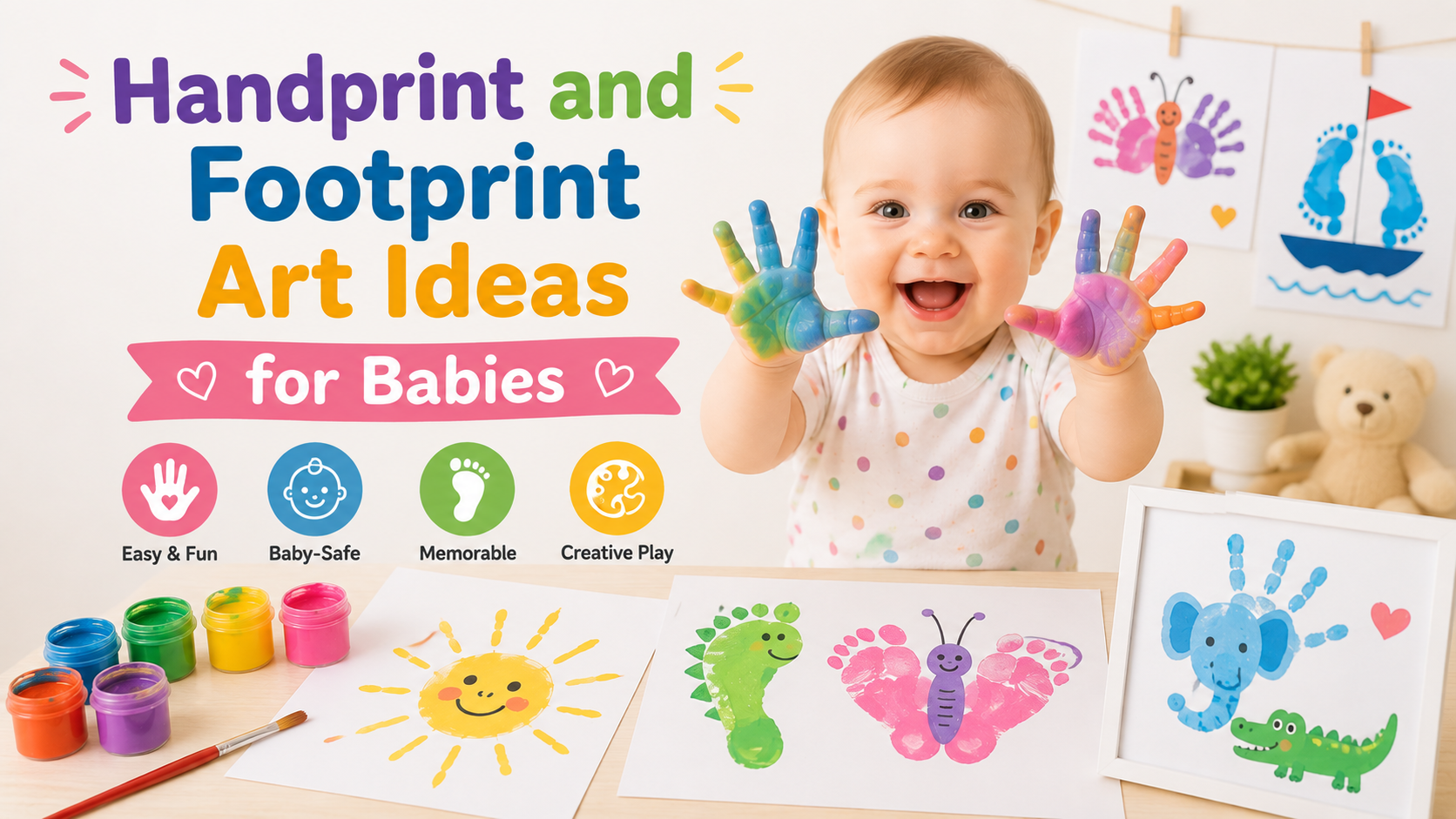
5. Handprint Bee or Dinosaur — Add drawn-on details (wings, spikes) once the print is dry to turn a simple handprint into a character. 6. Footprint Butterfly — Two footprints pressed side by side, wingtip to wingtip, become butterfly wings once dry.
7. Footprint Owl or Bird — A single footprint with drawn-on eyes and a beak becomes a simple bird shape.
Seasonal and Nature-Themed
8. Footprint Tree Trunk with Handprint Leaves — Use a footprint as the trunk and multiple handprints in seasonal colors (green, orange, white) as leaves.
9. Handprint Flower Bouquet — Multiple handprints in different colors arranged like blooms in a printed or drawn vase.
10. Footprint Wing Angel or Reindeer — Seasonal variations using the same footprint-as-wings or footprint-as-antler concept.
Gifts for Family
11. Handprint Card for Grandparents — A simple, dated print folded into a card — a fast, meaningful gift.
12. Canvas Wall Art — Photograph the finished print and have it printed onto a small canvas or wall tile as a lasting display piece.
13. Handprint Bowl (Older Toddlers) — Using polymer clay, press a handprint into a flattened disc and shape the edges up into a small bowl once your child is old enough to hold still longer.
Growth Tracking
14. Monthly Print Growth Chart — Take a print each month during the first year and arrange them side by side to visually track hand and foot growth.
15. Yearly Birthday Print Tradition — After the first year, switch to taking one print annually on your child’s birthday as an ongoing keepsake tradition.
How Often to Take Prints (Growth Tracking)
Many parents take handprints and footprints monthly during the first year, since growth is fastest and most visually dramatic during this stage. After age one, switching to a yearly tradition (often tied to a birthday) keeps the practice sustainable long-term without requiring monthly setup and cleanup.
Frequently Asked Questions
Gently massage the palm from wrist to fingertips just before applying paint or ink — this often encourages a clenched fist to relax open naturally.
Should I use paint or an ink pad for a baby’s first print? Start with a mess-free ink pad if this is your first attempt. It’s less vivid than paint but far easier to control while you’re still learning the technique.
Why do my baby’s prints keep coming out smudged? Smudging is almost always caused by lifting the hand or foot at an angle instead of straight up, or by rushing the press before your baby is settled.
Is it safe to use clay or plaster directly on a baby’s skin? Air-dry clay and baby-safe casting kits are generally safe for brief skin contact, but always check the product label for age recommendations and avoid anything that requires heat to set.
How often should I take my baby’s handprints and footprints? Monthly during the first year is common, since growth is most visible then; many families switch to a yearly tradition, often on the birthday, after that.
Continue exploring: browse the full Baby Activities hub.
Frequently Asked
Common Questions