
Newborns and young infants see the world differently than we do. Their vision is blurry, and they primarily detect high-contrast differences—especially bold black against white—rather than the full spectrum of colors. This is why high-contrast images and activities are such a powerful tool during tummy time. They capture attention, encourage head lifting, and support early visual and brain development while making those essential belly-down minutes more enjoyable.
Parents often search for “high contrast tummy time activities,” “black and white cards for tummy time,” or “how to use high contrast images with newborns” because these simple tools can transform a challenging session into focused, engaging play. Here’s how to use them effectively.
Why High Contrast Works So Well for Babies
In the first few months, a baby’s visual system is still developing. High-contrast patterns send stronger signals from the retina to the brain, helping strengthen visual pathways and improve focus. Research shows that time spent looking at these images supports visual perception and the brain’s ability to process what the eyes see.
During tummy time, the combination is especially effective. The interesting visual target motivates your baby to lift their head and chest higher and stay in the position longer. It also encourages visual tracking, head turning (which helps prevent flat spots), and early reaching as strength grows.
These activities are most impactful from birth through about 14 weeks, though many babies continue to enjoy them longer. As color vision improves around 4–5 months, you can gradually introduce brighter colors while still using high-contrast options.
Practical High Contrast Activities for Tummy Time
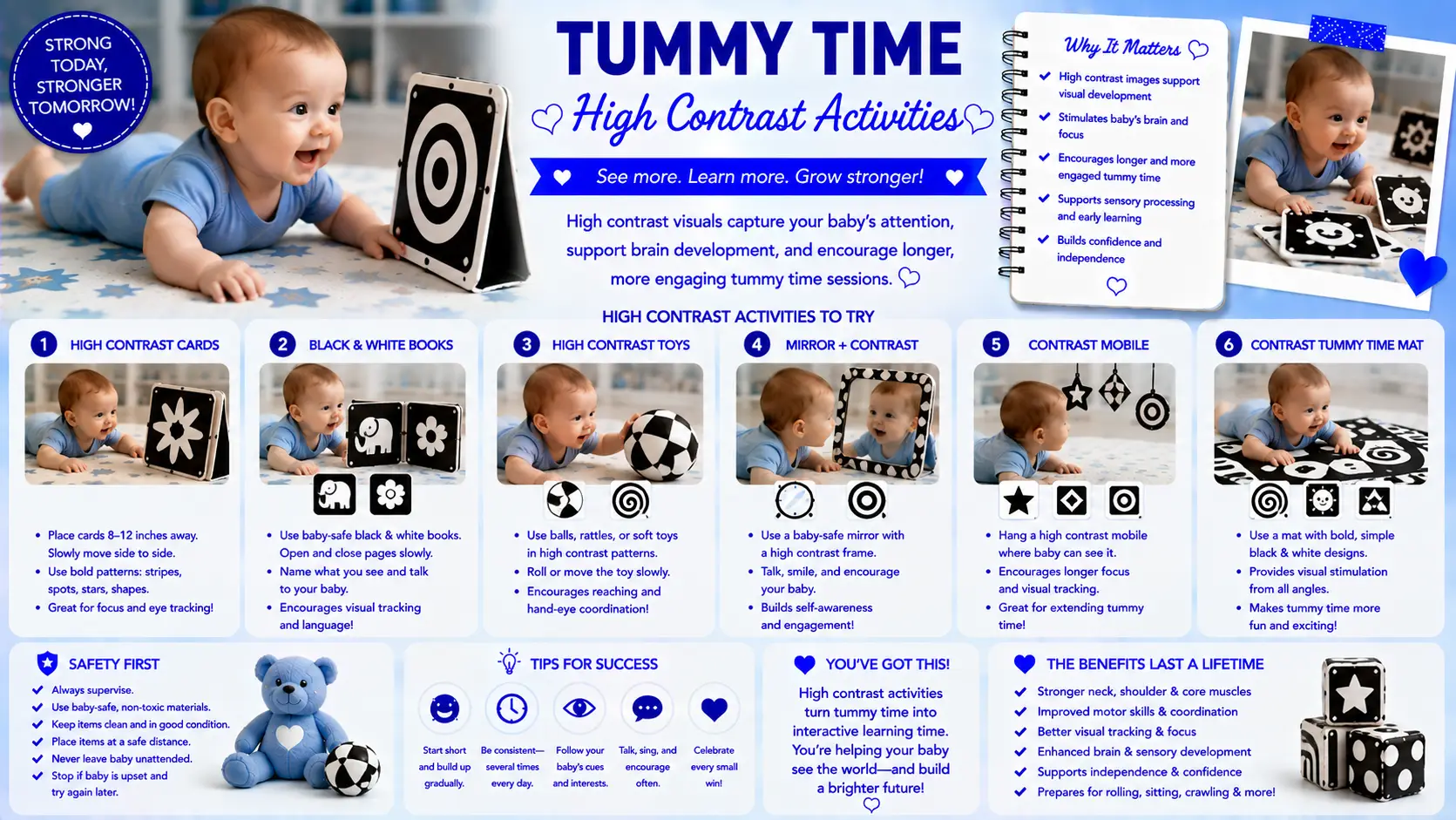
Floor-level card or image placement Place black-and-white cards or high-contrast prints on the floor just in front of your baby. When they lift their head even slightly, the bold patterns come into view. Start with simple geometric shapes or bold faces, then move to more complex designs as interest grows.
Supported thigh or lap play Lie your baby tummy-down across your thighs. Gently lift one leg higher so they can see a card held in their line of vision. Slowly raise the card to encourage a higher head lift. This position feels secure and gives you easy control over the visual target.
Standing card holder or propped images Use a small card stand, play gym holder, or simply prop cards against a soft toy or rolled towel. Position them so your baby sees the image when their head is turned to one side. Periodically switch the side your baby’s head rests on to promote balanced neck strength and reduce the risk of flat spots.
Tracking practice Hold a high-contrast card or black-and-white ball about 8–12 inches from your baby’s face. Move it slowly side to side or up and down. Watch as their eyes follow the movement—this builds visual tracking skills important for later reading and hand-eye coordination.
High-contrast books and soft toys Board books with bold black-and-white pages or soft books with contrasting patterns work beautifully. Prop the open book in front of your baby or hold the pages so they can focus while on their tummy. Some toys combine high-contrast designs with crinkle fabric or mirrors for multi-sensory appeal.
DIY and everyday options You don’t need store-bought materials. Print free high-contrast images, use black-and-white patterned fabric, or even show simple bold designs on a phone or tablet screen (kept at a safe distance and used briefly). Everyday contrasts—dark hair against a light shirt, window blinds, or ceiling fans—also naturally draw a newborn’s attention.
Tips for Success
Hold or place images roughly 8–12 inches from your baby’s face—the distance at which newborns see most clearly. Keep sessions short and positive. When your baby looks away, switch to a new image or take a break. Pair the visuals with your voice: describe what they see or simply talk softly to add a social element.
Rotate a few different cards or patterns so the experience stays fresh. Always supervise closely, and stop if your baby shows signs of overstimulation (turning away, fussing, or becoming glassy-eyed).
As your baby grows stronger, move the images slightly farther away or higher to challenge them to lift farther and reach. By 3–4 months, many babies begin combining high-contrast interest with reaching and pivoting on their tummy.
Choosing Materials
Look for sturdy, non-toxic cards or books with matte finishes to reduce glare. Rounded corners and soft edges are safer if your baby later tries to grasp them. Many popular sets include a range of simple to complex designs and double as part of a play gym or tummy time kit.
High-contrast activities offer a low-effort, high-reward way to support both vision and motor development. By giving your baby clear, interesting things to look at while on their belly, you help them build strength, focus, and early brain connections—all while making tummy time something they may actually want to do.
FAQ
Why are black and white high-contrast images best for newborns during tummy time?
Newborns have limited color vision and blurry focus. Bold black-and-white contrasts create the strongest visual signals, making it easier for them to see, focus, and stay engaged while building neck and upper-body strength.
How close should I hold high-contrast cards during tummy time?
About 8–12 inches from your baby’s face is ideal. This is the distance at which young infants see most clearly. Adjust slightly based on your baby’s response.
When should I start using high-contrast activities with my baby?
You can begin from the first days of life. High-contrast images are especially beneficial in the first 14 weeks, though many babies continue to enjoy them as their vision develops.
Can high-contrast cards help if my baby dislikes tummy time?
Yes. The engaging visuals often motivate babies to lift their heads and stay longer because they have something interesting to look at. Many parents find sessions become calmer and more productive with these tools.
Do I need special toys, or can I make my own high-contrast materials?
Both work well. Store-bought cards, books, and toys are convenient, but printed free high-contrast images, bold patterned fabric, or simple DIY cards are equally effective when used safely and under supervision.