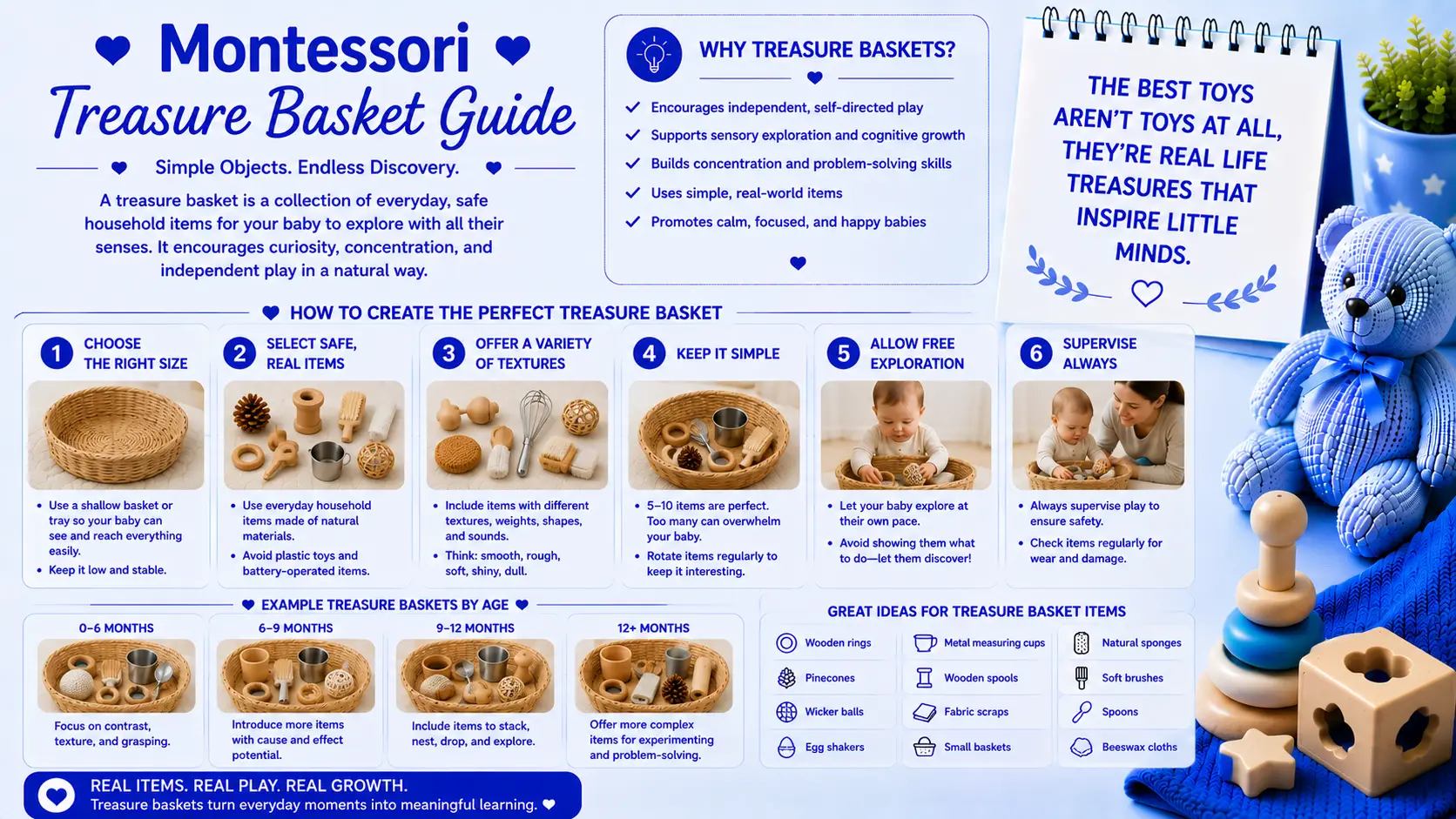

If you’ve come across the term “treasure basket” while researching Montessori activities for babies, it’s one of the simplest and most useful tools you can put together — and you probably already own everything you need. A Montessori treasure basket is just a container filled with everyday household objects, offered to a baby to explore freely, with no instructions and no “right” way to play.
This guide covers what a treasure basket is, when to introduce one, what to put in it, and how to keep it safe.
What Is a Montessori Treasure Basket?
A treasure basket is a low, sturdy basket or shallow bin filled with a variety of safe, everyday objects — think wooden spoons, fabric scraps, a whisk, a large seashell. The baby is placed nearby (usually sitting independently) and left to dig through, handle, and investigate the objects at their own pace, without an adult demonstrating or directing the play.
This concept, sometimes also called a “discovery basket” or “sensory basket,” comes from Elinor Goldschmied’s work on heuristic play, and it fits naturally into Montessori philosophy because it centers on independent, self-directed exploration rather than adult-led entertainment.
Why Treasure Baskets Matter
Babies learn about the world primarily through their senses — touch, taste (yes, mouthing included), sight, and sound. A well-stocked treasure basket gives a baby the chance to explore texture, weight, temperature, and shape entirely on their own terms.
Because it uses ordinary household objects rather than store-bought toys, a treasure basket is also one of the most budget-friendly Montessori activities you can offer. There’s no need to buy anything special — the “treasure” is often stuff already sitting in your kitchen or junk drawer.
When to Introduce a Treasure Basket
Most Montessori resources recommend introducing a treasure basket once a baby can sit up independently, typically somewhere between 6 and 9 months old. At this stage, babies have enough hand control to grasp and manipulate objects but aren’t yet mobile enough to wander off and get into things unsupervised.
That said, treasure baskets aren’t just for babies — toddlers and even preschoolers enjoy themed versions, especially when the objects are rotated to stay novel and interesting.
What to Put in a Montessori Treasure Basket
The best treasure baskets include a genuine variety of textures, weights, shapes, and materials. A few guiding categories to pull from:
Kitchen items: wooden spoons, a silicone whisk, measuring cups, a pastry brush, a small metal sieve
Bathroom items: a natural loofah, a soft hairbrush, a washcloth
Nature-based objects: large pinecones, smooth stones (too big to swallow), seashells, a piece of driftwood
Fabric and textiles: scarves, ribbon lengths, a small pom-pom, a piece of faux fur
Household odds and ends: a small tin, a large curtain ring, a set of keys on a ring, a cork
Many Montessori parents lean toward natural materials — wood, metal, cloth, and untreated wood — rather than brightly colored plastic, partly because babies mouth everything, and partly because natural materials simply offer more varied sensory feedback than uniform plastic toys.
Themed Treasure Basket Ideas
Once your baby has explored a general basket a few times, themed baskets can add variety and support specific concepts:
All one color – a basket of only red, or only blue, objects
Things that make noise – bells, a rain stick, a tin with dried beans sealed inside
Soft things – fabric scraps, cotton balls, a small stuffed toy
Round things – balls of different materials, a curtain ring, a bracelet
Kitchen basket – whisks, spoons, small pots, silicone spatulas
Rotating between a general basket and the occasional themed one keeps the activity fresh without requiring you to buy anything new.
Safety Guidelines for Treasure Baskets
Because babies explore with their mouths, safety is the most important part of putting a treasure basket together:
Size check: Every object should be too large to be a choking hazard — a good rule of thumb is that it shouldn’t fit entirely inside a toilet paper roll.
No loose parts: Avoid anything with small pieces that could detach, like buttons or beads that aren’t securely fixed.
Watch handle length: Items with long handles, such as whisks or wooden spoons, need supervision so a baby doesn’t poke themselves while sitting or reaching.
Avoid harsh materials: Skip anything with sharp edges, splinters, lead paint, or toxic finishes.
Always supervise. Even with a carefully curated basket, treasure basket play should happen with an adult nearby, not left unattended.
How to Offer a Treasure Basket
Place the basket within easy reach of your baby, either on the floor or a low shelf, and simply let them explore. Resist the urge to demonstrate “the right way” to use each object — the whole point is open-ended, baby-led discovery. If your baby uses an object in a way you didn’t expect, that’s not a problem to correct; it’s exactly the kind of independent exploration a treasure basket is meant to encourage.
As your baby gets older and starts to babble or talk, you can begin naming objects as they pick them up, adding simple vocabulary without turning the activity into a structured lesson.
Final Thoughts
A Montessori treasure basket is one of the easiest, lowest-cost ways to bring Montessori principles into your home. With a basket, a handful of safe household objects, and a little patience, you can offer your baby a genuinely rich sensory experience — no special toys required.
FAQ
What age is best for a Montessori treasure basket?
Most treasure baskets are introduced once a baby can sit independently, typically around 6 to 9 months, though toddlers and preschoolers can enjoy themed versions too.
What household items are safe to put in a treasure basket?
Wooden spoons, metal whisks, fabric scraps, large seashells, and pinecones are all common choices. The key is avoiding anything small enough to be a choking hazard or with detachable parts.
How many objects should be in a treasure basket?
There’s no fixed number, but somewhere between 8 and 15 varied objects gives a baby enough to explore without being overwhelming.
Do treasure basket objects need to be natural materials?
Not strictly, but many Montessori parents favor natural materials like wood, metal, and cloth over plastic, since they offer more varied textures and are less likely to contain harsh chemicals.
How often should I rotate items in the treasure basket?
Rotate objects whenever your baby seems to lose interest, often every one to two weeks, and swap in new household finds to keep the exploration fresh.