
It’s tempting to think Montessori “practical life” work belongs to preschoolers with tiny brooms and pitchers. But long before a child can sweep a floor, practical life activities for babies are already quietly happening — in diaper changes, mealtimes, and the ordinary rhythm of a day. The Montessori approach treats even infants as capable participants in real life, not passive bystanders waiting to grow into it.
This guide breaks practical life down by category rather than age, so you can pick activities based on what your baby seems ready for right now, whatever stage that happens to be.
What Is Practical Life in Montessori?
Practical life is one of the four core areas of the Montessori curriculum, alongside sensorial, language, and math. It refers to real, purposeful, everyday tasks, as opposed to toys or games designed purely for entertainment. Maria Montessori organized this work into a few main categories:
Care of self – feeding, dressing, washing
Care of the environment – tidying, wiping, watering plants
Preliminary exercises – foundational movements like carrying, pouring, and transferring
Grace and courtesy – simple social gestures like waving or passing objects gently
For babies, these categories look far simpler than they do for a 3-year-old, but the underlying goal is the same: building competence and independence through real participation.
Care of Self Activities for Babies
Care of self is usually the easiest category to start with, since it happens naturally throughout the day.
Diaper changes as participation, not just maintenance. Narrate each step (“I’m lifting your legs now”) and pause to let your baby help where they can, like holding still or pushing a leg through.
Hand and face washing. Even a young baby can start to associate a warm washcloth with a simple self-care routine.
Dressing assistance. Around 9–12 months, babies can begin pushing an arm through a sleeve or holding a leg still for socks.
Self-feeding. Offering soft finger foods and a small open cup around 6 months invites independence at mealtimes, well before a baby has full spoon control.
Care of the Environment Activities for Babies
This category introduces babies to the idea that they can affect and care for the world around them, not just be cared for.
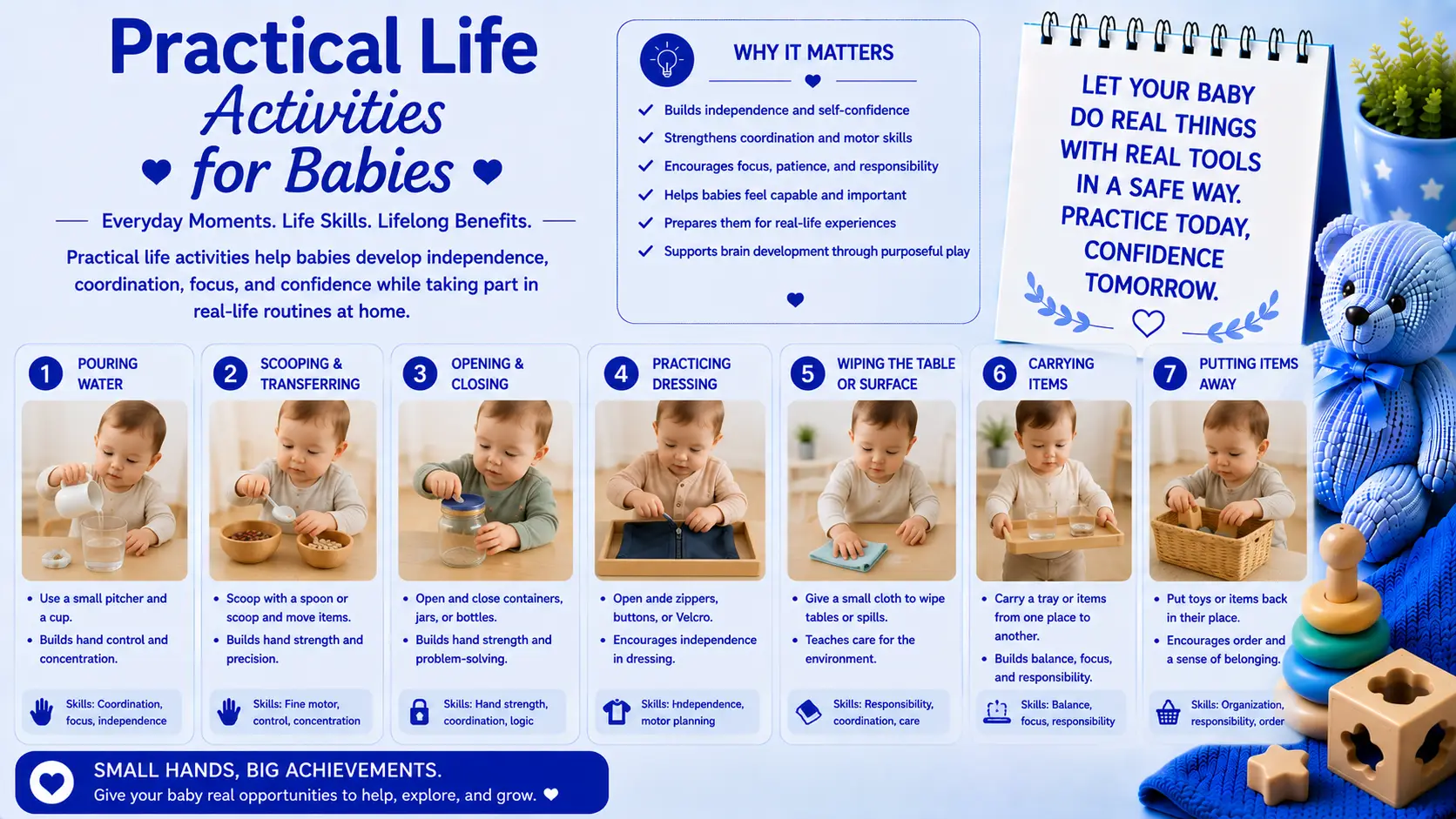
Object retrieval. Helping put a toy back on a low shelf after playing, even if it’s just one item, builds an early sense of order.
Simple cleanup. Handing a baby a cloth to pat at a spill (even if it doesn’t actually clean much) starts building the habit early.
Watering a plant. With a small pitcher and close supervision, even a young toddler can pour a little water onto a sturdy houseplant.
Sorting laundry. Around 12 months, babies enjoy dropping items like socks into a basket, which doubles as a practical life and fine motor activity.
Preliminary Exercises: The Foundational Movements
Montessori identifies certain basic movements as building blocks for almost everything else a child will do. These preliminary exercises can start surprisingly early:
Carrying. Letting a baby carry a light, sturdy object (like a small basket) across the room builds coordination and confidence.
Transferring. Moving objects from one container to another, whether it’s blocks into a bin or spoons between bowls, is one of the most valuable early practical life tasks.
Pouring. Around 12–18 months, a small pitcher with a little water or rice, poured between two cups, becomes a favorite repeatable activity.
Opening and closing. Simple containers with lids give babies a satisfying, self-correcting task that builds wrist control.
Grace and Courtesy for Babies
Grace and courtesy might sound like an older-child concept, but the seeds are planted early through modeling, not instruction:
Waving hello and goodbye
Gently passing an object rather than throwing it
Saying simple words like “please” and “thank you” as a baby begins babbling, even before they fully understand them
Babies absorb social patterns long before they can perform them, so consistent, gentle modeling matters more than direct teaching at this stage.
How to Introduce Practical Life Without Overwhelming Your Baby
Start with what they’re already trying to do. If your baby keeps reaching for the spoon during mealtime, that’s your cue, not a schedule on a chart.
Use real, appropriately sized tools. A small pitcher, a soft-bristled brush, or blunt toddler utensils work better than pretend plastic versions, since real tools give real feedback.
Expect it to be slower and messier than doing it yourself. That’s not a sign you’re doing it wrong — it’s the whole point. Building the skill takes longer than skipping it.
Keep sessions short. A few minutes of genuine participation is worth far more than a long, adult-paced task a baby loses interest in halfway through.
Final Thoughts
Practical life activities for babies aren’t about turning your infant into a tiny assistant. They’re about recognizing that babies want to participate in real life, not just watch it happen around them. Starting with small, real tasks — carrying, transferring, self-feeding, simple care routines — builds the foundation for the independence and confidence Montessori is best known for.
FAQ
What’s the earliest age to start practical life activities with a baby?
You can begin as early as birth with observational practical life, like narrating diaper changes and feeding. Hands-on tasks generally start once a baby can sit independently, around 6 months.
Do practical life activities require special Montessori equipment?
No. Most practical life work for babies uses ordinary household items, like small pitchers, washcloths, and real (child-sized) utensils, rather than purchased materials.
How is practical life different from a typical baby toy?
Practical life activities involve real, purposeful tasks with a genuine outcome, like pouring water or tidying a toy, rather than toys designed mainly for entertainment or passive play.
Should I correct my baby if they do a practical life task “wrong”?
Generally, no. Montessori practical life is about allowing exploration and repetition; gentle modeling works better than correcting a baby mid-task.
How often should I offer practical life activities?
There’s no strict schedule. Weaving small opportunities into daily routines, like mealtimes, diaper changes, and tidying up, tends to work better than setting aside separate structured sessions.