Skip to content
DidYouSearch DidYouSearch
  • did you search?
  • Baby Plus+
    • Baby Activities
      • Arts & Crafts
      • Indoor Activities
      • Montessori
      • Music
      • Outdoor Activities
      • Reading
      • Sensory Play
      • Tummy Time
    • Baby Development
      • Brain Development
      • Cognitive Development
      • Emotional Development
      • Fine Motor Skills
      • Growth Milestones
      • Monthly Milestones
      • Motor Skills
      • Physical Development
      • Social Development
      • Speech Development
    • Baby Feeding
      • Allergies
      • Baby Led Weaning
      • Bottle Feeding
      • Breast feeding
        • Breastfeeding Diet
        • Breastfeeding Positions
        • Latch Problems
        • Low Milk Supply
        • Mastitis
        • Pumping Schedule
        • Weaning
      • Burping
      • Cluster Feeding
      • Feeding Schedule
      • Formula Feeding
        • Formula Amount
        • Formula Brands
        • Formula Comparison
        • Formula Preparation
        • Formula Storage
      • Hydration
      • Pumping
      • Solid Foods
    • Baby Gear Reviews
      • Best Baby Carrier
      • Best Baby Monitor
      • Best Baby Strollers
      • Best Bottles
      • Best Breast Pump
      • Best Car Seat
      • Best Cribs
      • Best Diapers
      • Best Formula
      • Best Toys
    • Baby Growth
      • Growth Spurts
      • Height Charts
      • Monthly Growth
      • Percentiles
      • Weight Charts
    • Baby Health
      • Allergies
      • Cold
      • Constipation
      • Cough
      • Diarrhea
      • Ear Infection
      • Fever
      • Flu
      • Pediatric Visits
      • Rashes
      • Teething
      • Vaccines
      • Vomiting
    • Baby Nutrition
      • Dairy
      • Drinks
      • Eggs
      • Fish
      • Fruits
      • Healthy Recipes
      • Meat
      • Snacks
      • Vegetables
      • Vitamins
    • Baby Products
      • Baby Carriers
      • Bassinets
      • Bottles
      • Breast Pumps
      • Car Seats
      • Cribs
      • Diaper Bags
      • High Chairs
      • Monitors
      • Strollers
      • Swings
      • Toys
      • Walkers
    • Baby Recipes
      • BLW Recipes
      • Breakfast
      • Dinner
      • Finger Foods
      • Lunch
      • Purees
      • Snacks
    • Baby Safety
      • Baby Proofing
      • Car Seats
      • Choking Hazards
      • CPR
      • Home Safety
      • Poison Prevention
      • Safe Sleep
      • Sun Protection
      • Water Safety
  • Baby Names
    • Boy Names
    • Girl Names
    • American baby boy names
    • American baby girl names
    • Biblical Names
    • Middle Names
    • Modern Names
    • Short Names
    • Unique Names
    • Unisex Names
  • Recommended
    • Baby Shopping
      • Baby Registry
      • Budget Baby Shopping
      • Hospital Bag
      • Must Have Products
      • Newborn Checklist
      • Nursery Ideas
    • Baby Sleep
      • Bedtime Routine
      • Co Sleeping
      • Crib Safety
      • Nap Schedules
      • Night Wakings
      • Sleep Environment
      • Sleep Products
      • Sleep Regression
      • Sleep Training
      • Wake Windows
      • White Noise
    • Childcare
      • Daycare
      • Babysitters
      • Kindergarten
      • Nannies
      • Preschool
    • Newborn Care
      • Nail Care
      • Baby Hygiene
      • Bathing
      • Crying
      • Diapering
      • Ear Care
      • Eye Care
      • Skin Care
      • Soothing Techniques
      • Temperature
      • Umbilical Cord
    • Special Needs
      • Premature Babies
      • Autism Signs
      • Developmental Delays
      • Down Syndrome
      • NICU
      • Twins
    • Seasonal Baby Care
      • Spring
      • Summer
      • Travel
      • Fall
      • Holidays
      • Winter
  • Parenting
    • Bonding
    • Discipline
    • Emotional Intelligence
    • First Time Parents
    • Gentle Parenting
    • Positive Parenting
    • Routines
    • Single Parents
    • Working Parents
  • Pregnancy
    • Pregnancy Complications
    • Labor & Delivery
    • Postpartum Recovery
    • Pregnancy Exercises
    • Pregnancy Medications
    • Pregnancy Nutrition
    • Pregnancy Sleep
    • Pregnancy Symptoms
    • Pregnancy Tests
    • Pregnancy Vitamins
    • Pregnancy Weeks
  • Toddler
    • Preschool
    • Speech
    • Tantrums
    • Toddler Food
    • Toddler Sleep
    • Behavior
    • Independence
    • Learning
    • Potty Training
  • Traveling with Baby
    • Road Trips
    • Beach
    • Camping
    • Flying
    • Hotels
    • Packing Lists
  • did you search?
  • Baby Plus+
    • Baby Activities
      • Arts & Crafts
      • Indoor Activities
      • Montessori
      • Music
      • Outdoor Activities
      • Reading
      • Sensory Play
      • Tummy Time
    • Baby Development
      • Brain Development
      • Cognitive Development
      • Emotional Development
      • Fine Motor Skills
      • Growth Milestones
      • Monthly Milestones
      • Motor Skills
      • Physical Development
      • Social Development
      • Speech Development
    • Baby Feeding
      • Allergies
      • Baby Led Weaning
      • Bottle Feeding
      • Breast feeding
        • Breastfeeding Diet
        • Breastfeeding Positions
        • Latch Problems
        • Low Milk Supply
        • Mastitis
        • Pumping Schedule
        • Weaning
      • Burping
      • Cluster Feeding
      • Feeding Schedule
      • Formula Feeding
        • Formula Amount
        • Formula Brands
        • Formula Comparison
        • Formula Preparation
        • Formula Storage
      • Hydration
      • Pumping
      • Solid Foods
    • Baby Gear Reviews
      • Best Baby Carrier
      • Best Baby Monitor
      • Best Baby Strollers
      • Best Bottles
      • Best Breast Pump
      • Best Car Seat
      • Best Cribs
      • Best Diapers
      • Best Formula
      • Best Toys
    • Baby Growth
      • Growth Spurts
      • Height Charts
      • Monthly Growth
      • Percentiles
      • Weight Charts
    • Baby Health
      • Allergies
      • Cold
      • Constipation
      • Cough
      • Diarrhea
      • Ear Infection
      • Fever
      • Flu
      • Pediatric Visits
      • Rashes
      • Teething
      • Vaccines
      • Vomiting
    • Baby Nutrition
      • Dairy
      • Drinks
      • Eggs
      • Fish
      • Fruits
      • Healthy Recipes
      • Meat
      • Snacks
      • Vegetables
      • Vitamins
    • Baby Products
      • Baby Carriers
      • Bassinets
      • Bottles
      • Breast Pumps
      • Car Seats
      • Cribs
      • Diaper Bags
      • High Chairs
      • Monitors
      • Strollers
      • Swings
      • Toys
      • Walkers
    • Baby Recipes
      • BLW Recipes
      • Breakfast
      • Dinner
      • Finger Foods
      • Lunch
      • Purees
      • Snacks
    • Baby Safety
      • Baby Proofing
      • Car Seats
      • Choking Hazards
      • CPR
      • Home Safety
      • Poison Prevention
      • Safe Sleep
      • Sun Protection
      • Water Safety
  • Baby Names
    • Boy Names
    • Girl Names
    • American baby boy names
    • American baby girl names
    • Biblical Names
    • Middle Names
    • Modern Names
    • Short Names
    • Unique Names
    • Unisex Names
  • Recommended
    • Baby Shopping
      • Baby Registry
      • Budget Baby Shopping
      • Hospital Bag
      • Must Have Products
      • Newborn Checklist
      • Nursery Ideas
    • Baby Sleep
      • Bedtime Routine
      • Co Sleeping
      • Crib Safety
      • Nap Schedules
      • Night Wakings
      • Sleep Environment
      • Sleep Products
      • Sleep Regression
      • Sleep Training
      • Wake Windows
      • White Noise
    • Childcare
      • Daycare
      • Babysitters
      • Kindergarten
      • Nannies
      • Preschool
    • Newborn Care
      • Nail Care
      • Baby Hygiene
      • Bathing
      • Crying
      • Diapering
      • Ear Care
      • Eye Care
      • Skin Care
      • Soothing Techniques
      • Temperature
      • Umbilical Cord
    • Special Needs
      • Premature Babies
      • Autism Signs
      • Developmental Delays
      • Down Syndrome
      • NICU
      • Twins
    • Seasonal Baby Care
      • Spring
      • Summer
      • Travel
      • Fall
      • Holidays
      • Winter
  • Parenting
    • Bonding
    • Discipline
    • Emotional Intelligence
    • First Time Parents
    • Gentle Parenting
    • Positive Parenting
    • Routines
    • Single Parents
    • Working Parents
  • Pregnancy
    • Pregnancy Complications
    • Labor & Delivery
    • Postpartum Recovery
    • Pregnancy Exercises
    • Pregnancy Medications
    • Pregnancy Nutrition
    • Pregnancy Sleep
    • Pregnancy Symptoms
    • Pregnancy Tests
    • Pregnancy Vitamins
    • Pregnancy Weeks
  • Toddler
    • Preschool
    • Speech
    • Tantrums
    • Toddler Food
    • Toddler Sleep
    • Behavior
    • Independence
    • Learning
    • Potty Training
  • Traveling with Baby
    • Road Trips
    • Beach
    • Camping
    • Flying
    • Hotels
    • Packing Lists
Close

Search

Home/Baby Activities/Montessori/Montessori Sensory Activities
Montessori

Montessori Sensory Activities

By DrAdam
August 12, 2026 4 Min Read
0

Montessori sensory activities (often called sensorial activities) help young children refine their senses through purposeful, hands-on exploration. Maria Montessori recognized that children absorb the world most powerfully through sight, sound, touch, smell, and taste in the early years. These experiences build concentration, vocabulary, discrimination skills, and a foundation for later math, language, and science learning.

Unlike random sensory play, Montessori-inspired versions isolate one quality at a time (for example, texture or color), encourage repetition, and use real or carefully prepared materials. Parents searching for “Montessori sensory activities for toddlers,” “easy Montessori sensorial activities at home,” or “Montessori sensory activities for babies” will find that many of the best options require little more than household items or natural objects.

Why Montessori Sensorial Work Matters

Contents hide
1 Why Montessori Sensorial Work Matters
2 Practical Montessori Sensory Activities You Can Try at Home
3 Tips for Success at Home
4 FAQ
4.1 What are Montessori sensory activities?
4.2 What age are Montessori sensory activities suitable for?
4.3 How do Montessori sensorial activities differ from regular sensory play?
4.4 What are the main benefits of Montessori sensory activities?
4.5 Can I do effective Montessori sensory activities without buying special materials?

Sensorial activities sharpen a child’s ability to notice fine differences. A child who has matched sound cylinders or graded textures develops clearer perception and stronger focus. Benefits include improved fine-motor control, richer descriptive language (“rough,” “smooth,” “loud,” “soft”), early classification skills, and greater independence. These experiences also support emotional regulation—many children find calm in repetitive pouring, sorting, or nature exploration.

The approach works especially well for ages 0–6, with adaptations for infants (treasure baskets), toddlers (simple matching and transferring), and preschoolers (more precise grading and naming).

Practical Montessori Sensory Activities You Can Try at Home

Here are accessible, high-impact ideas drawn from common classroom practices and home adaptations.

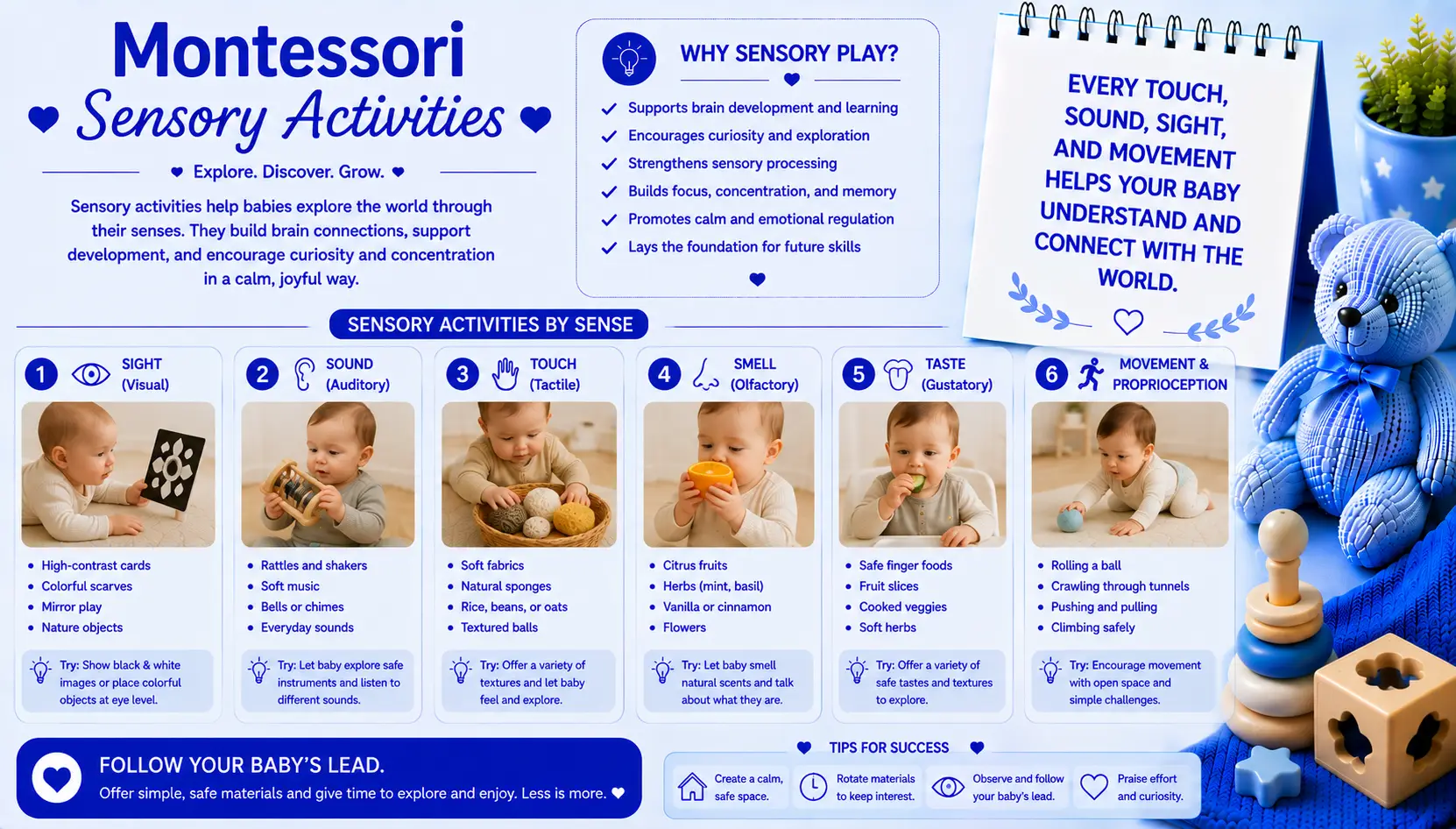
Treasure baskets and discovery baskets Fill a low basket with safe, interesting everyday objects: wooden spoons, metal measuring cups, fabric scraps of different textures, a smooth stone, a pinecone, a soft brush. For babies and young toddlers, this is pure sensory exploration. Older toddlers can match pairs or describe what they feel. Rotate the contents every week or two to keep interest high.

Texture exploration Create a simple sensory box or fabric basket with pairs of materials—velvet, sandpaper, silk, wool, smooth wood, rough bark. Invite the child to feel each one with eyes open, then try matching with eyes closed or while looking away. Nature walks supply free materials: leaves, bark, pebbles, and soil offer endless tactile variety.

Sound activities Make DIY sound cylinders or shakers by filling identical containers (small jars or bottles) with pairs of materials such as rice, beans, sand, or bells. The child shakes and matches the pairs by sound alone. Sound walks outdoors—listening for birds, wind, traffic, or footsteps—extend the work naturally. A “silent game” of sitting quietly for short periods builds auditory attention.

Smell bottles Saturate cotton balls with different scents (vanilla, lemon, cinnamon, lavender, coffee) and place them in small opaque or covered containers. Children smell and match pairs or simply name the familiar aromas. Herbs from the kitchen or garden work equally well and connect to real cooking experiences.

Color and visual discrimination Use colored blocks, pom-poms, socks, or household objects for sorting by color. Start with primary colors and progress to shades. Nesting cups or stacking rings introduce size ordering. Simple knobbed puzzles or shape sorters refine visual discrimination and fine-motor precision.

Taste experiences Offer small samples of the basic tastes—sweet (apple or honey), sour (lemon), salty, bitter (a tiny bit of dark chocolate or plain yogurt), and umami (mild cheese or mushroom). Talk about the flavors. Exploring whole fruits and vegetables in a produce basket combines taste, smell, and touch.

Water and transferring work Pouring water between small pitchers, transferring stones or beans with the hands or a spoon, and simple water play refine control of movement while engaging multiple senses. These activities double as practical-life practice.

Outdoor and seasonal exploration Nothing replaces time outside. Feeling grass, wind, rain, or snow; listening to birds; smelling flowers or pine; and collecting natural objects provide rich, multi-sensory input that indoor materials cannot fully replicate.

Many of these ideas appear repeatedly in popular resources because they are effective, low-cost, and adaptable. Classic Montessori materials such as the pink tower, sound cylinders, fabric boxes, or smelling bottles follow the same principles and can be introduced when a child shows readiness, usually in the toddler-to-preschool years.

Tips for Success at Home

Offer one activity at a time in a calm, prepared space.

Demonstrate slowly and briefly, then step back.

Use precise language and let the child lead.

Prioritize real materials over plastic when possible.

Accept that exploration can be messy—place a mat or towel underneath.

Follow the child’s interest and developmental stage rather than a rigid schedule.

These activities support the sensitive periods for sensory refinement that Montessori identified, helping children order and understand their world.

FAQ

What are Montessori sensory activities?

They are purposeful experiences designed to isolate and refine one sense at a time—sight, hearing, touch, smell, or taste—using carefully chosen materials. The goal is discrimination, concentration, and vocabulary rather than open-ended mess play alone.

What age are Montessori sensory activities suitable for?

They begin in infancy with treasure baskets and continue through the early elementary years. Most home activities work especially well for babies, toddlers, and preschoolers (roughly 6 months to 6 years), with increasing complexity as the child develops.

How do Montessori sensorial activities differ from regular sensory play?

Montessori versions usually isolate one quality, invite repetition and precise matching or grading, and often include language. Regular sensory bins can be valuable for exploration and practical life but may engage multiple senses simultaneously without the same structured refinement.

What are the main benefits of Montessori sensory activities?

They build sensory discrimination, concentration, fine-motor skills, descriptive language, classification ability, and a foundation for academic learning. Many children also gain calm and confidence through successful, self-directed work.

Can I do effective Montessori sensory activities without buying special materials?

Yes. Household items, kitchen tools, natural objects from outside, fabric scraps, spices, and simple containers cover most of the core experiences. Store-bought Montessori materials are helpful but not required for meaningful sensorial work at home.


Author

DrAdam

Dr. Adam. Obstetrician and Gynecologist

Follow Me
Other Articles
Previous

Practical Life Activities for Babies

Next

Montessori Language Activities

No Comment! Be the first one.

Leave a Reply Cancel reply

Your email address will not be published. Required fields are marked *

What is Did You Search?

The “Did You Search” website was created for all mothers and families. Just search to find all your needs about your children.

Links

  • about
  • contact
  • privacy policy
  • medical disclaimer
  • sitemap
Copyright 2026 — DidYouSearch. All rights reserved.