
Montessori language activities help children develop spoken and written language through concrete, hands-on experiences rather than worksheets or drills. In the Montessori approach, language learning begins with rich oral experiences, moves into sound awareness, and gradually prepares the child for writing and reading. Parents looking for “Montessori language activities for toddlers,” “Montessori language materials at home,” or “easy Montessori reading activities” will find that many of the most effective ideas use everyday objects, clear speech, and short, purposeful play.
Maria Montessori observed that children absorb language effortlessly in the early years. The materials and activities isolate one skill at a time—vocabulary, phonemic awareness, letter-sound connections, or word building—and move from concrete to abstract. This sequence supports strong listening, speaking, reading, and writing foundations without pressure.
Why Montessori Language Work Matters
These activities build vocabulary through real objects and conversations, develop phonemic awareness (the ability to hear and play with sounds in words), strengthen fine-motor skills needed for writing, and foster a natural love of books and communication. Children gain confidence as they succeed with materials that have a clear beginning, middle, and end. Daily reading, naming objects, and simple sound games create a language-rich environment that research and classroom practice both support.
The work suits ages roughly 1–6, with simple naming and matching for toddlers and more advanced letter and word work for preschoolers.
Practical Montessori Language Activities for Home
Here are accessible activities that appear consistently across high-quality Montessori resources.
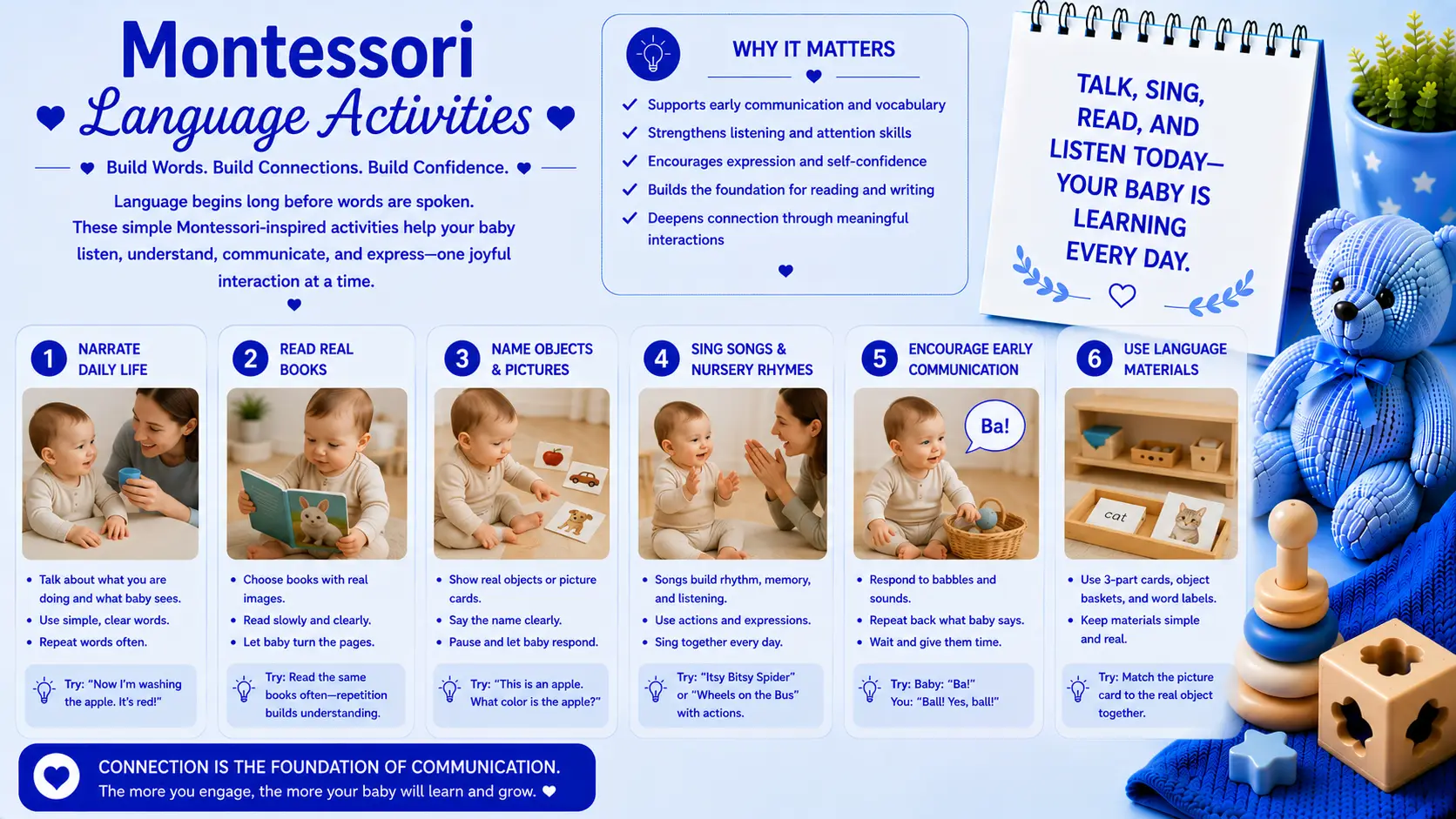
Object baskets and vocabulary work Fill a small basket with 4–8 familiar objects from one category—kitchen tools, animals, clothing, or nature items. Name each object clearly, pause, and invite the child to explore and repeat. Later, ask the child to “show me the spoon” or “give me the pinecone.” This is one of the highest-value Montessori language activities for toddlers and builds both receptive and expressive vocabulary.
Picture-to-object matching and language cards Pair real objects with clear photo cards, or use sets of classified picture cards (fruits, vehicles, body parts). Children match object to picture or picture to picture. Three-period lessons work well here: name the items, ask the child to point to one, then ask “What is this?” These activities expand vocabulary and teach that pictures represent real things.
Sound games and “I Spy” Place a few familiar objects on a tray. Say, “I spy something that starts with /b/” (use the pure sound, not the letter name). The child finds the matching object. Start with beginning sounds and keep sessions short. Sound pouches or baskets sorted by initial sound offer another variation. These games develop phonemic awareness, a critical pre-reading skill.
Sandpaper letters These tactile cards let children feel the shape of a letter while saying its sound. Trace the letter with two fingers while clearly pronouncing the sound. Introduce only a few at a time. Sandpaper letters connect the visual, tactile, and auditory senses and prepare the hand and mind for writing.
Movable alphabet and early word building Once a child knows several letter sounds, the movable alphabet allows them to “write” words by arranging letters without the motor demand of pencil work. Begin with simple phonetic (CVC) words and a picture prompt. This is a bridge between knowing sounds and reading or writing independently.
Reading, storytelling, and conversation Daily shared reading remains one of the most powerful language activities. Choose books with clear illustrations, rich language, and relatable themes. Tell stories, sing songs, recite poems, and narrate everyday routines. Vocabulary walks—naming furniture, plants, or foods while moving through the house or neighborhood—also enrich language naturally.
Pre-writing preparation Metal insets, tracing, playdough, and simple drawing strengthen the hand. In Montessori, children typically develop writing skills before fluent reading because the hand and mind are prepared through these concrete experiences.
Tips for Success at Home
Keep activities short and follow the child’s interest. Use precise, clear language and model rather than quiz constantly. Offer real objects whenever possible. Rotate materials so the language shelf stays inviting but not overwhelming. Focus first on oral language and sound awareness before introducing letters. Consistency and rich conversation matter more than perfect materials.
These ideas require little specialized equipment. Household items, printed photos, a few baskets, and books cover most of the early work. Classic materials such as sandpaper letters and the movable alphabet can be added later when the child shows readiness.
FAQ
What are Montessori language activities?
They are hands-on experiences that develop spoken language, sound awareness, vocabulary, and the foundations of reading and writing. Activities progress from real objects and conversation to tactile letters and word building, always moving from concrete to abstract.
At what age should I start Montessori language activities?
Oral language work begins in infancy through talking, reading, and naming. Object baskets and matching suit toddlers (around 1–3 years). Sound games often become engaging around 2.5–3 years, and sandpaper letters or the movable alphabet typically appear between 3 and 5 years, depending on the individual child.
Do I need expensive Montessori language materials?
No. Object baskets, photo cards, everyday items for sound games, books, and clear adult speech form the core of home language work. Sandpaper letters and a movable alphabet are helpful later but are not required to begin.
What is the difference between Montessori language activities and traditional early literacy?
Montessori emphasizes phonemic awareness and writing preparation before formal reading, uses concrete materials with a control of error, and prioritizes the child’s interest and readiness. Traditional approaches sometimes introduce letter names or worksheets earlier and rely more on adult-directed instruction.
How can I support language development every day without special activities?
Talk with your child throughout the day, read books together, narrate routines, sing songs, play simple sound games during walks or mealtimes, and give the child time to respond. A language-rich environment of conversation and books provides the strongest foundation.