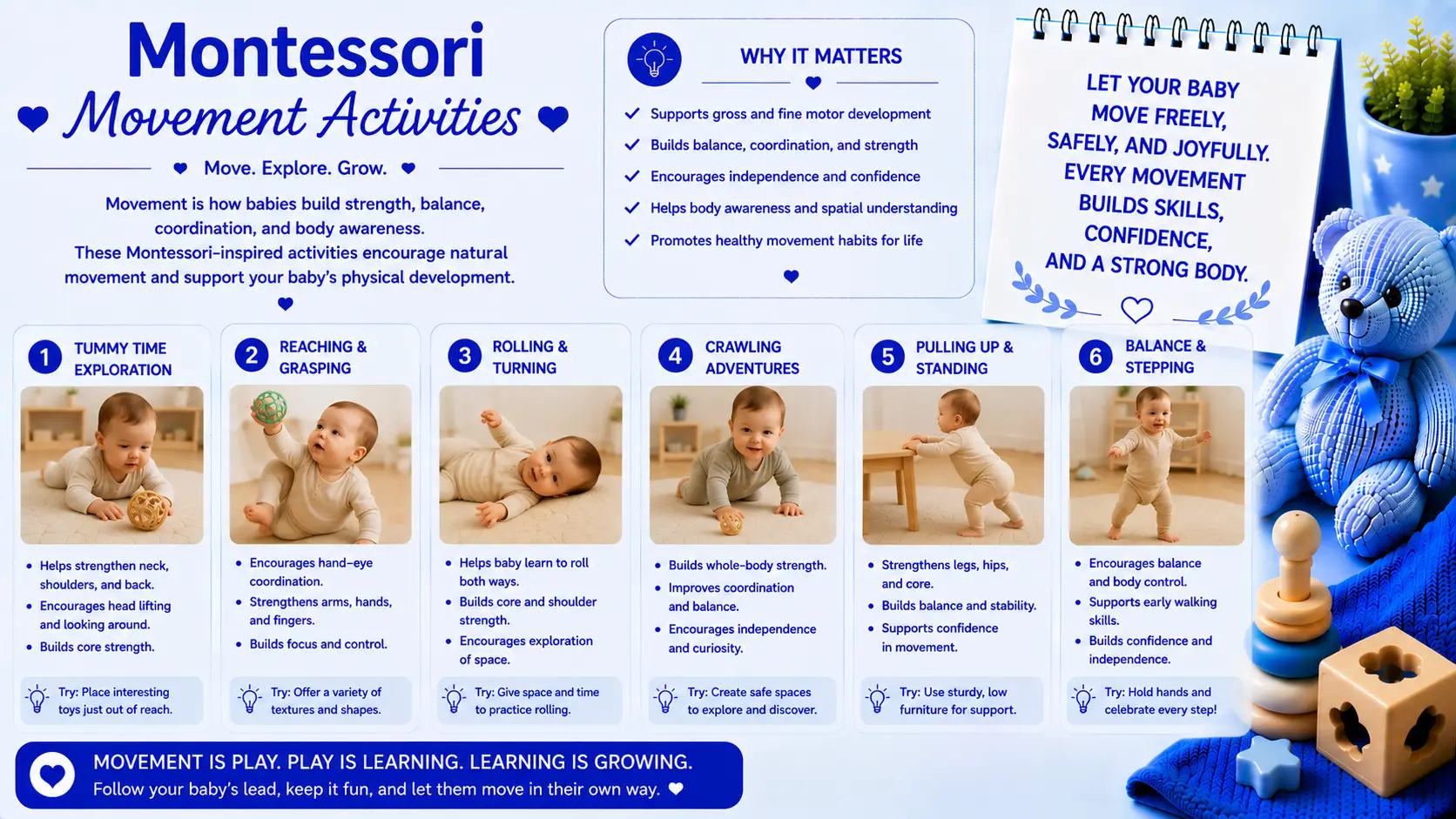

Movement sits at the heart of Montessori education. Maria Montessori observed that children learn through their bodies as much as through their minds. “Watching a child makes it obvious that the development of his mind comes about through his movements,” she wrote. Today we call this embodied cognition—the idea that physical action shapes thinking—but Montessori understood it more than a century ago.
In a true Montessori environment, children do not sit still for long stretches. They choose work, carry materials carefully to a mat or table, return them when finished, and move freely within clear limits. This purposeful movement builds coordination, concentration, independence, and self-control. Whether you follow Montessori at home or in a classroom, incorporating intentional Montessori movement activities supports the whole child.
Why Movement Matters in Montessori
Young children pass through a sensitive period for movement, especially from birth to around age six. During this time they refine gross motor skills (balance, strength, whole-body coordination) and fine motor skills (hand-eye control, precision). Practical life work, sensorial materials, and even language and math activities all involve purposeful motion.
When children move with intention—carrying a tray without spilling, walking heel-to-toe along a line, or pouring water carefully—they develop what Montessori called “control of movement.” This control feeds concentration and later academic work. Restricting movement or treating it as an afterthought can leave children restless or frustrated. Giving them meaningful ways to move meets their developmental need and often reduces disruptive behavior.
Classic Montessori Movement Activities
Walking on the Line One of the best-known Montessori gross motor activities, walking on the line helps children develop balance, equilibrium, and focus. A simple ellipse or meandering line of tape or chalk on the floor becomes a path. Children begin by walking naturally, then progress to heel-to-toe walking, carrying objects, balancing a beanbag on the head, or moving to music. The activity can be calming or challenging depending on how it is presented. Many classrooms keep a permanent line so children can practice independently whenever they feel the need to move with purpose.
The Silence Game This classic exercise builds both self-control and auditory awareness. After a period of quiet listening, children try to remain completely still and silent for a short time. It trains the body to pause and the mind to notice subtle sounds. Over time it becomes a peaceful group experience that many children request.
Practical Life Work That Builds Movement Everyday tasks are rich sources of movement:
Carrying a chair or tray carefully across the room
Sweeping, dusting, mopping, or table washing
Pouring dry or wet materials
Rolling and unrolling a work rug
Preparing food or arranging flowers
These activities strengthen large and small muscles while giving children real responsibility. They also teach grace and courtesy—moving through a shared space without bumping others or making unnecessary noise.
Music and Movement Many Montessori settings include silk scarf dancing to classical music, marching to a steady beat, freeze dance, or simple yoga poses with picture cards. These activities develop body awareness, rhythm, and coordination while remaining child-led and joyful. Scarves, ribbons, or small instruments can turn an ordinary afternoon into focused, creative movement.
Movement Activities for Toddlers and Preschoolers
For toddlers (roughly 18 months–3 years), keep activities simple and sensorial. Pushing a child-sized cart, climbing low furniture independently, rolling a ball back and forth, or transferring objects between baskets all support early gross motor development. Outdoor time with safe climbing, digging, and running is essential.
Preschoolers (3–6) are ready for more refined challenges: obstacle courses made from household items, balancing on a low beam or stepping stones, yoga or ballet position cards with a sand timer, jump-rope work on a mat, or scavenger hunts that require walking the room to match colors, sounds, or quantities. Carrying the pink tower, red rods, or golden beads one piece at a time naturally builds strength and careful movement.
A dedicated “movement shelf” can help. Stock it with yoga cards, exercise station cards, a jump rope (handles removed), or simple balancing tools. A yoga mat defines the space so children know where big movements belong.
Tips for Home and Classroom
Observe the child. Some children need frequent full-body movement; others prefer quieter refinement. Offer choices rather than forcing group exercises. Keep the environment prepared so children can access materials independently and return them. Outdoors is ideal—gardens, parks, and natural spaces provide unlimited opportunities for purposeful movement. Limit passive screen time; real movement cannot be replaced by digital activity.
Start small. Tape a line on the floor. Put a pitcher and two cups on a low shelf. Play one piece of classical music and offer scarves. Consistency and respect for the child’s pace matter more than elaborate setups.
FAQ
What are the best Montessori movement activities for toddlers?
Focus on gross motor exploration: pushing and pulling toys, climbing low structures, rolling balls, carrying lightweight objects, and outdoor free play. Simple practical life tasks such as wiping a table or transferring large objects also work well.
How does walking on the line help children?
It develops balance, coordination, concentration, and body awareness. The controlled, repetitive movement can also have a calming effect and prepares children for more precise work later.
Can Montessori movement activities help with restless or high-energy children?
Yes. When children have legitimate outlets for movement—especially purposeful ones—they often settle more easily into focused work. A movement shelf or outdoor time can reduce the need for constant redirection.
Do I need special materials for Montessori gross motor activities?
No. Painter’s tape, a yoga mat, household objects, music, and outdoor space are often enough. Traditional materials like the pink tower or practical life tools already incorporate significant movement.
How often should children do movement activities in a Montessori setting?
Movement is woven throughout the day rather than scheduled as a separate “PE” block. Children move whenever they choose work, care for the environment, or practice walking the line. Structured group movement can be offered occasionally, but freedom of movement within limits remains the foundation.