
There’s something about fresh air and open grass that babies just respond to. Wide eyes, kicking legs, that little gasp when a breeze hits their face for the first time — parks are basically a giant sensory playground, and you don’t need a single toy to make the most of one. If you’ve been wondering when you can take your baby to the park, or you’re just looking for new ways to fill an afternoon outside, here’s a practical, easy-to-follow guide.
When Can Babies Go to the Park?
Most pediatricians say it’s fine to take a newborn outside within the first couple of weeks, as long as you’re avoiding extreme heat, cold, or crowds. There’s no real age minimum for a park visit — the type of activity is what changes as your baby grows. A two-month-old will mostly enjoy the shade, the sounds, and being close to you. A crawling nine-month-old is ready to explore grass and textures. And once your baby can sit unassisted, a whole new world of park play opens up.
Why Outdoor Play Matters for Babies
Time outdoors does more than pass an afternoon. It supports:
Sensory development — grass, wind, sunlight, and sound all give baby new input to process
Motor skills — reaching, rolling, and eventually crawling on uneven natural surfaces builds strength differently than a flat living room floor
Sleep and mood regulation — natural light exposure, especially in the morning, helps regulate circadian rhythms
Bonding — a change of scenery tends to bring out more eye contact, babbling, and shared attention between you and your baby
Best Park Activities by Age and Stage
Newborns to 3 Months: Just Being Outside
At this stage, the “activity” is simply the environment. Lay a blanket in the shade, hold your baby facing outward so they can take in the trees and sky, and let them nap or watch the world go by. A light breeze on their skin and dappled sunlight through leaves are genuinely stimulating at this age.
4 to 6 Months: Tummy Time and Texture Play
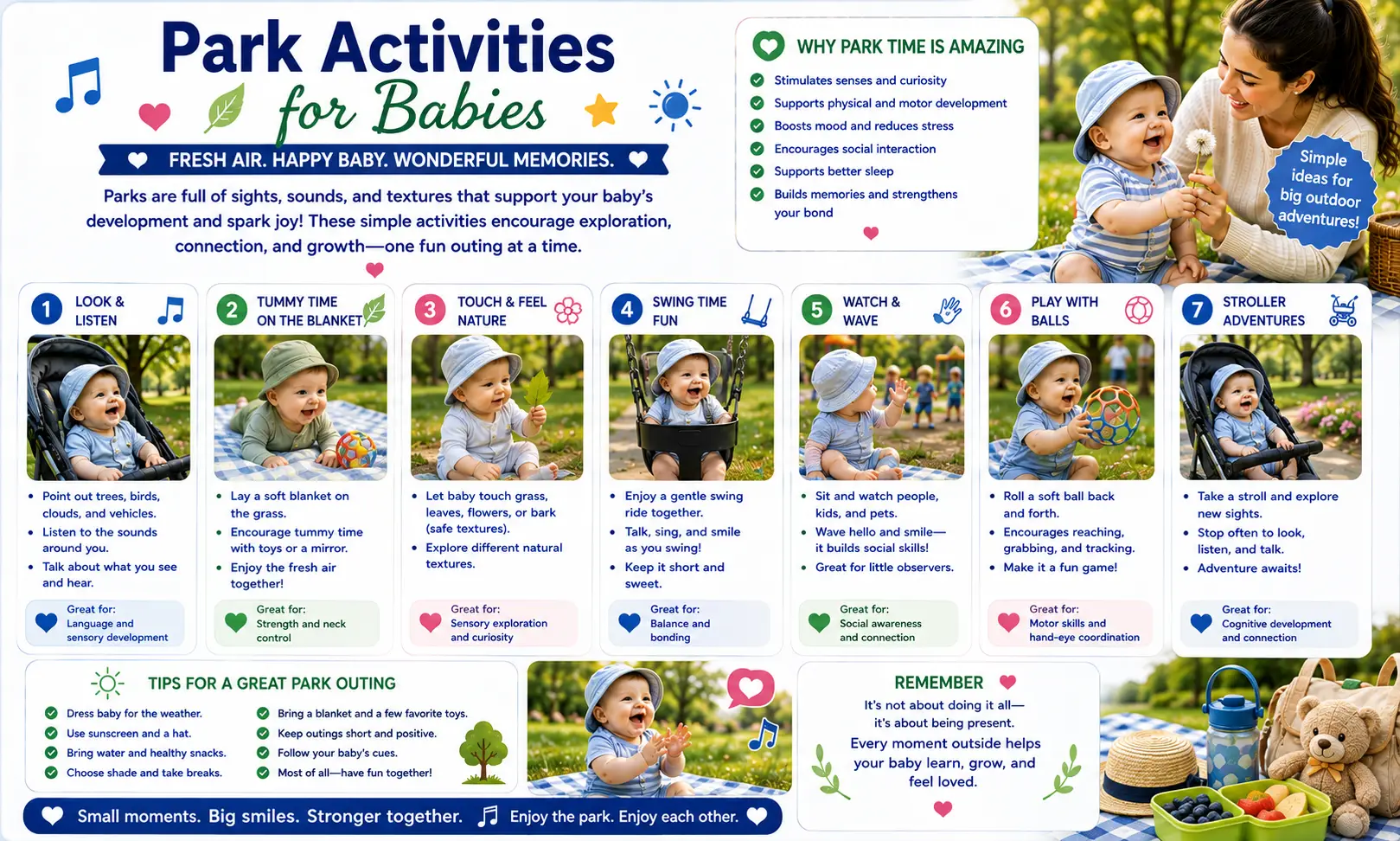
Outdoor tummy time on a blanket is a favorite for a reason — babies tend to lift their heads longer outside, probably because there’s more to look at. Let bare feet touch grass. Rustle a leaf near their hand. This is also a good stage for baby-safe outdoor sensory play, like gently brushing different textures (a soft leaf, a smooth stone) against their palms.
7 to 12 Months: Exploration Mode
Once babies are sitting or crawling, parks become genuinely exciting. Try:
Nature scavenger hunts — collect leaves, sticks, and pinecones in a small basket for baby to touch and (supervised) mouth
Ball rolling — a soft, textured ball rolled across the grass is endlessly fascinating for a sitting baby
Bubbles — popping bubbles is a genuine crowd-pleaser and helps with hand-eye coordination
Baby swings — most parks allow babies in enclosed bucket swings once they can sit up well on their own, usually around 6–9 months; always keep the motion gentle and slow
Picnic and finger foods — for babies who’ve started solids, a park picnic with soft foods like banana or avocado is a low-pressure way to introduce new textures and tastes
12+ Months: Toddling Toward the Playground
Walking or almost-walking babies are ready for supported play on low slides, soft rubber flooring, and gentle swings, plus simple games like “find the yellow flower” or a slow-motion chase across the grass.
Simple Park Activity Ideas Worth Trying
Blanket and blocks — bring a few stacking toys and let baby explore them in a new setting
Shadow play — hold baby’s hand up to a sunny patch and watch them notice their own shadow
Bird and dog watching — babies are naturally drawn to movement, and pointing out a bird or a passing dog builds early attention and language skills
Water play — if your park has a splash pad or shallow sprinkler area, supervised water play is one of the most popular outdoor activities for babies and toddlers alike
Music in the park — bring a small speaker and sway or bounce baby to a favorite song
Park Safety Tips for Babies
Check the temperature — avoid peak sun hours in hot weather, and dress in layers when it’s cool
Use sunscreen (SPF 30+) on babies over 6 months; for younger babies, rely on shade, hats, and lightweight clothing instead
Bring water or a bottle, even on cooler days
Keep an eye on other children near play equipment, since baby swings and toddler slides are often shared spaces
Pack a small first-aid kit and always supervise closely near sand, water, or anything small enough to mouth
A Few Packing Essentials
A lightweight blanket, a sun hat, a couple of familiar toys, snacks or a bottle, sunscreen, and a change of clothes cover most park trips. Keep the bag simple — babies are usually far more interested in the park itself than anything you bring.
Final Thoughts
You don’t need a special outing or elaborate plan to make park time meaningful for your baby. A patch of grass, some shade, and your undivided attention go a long way. As your baby grows, the same park will offer something new every few months — which is part of what makes it such an easy, repeatable outing for busy parents.
FAQ
Is it safe to take a newborn to the park?
Yes, as long as you avoid extreme temperatures, direct harsh sun, and crowded or high-pollen conditions. Keep visits short and shaded for the first few weeks.
What age can babies go on park swings?
Most enclosed bucket swings are safe once a baby can sit up unassisted and has good head control, typically around 6 to 9 months. Always use the gentlest motion.
What are good sensory activities for babies at the park?
Grass under bare feet, leaves and soft textures, bubbles, gentle breezes, and watching light through trees are all simple, effective sensory experiences for babies.
How long should a baby stay outside at the park?
There’s no strict rule, but 20–40 minutes is a comfortable range for younger babies, while older babies who are actively exploring can often handle an hour or more, weather permitting.
Do babies need sunscreen at the park?
Babies under 6 months should be kept in shade and covered with lightweight clothing and hats rather than sunscreen. For babies over 6 months, a mineral-based SPF 30+ sunscreen on exposed skin is recommended.