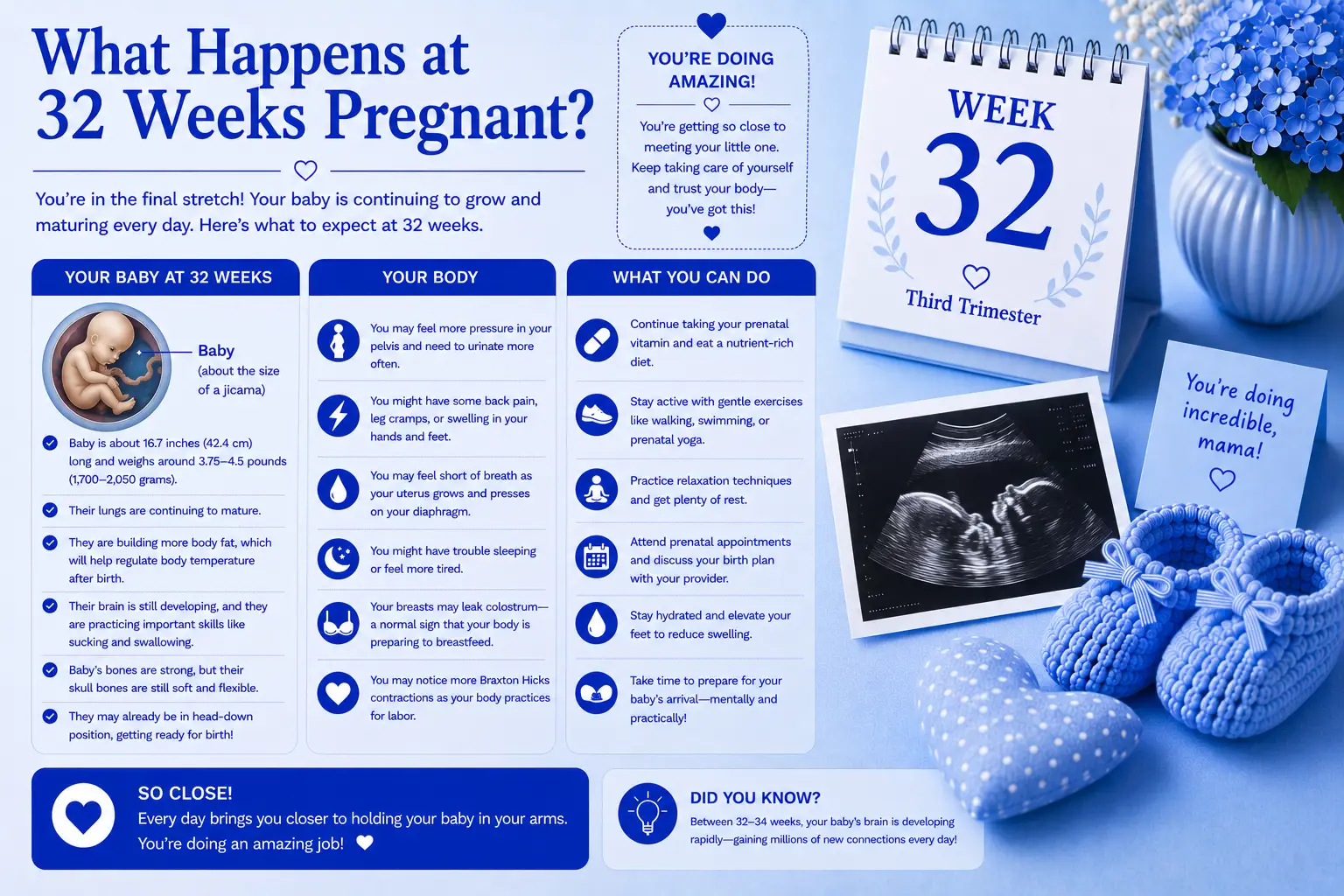

At 32 weeks, you’re about eight months along with roughly eight weeks to go, and your baby is putting on weight fast in preparation for life outside the womb. Here’s what’s happening for both of you this week.
Your Baby at 32 Weeks
Your baby weighs around 3.75 to 4 pounds (roughly 1.7–1.8 kg) and measures about 16–17 inches long — comparable in size to a jicama, leek, or large squash depending on the comparison you come across. Major development this week includes:
Lungs are nearing full development and practicing breathing movements by inhaling small amounts of amniotic fluid
Fat stores are building rapidly, making the skin look less wrinkled and more filled out — this fat is essential for regulating body temperature after birth
Lanugo (the fine, soft body hair that’s covered your baby for months) continues shedding, though some babies are still born with a bit of it
Fingernails and toenails are present, and hair, eyebrows, and eyelashes are typically visible
Bones are hardening, though the skull remains soft and flexible to make delivery easier
The nervous system is becoming more coordinated, and your baby is more responsive to light, sound, and touch
Sleep-wake cycles are becoming more defined, often noticeable as distinct active and quiet periods
Many babies begin settling into a head-down position around this time in preparation for birth, though there’s still time to turn — your provider typically won’t assess positioning closely until closer to weeks 35–36.
Common Symptoms at 32 Weeks Pregnant
With your baby taking up more room, symptoms often become more pronounced:
Shortness of breath — your uterus, now measured about 5 inches above your belly button, presses up against your diaphragm
Heartburn, from that same upward pressure
Back pain and pelvic pressure, as the extra weight shifts your center of gravity
Mild swelling in the hands, face, legs, ankles, or feet
Braxton Hicks contractions — usually irregular, mild, and often eased by rest, hydration, or changing position
Increased vaginal discharge, which naturally picks up as your body prepares for labor
Leaking colostrum — the early, nutrient-rich pre-milk; breast pads can help manage this
Reduced fetal movement intensity (not frequency) — as your baby has less room, kicks may feel different, more like stretches or rolls rather than sharp jabs
Weight gain at this stage is typically around a pound per week, and blood volume has increased by roughly 40–50% since the start of pregnancy to support both you and your baby.
Prenatal Appointments at 32 Weeks
Many providers shift from monthly to biweekly checkups around 32 weeks, keeping a closer eye on signs of infection, preterm labor, or preeclampsia (sometimes called pregnancy toxemia). If you’re having a higher-risk pregnancy or expecting multiples, a 3D/4D ultrasound may also be offered around now, giving you a clearer look at your baby’s facial features and movements.
Signs of Labor to Know
It’s a good time to familiarize yourself with the signs of labor so you can tell them apart from ordinary pregnancy discomfort. These include your water breaking, loss of the mucus plug, vaginal bleeding or spotting, regular and intensifying contractions, and unusual cramping or diarrhea. Babies born at 32 weeks are considered premature but generally have good survival rates with NICU support, since most major organs are formed — it’s mainly the lungs and brain that still have developing left to do.
When to Call Your Doctor
Contact your provider for severe swelling, vision changes, chest pain, intense abdominal pain, a strong or persistent headache, or any symptoms that feel significantly different from your usual pregnancy discomforts. These can be signs of preeclampsia or other complications worth checking promptly.
Tips for Week 32
Keep track of fetal movement patterns and mention any noticeable changes to your provider
Pick up nursing or breast pads if colostrum leaking becomes noticeable
Rest with your feet elevated to help ease swelling
Continue avoiding alcohol, limiting caffeine, and steering clear of unpasteurized dairy
Start planning your route and logistics for getting to the hospital or birth center
FAQ
How big is a baby at 32 weeks pregnant?
Around 3.75–4 pounds and roughly 16–17 inches long — often compared to a jicama or large squash.
Is it normal to have trouble breathing at 32 weeks pregnant?
Yes. As your uterus grows and presses on your diaphragm, shortness of breath is a common and expected symptom in the third trimester.
Has my baby’s position been decided by 32 weeks?
Not necessarily. Many babies settle head-down around this time, but there’s still room to turn. Providers usually don’t formally assess position until closer to 35–36 weeks.
Would a baby born at 32 weeks survive?
Babies born at 32 weeks are considered premature but generally have favorable survival rates with NICU care, since most organs are formed — the lungs and brain are typically what still need the most time to mature.
Are Braxton Hicks contractions normal at 32 weeks?
Yes, they’re common at this stage and are usually irregular, mild, and improve with rest or hydration. Contact your provider if they become regular, painful, or increasingly frequent.