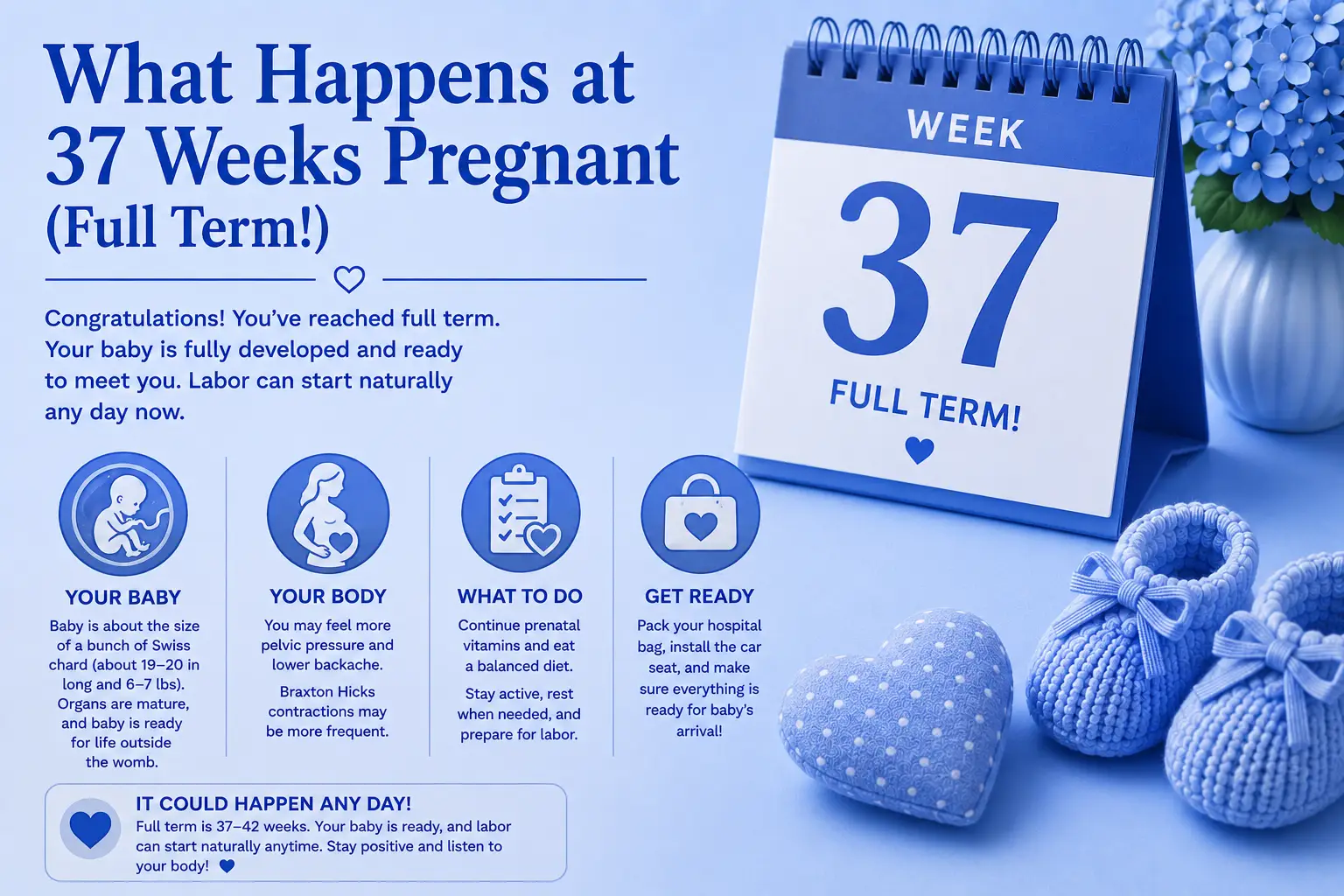

At 37 weeks, you’ve reached a meaningful threshold — your baby is now considered developed enough to be born safely, and labor could realistically start any day. Here’s what’s happening for you and your baby this week, plus an important clarification on what “full term” actually means.
Is 37 Weeks Really “Full Term”?
This is one of the most searched questions at this stage, and the answer is a little nuanced. Medically, 37 weeks is classified as early term, not full term. According to standard pregnancy terminology:
Early term: 37 weeks 0 days – 38 weeks 6 days
Full term: 39 weeks 0 days – 40 weeks 6 days
Late term: 41 weeks 0 days – 41 weeks 6 days
Postterm: 42 weeks and beyond
That said, 37 weeks is still a genuine milestone: your baby is developed enough to be born safely if labor starts now, even though a bit more time in the womb continues to benefit brain and lung maturation.
Your Baby at 37 Weeks
Your baby weighs around 6 to 7 pounds and measures roughly 18–19 inches long — about the size of a small watermelon. Development is largely about fine-tuning rather than major growth spurts at this point:
Organ systems are essentially ready — the heart, kidneys, digestive system, and brain are formed and functioning, though the brain and lungs continue maturing
Reflexes are well established — gripping, swallowing, and responding to touch or sound
Fat stores continue thickening, helping with temperature regulation after birth
Skin is smoother, having shed most of the lanugo and vernix
The gut contains meconium, the sticky, dark substance that will become your baby’s first bowel movement
Hiccups may be frequent and noticeable as little rhythmic jumps in your belly
Common Symptoms at 37 Weeks Pregnant
Pelvic pressure, as your baby settles lower
Braxton Hicks contractions, which may feel more frequent or intense
Back discomfort
Trouble sleeping
Frequent urination
Increased vaginal discharge
Heartburn, gas, and bloating, from continued pressure on your digestive system
Emotional intensity — heightened sensitivity, impatience, nesting urges, or a mix of excitement and anxiety are all common and normal
Early Signs of Labor
Week 37 is a good time to review the signs of labor so you can recognize them when they happen:
Losing your mucus plug — a clear, pink, or slightly blood-tinged discharge that can appear hours, days, or even weeks before labor starts
The “bloody show” — a blood-tinged discharge signaling your cervix is changing in preparation for delivery (different from heavier bleeding, which needs prompt medical attention)
Your water breaking — either a gush or a slow trickle of fluid
Contractions that become regular and increasingly painful, as opposed to irregular Braxton Hicks
Not everyone experiences all — or any — of these before labor actually begins, and it’s common for early signs to feel subtle or ambiguous.
When to Call Your Doctor
Contact your provider right away for heavy vaginal bleeding, a significant decrease in fetal movement, regular contractions six or more times in an hour while at rest, fluid leakage you suspect is your water breaking, or any symptoms that feel out of the ordinary.
Tips for Week 37
- Finish packing your hospital bag if you haven’t already
- Keep tracking fetal movement daily
- Rest when you can — labor takes real energy
- Review your birth plan and pain management preferences with your provider
- Try eating smaller meals and walking after eating to ease digestive discomfort
FAQ
Is 37 weeks considered full term?
Not quite. Medically, 37–38 weeks is classified as “early term,” while true full term starts at 39 weeks. Even so, a baby born at 37 weeks is generally considered developed enough to be born safely.
How big is a baby at 37 weeks pregnant?
Around 6 to 7 pounds and 18–19 inches long — comparable to a small watermelon.
What does losing the mucus plug mean?
It’s a sign that your cervix is beginning to change in preparation for labor, but it doesn’t mean labor is imminent — it can happen hours, days, or even weeks before delivery.
Is spotting normal at 37 weeks pregnant?
Light spotting can be normal, often from a sensitive cervix, especially after sex. However, heavier bleeding should always be checked promptly by your provider.
Can I go into labor at 37 weeks?
Yes. Labor at 37 weeks is not considered preterm, and many babies are born safely and healthily at this stage, though some benefit from a bit more time in utero for continued lung and brain development.