
Skip to content
DidYouSearch DidYouSearch
  • did you search?
  • Baby Plus+
    • Baby Activities
      • Arts & Crafts
      • Indoor Activities
      • Montessori
      • Music
      • Outdoor Activities
      • Reading
      • Sensory Play
      • Tummy Time
    • Baby Development
      • Brain Development
      • Cognitive Development
      • Emotional Development
      • Fine Motor Skills
      • Growth Milestones
      • Monthly Milestones
      • Motor Skills
      • Physical Development
      • Social Development
      • Speech Development
    • Baby Feeding
      • Allergies
      • Baby Led Weaning
      • Bottle Feeding
      • Breast feeding
        • Breastfeeding Diet
        • Breastfeeding Positions
        • Latch Problems
        • Low Milk Supply
        • Mastitis
        • Pumping Schedule
        • Weaning
      • Burping
      • Cluster Feeding
      • Feeding Schedule
      • Formula Feeding
        • Formula Amount
        • Formula Brands
        • Formula Comparison
        • Formula Preparation
        • Formula Storage
      • Hydration
      • Pumping
      • Solid Foods
    • Baby Gear Reviews
      • Best Baby Carrier
      • Best Baby Monitor
      • Best Baby Strollers
      • Best Bottles
      • Best Breast Pump
      • Best Car Seat
      • Best Cribs
      • Best Diapers
      • Best Formula
      • Best Toys
    • Baby Growth
      • Growth Spurts
      • Height Charts
      • Monthly Growth
      • Percentiles
      • Weight Charts
    • Baby Health
      • Allergies
      • Cold
      • Constipation
      • Cough
      • Diarrhea
      • Ear Infection
      • Fever
      • Flu
      • Pediatric Visits
      • Rashes
      • Teething
      • Vaccines
      • Vomiting
    • Baby Nutrition
      • Dairy
      • Drinks
      • Eggs
      • Fish
      • Fruits
      • Healthy Recipes
      • Meat
      • Snacks
      • Vegetables
      • Vitamins
    • Baby Products
      • Baby Carriers
      • Bassinets
      • Bottles
      • Breast Pumps
      • Car Seats
      • Cribs
      • Diaper Bags
      • High Chairs
      • Monitors
      • Strollers
      • Swings
      • Toys
      • Walkers
    • Baby Recipes
      • BLW Recipes
      • Breakfast
      • Dinner
      • Finger Foods
      • Lunch
      • Purees
      • Snacks
    • Baby Safety
      • Baby Proofing
      • Car Seats
      • Choking Hazards
      • CPR
      • Home Safety
      • Poison Prevention
      • Safe Sleep
      • Sun Protection
      • Water Safety
  • Baby Names
    • Boy Names
    • Girl Names
    • American baby boy names
    • American baby girl names
    • Biblical Names
    • Middle Names
    • Modern Names
    • Short Names
    • Unique Names
    • Unisex Names
  • Recommended
    • Baby Shopping
      • Baby Registry
      • Budget Baby Shopping
      • Hospital Bag
      • Must Have Products
      • Newborn Checklist
      • Nursery Ideas
    • Baby Sleep
      • Bedtime Routine
      • Co Sleeping
      • Crib Safety
      • Nap Schedules
      • Night Wakings
      • Sleep Environment
      • Sleep Products
      • Sleep Regression
      • Sleep Training
      • Wake Windows
      • White Noise
    • Childcare
      • Daycare
      • Babysitters
      • Kindergarten
      • Nannies
      • Preschool
    • Newborn Care
      • Nail Care
      • Baby Hygiene
      • Bathing
      • Crying
      • Diapering
      • Ear Care
      • Eye Care
      • Skin Care
      • Soothing Techniques
      • Temperature
      • Umbilical Cord
    • Special Needs
      • Premature Babies
      • Autism Signs
      • Developmental Delays
      • Down Syndrome
      • NICU
      • Twins
    • Seasonal Baby Care
      • Spring
      • Summer
      • Travel
      • Fall
      • Holidays
      • Winter
  • Parenting
    • Bonding
    • Discipline
    • Emotional Intelligence
    • First Time Parents
    • Gentle Parenting
    • Positive Parenting
    • Routines
    • Single Parents
    • Working Parents
  • Pregnancy
    • Pregnancy Complications
    • Labor & Delivery
    • Postpartum Recovery
    • Pregnancy Exercises
    • Pregnancy Medications
    • Pregnancy Nutrition
    • Pregnancy Sleep
    • Pregnancy Symptoms
    • Pregnancy Tests
    • Pregnancy Vitamins
    • Pregnancy Weeks
  • Toddler
    • Preschool
    • Speech
    • Tantrums
    • Toddler Food
    • Toddler Sleep
    • Behavior
    • Independence
    • Learning
    • Potty Training
  • Traveling with Baby
    • Road Trips
    • Beach
    • Camping
    • Flying
    • Hotels
    • Packing Lists
  • did you search?
  • Baby Plus+
    • Baby Activities
      • Arts & Crafts
      • Indoor Activities
      • Montessori
      • Music
      • Outdoor Activities
      • Reading
      • Sensory Play
      • Tummy Time
    • Baby Development
      • Brain Development
      • Cognitive Development
      • Emotional Development
      • Fine Motor Skills
      • Growth Milestones
      • Monthly Milestones
      • Motor Skills
      • Physical Development
      • Social Development
      • Speech Development
    • Baby Feeding
      • Allergies
      • Baby Led Weaning
      • Bottle Feeding
      • Breast feeding
        • Breastfeeding Diet
        • Breastfeeding Positions
        • Latch Problems
        • Low Milk Supply
        • Mastitis
        • Pumping Schedule
        • Weaning
      • Burping
      • Cluster Feeding
      • Feeding Schedule
      • Formula Feeding
        • Formula Amount
        • Formula Brands
        • Formula Comparison
        • Formula Preparation
        • Formula Storage
      • Hydration
      • Pumping
      • Solid Foods
    • Baby Gear Reviews
      • Best Baby Carrier
      • Best Baby Monitor
      • Best Baby Strollers
      • Best Bottles
      • Best Breast Pump
      • Best Car Seat
      • Best Cribs
      • Best Diapers
      • Best Formula
      • Best Toys
    • Baby Growth
      • Growth Spurts
      • Height Charts
      • Monthly Growth
      • Percentiles
      • Weight Charts
    • Baby Health
      • Allergies
      • Cold
      • Constipation
      • Cough
      • Diarrhea
      • Ear Infection
      • Fever
      • Flu
      • Pediatric Visits
      • Rashes
      • Teething
      • Vaccines
      • Vomiting
    • Baby Nutrition
      • Dairy
      • Drinks
      • Eggs
      • Fish
      • Fruits
      • Healthy Recipes
      • Meat
      • Snacks
      • Vegetables
      • Vitamins
    • Baby Products
      • Baby Carriers
      • Bassinets
      • Bottles
      • Breast Pumps
      • Car Seats
      • Cribs
      • Diaper Bags
      • High Chairs
      • Monitors
      • Strollers
      • Swings
      • Toys
      • Walkers
    • Baby Recipes
      • BLW Recipes
      • Breakfast
      • Dinner
      • Finger Foods
      • Lunch
      • Purees
      • Snacks
    • Baby Safety
      • Baby Proofing
      • Car Seats
      • Choking Hazards
      • CPR
      • Home Safety
      • Poison Prevention
      • Safe Sleep
      • Sun Protection
      • Water Safety
  • Baby Names
    • Boy Names
    • Girl Names
    • American baby boy names
    • American baby girl names
    • Biblical Names
    • Middle Names
    • Modern Names
    • Short Names
    • Unique Names
    • Unisex Names
  • Recommended
    • Baby Shopping
      • Baby Registry
      • Budget Baby Shopping
      • Hospital Bag
      • Must Have Products
      • Newborn Checklist
      • Nursery Ideas
    • Baby Sleep
      • Bedtime Routine
      • Co Sleeping
      • Crib Safety
      • Nap Schedules
      • Night Wakings
      • Sleep Environment
      • Sleep Products
      • Sleep Regression
      • Sleep Training
      • Wake Windows
      • White Noise
    • Childcare
      • Daycare
      • Babysitters
      • Kindergarten
      • Nannies
      • Preschool
    • Newborn Care
      • Nail Care
      • Baby Hygiene
      • Bathing
      • Crying
      • Diapering
      • Ear Care
      • Eye Care
      • Skin Care
      • Soothing Techniques
      • Temperature
      • Umbilical Cord
    • Special Needs
      • Premature Babies
      • Autism Signs
      • Developmental Delays
      • Down Syndrome
      • NICU
      • Twins
    • Seasonal Baby Care
      • Spring
      • Summer
      • Travel
      • Fall
      • Holidays
      • Winter
  • Parenting
    • Bonding
    • Discipline
    • Emotional Intelligence
    • First Time Parents
    • Gentle Parenting
    • Positive Parenting
    • Routines
    • Single Parents
    • Working Parents
  • Pregnancy
    • Pregnancy Complications
    • Labor & Delivery
    • Postpartum Recovery
    • Pregnancy Exercises
    • Pregnancy Medications
    • Pregnancy Nutrition
    • Pregnancy Sleep
    • Pregnancy Symptoms
    • Pregnancy Tests
    • Pregnancy Vitamins
    • Pregnancy Weeks
  • Toddler
    • Preschool
    • Speech
    • Tantrums
    • Toddler Food
    • Toddler Sleep
    • Behavior
    • Independence
    • Learning
    • Potty Training
  • Traveling with Baby
    • Road Trips
    • Beach
    • Camping
    • Flying
    • Hotels
    • Packing Lists
Close

Search

Home/Pregnancy/Pregnancy Weeks/What happens at 40 weeks pregnant?
Pregnancy Weeks

What happens at 40 weeks pregnant?

By DrAdam
August 8, 2026 4 Min Read
0

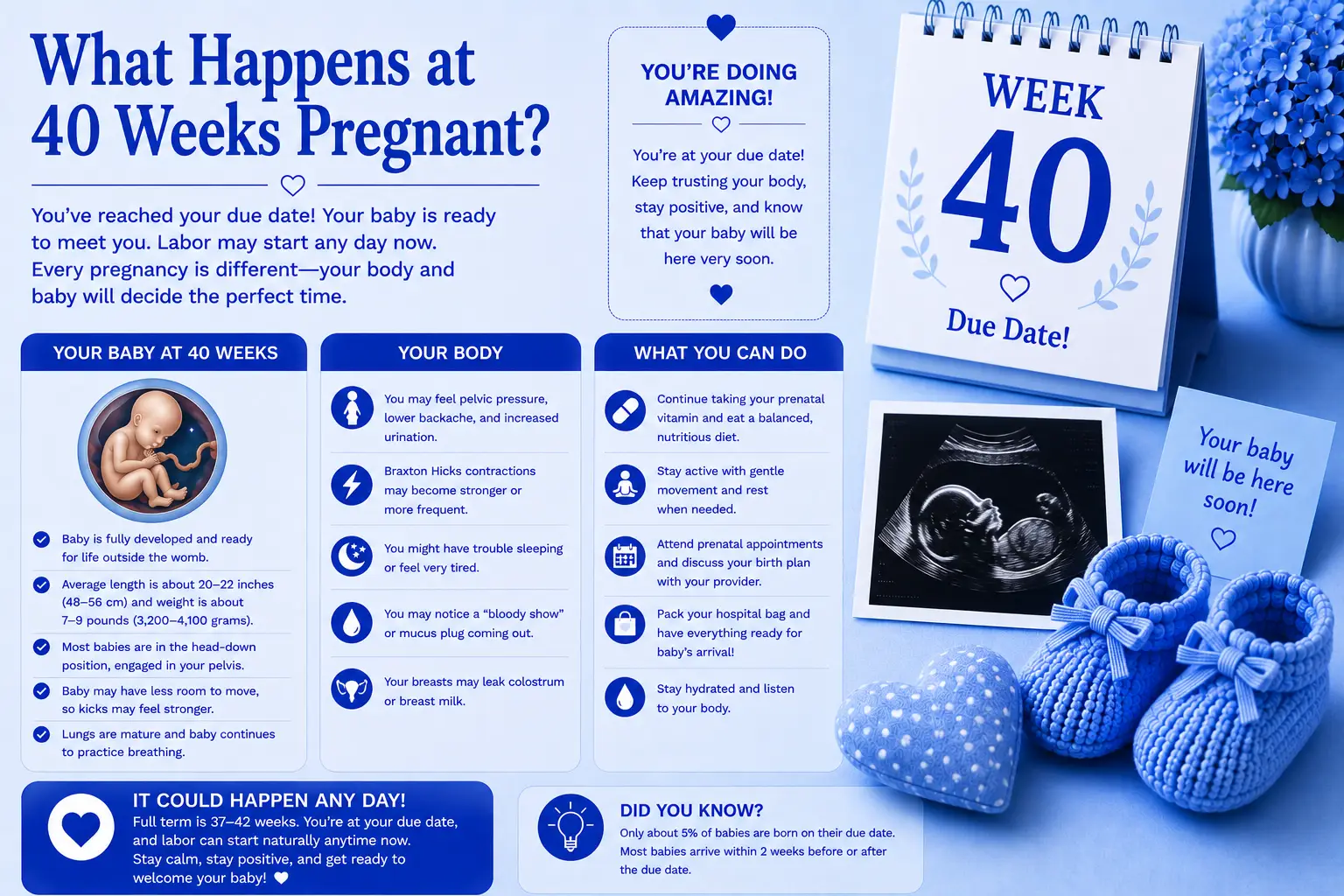
Forty weeks is your official due date — but it’s worth knowing upfront that only about 5% of babies actually arrive on that exact day. If you’re at 40 weeks with no signs of labor yet, that’s completely normal. Here’s what’s happening for you and your baby, and what comes next if labor hasn’t started.

Your Baby at 40 Weeks

Contents hide
1 Your Baby at 40 Weeks
2 Why So Few Babies Arrive on Their Due Date
3 What Happens If You Go Past Your Due Date
4 The Induction Conversation
5 Common Symptoms at 40 Weeks Pregnant
6 Can You Naturally Induce Labor?
7 When to Call Your Doctor
8 Tips for Week 40
9 FAQ
9.1 How many babies are actually born on their due date?
9.2 Is it dangerous to go past 40 weeks pregnant?
9.3 How big is a baby at 40 weeks pregnant?
9.4 Can I do anything to naturally start labor?
9.5 When will my doctor recommend induction if I go past my due date?

By 40 weeks, your baby is considered fully developed and ready for life outside the womb. Average size at this stage is around 7.5 pounds and about 20 inches long, though this varies quite a bit from baby to baby. Your baby will keep moving right up until — and during — labor, so continuing to track movement patterns still matters even this close to delivery.

Why So Few Babies Arrive on Their Due Date

A due date is an estimate based on a 280-day (40-week) average pregnancy length counted from the first day of your last menstrual period — not a deadline. In reality, a full-term pregnancy is considered anywhere from 37 to 42 weeks, and it’s entirely normal to go past 40 weeks, especially with a first pregnancy.

What Happens If You Go Past Your Due Date

If labor hasn’t started by 40 weeks, your provider will likely increase monitoring rather than jump straight to intervention. This typically includes:

Non-stress tests, which track your baby’s heart rate and movement

A biophysical profile, combining ultrasound with heart rate monitoring to check amniotic fluid levels, breathing movements, and overall wellbeing

Cervical checks, to see if your body is starting to prepare for labor

Pregnancy terminology beyond 40 weeks is specific:

Late term: 41 weeks 0 days – 41 weeks 6 days

Postterm: 42 weeks and beyond

The Induction Conversation

Research consistently shows that risks — including stillbirth — begin rising modestly around 41 weeks and increase more significantly after 42 weeks. Because of this, most providers will discuss induction if labor hasn’t started naturally by somewhere between 41 and 42 weeks, though the exact timing and approach vary by provider and by your individual risk factors. Some conditions — like gestational diabetes, preeclampsia, or concerns about amniotic fluid levels — may prompt an earlier conversation about induction regardless of your due date.

It’s worth knowing that induction itself carries some risks too, including changes in fetal heart rate and a higher likelihood of needing continuous monitoring during labor. This is a decision best made together with your provider, weighing your specific circumstances rather than a one-size-fits-all rule.

Common Symptoms at 40 Weeks Pregnant

Increased pelvic pressure

Stronger, more frequent Braxton Hicks contractions

Trouble sleeping

Nesting instinct — a sudden burst of energy to clean, organize, or prepare

Loss of the mucus plug, or increased vaginal discharge

Lower back pain

Emotional ups and downs — a mix of impatience, excitement, and anxiety is extremely common at this stage

Can You Naturally Induce Labor?

It’s a common question, but there’s no solid evidence that anything — walking, spicy food, sex, or herbal supplements — reliably starts labor. Herbal supplements in particular are best avoided, since they can carry risks for your baby. Labor generally starts on its own timeline, influenced by hormonal changes rather than anything you actively do.

When to Call Your Doctor

Contact your provider right away for a significant decrease in fetal movement, your water breaking, heavy vaginal bleeding, or contractions that are becoming regular and increasingly close together — these are all reasons to be seen or head to the hospital.

Tips for Week 40

Rest as much as possible — labor takes real physical energy

Keep doing daily kick counts

Stay in close contact with your provider about monitoring and next steps

Try to stay mentally flexible about timing; babies rarely follow a strict schedule

Lean on your support system for both practical help and reassurance

FAQ

How many babies are actually born on their due date?

Only about 5%. Most babies arrive within a week or two of the estimated due date, either before or after.

Is it dangerous to go past 40 weeks pregnant?

Not typically on its own. Risks rise modestly starting around 41 weeks and more significantly after 42 weeks, which is why increased monitoring — and eventually induction — becomes part of the conversation.

How big is a baby at 40 weeks pregnant?

On average, around 7.5 pounds and about 20 inches long, though healthy babies vary widely in size.

Can I do anything to naturally start labor?

There’s no reliable evidence that any activity — exercise, spicy food, sex — triggers labor. It’s best to avoid herbal supplements marketed for this purpose, as they can pose risks.

When will my doctor recommend induction if I go past my due date?

This varies by provider and individual risk factors, but many recommend discussing induction somewhere between 41 and 42 weeks if labor hasn’t started on its own, sometimes earlier if there are specific medical concerns.


Author

DrAdam

Dr. Adam. Obstetrician and Gynecologist

Follow Me
Other Articles
Previous

What happens at 37 weeks pregnant (full term)?

Next

Baby size comparison by week (fruit chart)

No Comment! Be the first one.

Leave a Reply Cancel reply

Your email address will not be published. Required fields are marked *

What is Did You Search?

The “Did You Search” website was created for all mothers and families. Just search to find all your needs about your children.

Links

  • about
  • contact
  • privacy policy
  • medical disclaimer
  • sitemap
Copyright 2026 — DidYouSearch. All rights reserved.