
“How big is my baby?” is one of the most common questions in pregnancy, and comparing your baby’s size to fruits and vegetables is a favorite way to make those numbers feel real. A measurement in millimeters or grams doesn’t mean much on its own — but “the size of a lime” or “about as big as a pineapple” instantly clicks. Here’s a full week-by-week baby size chart, plus what these comparisons actually mean.
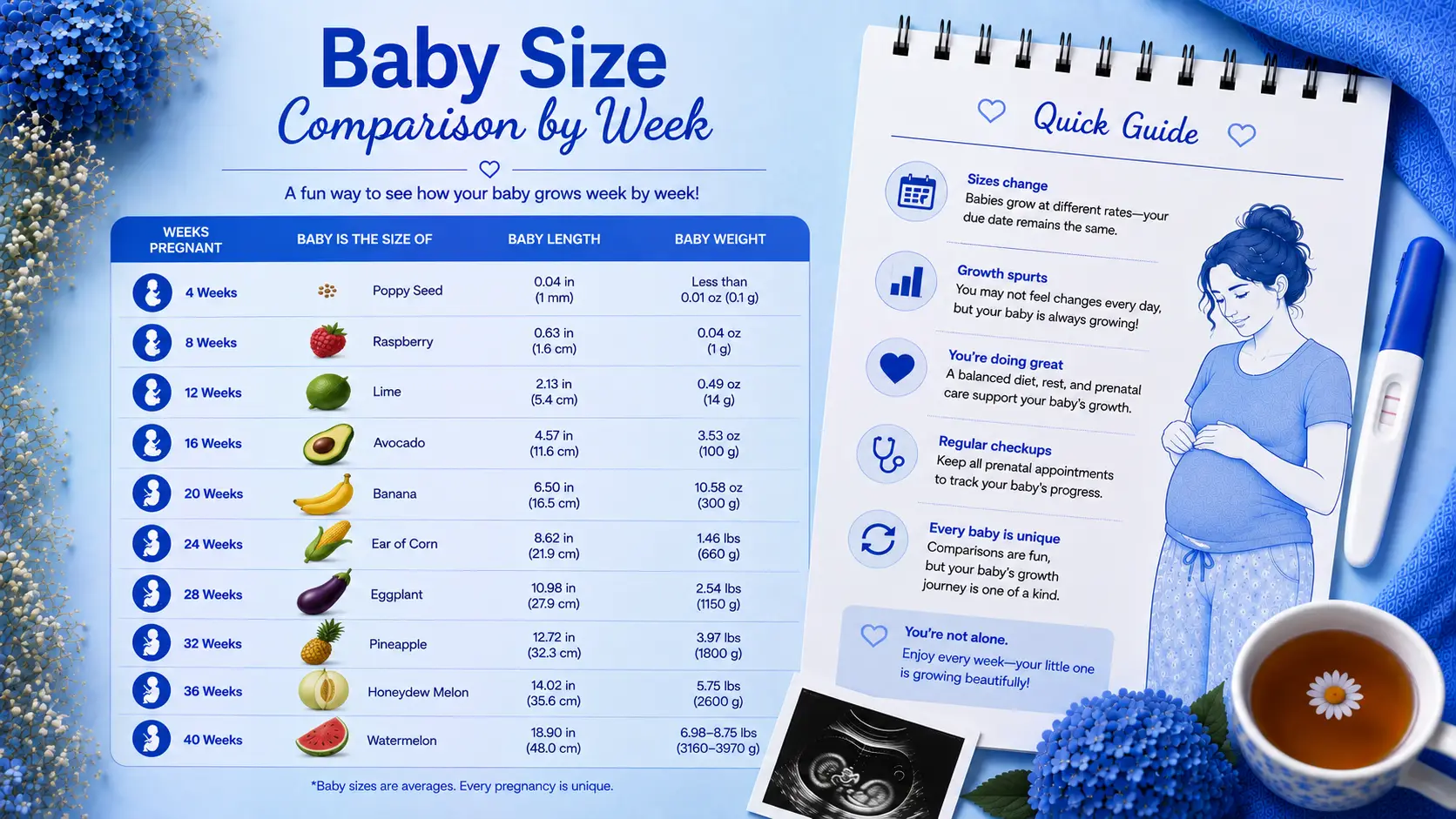
Baby Size by Week: Fruit & Veggie Comparison Chart
| Week | Fruit/Veggie Comparison | Approx. Length |
| 4 | Poppy seed | ~2 mm |
| 5 | Sesame seed | ~3 mm |
| 6 | Pomegranate seed / lentil | ~4–6 mm |
| 7 | Blueberry | ~1.3 cm |
| 8 | Kidney bean / raspberry | ~1.6 cm |
| 9 | Grape | ~2.3 cm |
| 10 | Kumquat | ~3.1 cm |
| 11 | Fig | ~4.1 cm |
| 12 | Lime | ~5.4 cm |
| 13 | Lemon | ~7.4 cm |
| 14 | Peach | ~8.7 cm |
| 15 | Apple | ~10.1 cm |
| 16 | Avocado | ~11.6 cm |
| 17 | Turnip | ~13 cm |
| 18 | Bell pepper | ~14.2 cm |
| 19 | Heirloom tomato | ~15.3 cm |
| 20 | Banana | ~25.6 cm |
| 21 | Carrot | ~26.7 cm |
| 22 | Spaghetti squash | ~27.8 cm |
| 23 | Large mango | ~28.9 cm |
| 24 | Ear of corn | ~30 cm |
| 25 | Rutabaga (swede) | ~34.6 cm |
| 26 | Scallion / red cabbage | ~35.6 cm |
| 27 | Cauliflower | ~36.6 cm |
| 28 | Large eggplant / head of lettuce | ~37.6 cm |
| 29 | Butternut squash | ~38.6 cm |
| 30 | Cabbage | ~39.9 cm |
| 31 | Coconut | ~41.1 cm |
| 32 | Jicama / bunch of celery | ~42.4 cm |
| 33 | Pineapple | ~43.7 cm |
| 34 | Cantaloupe | ~45 cm |
| 35 | Honeydew melon | ~46.2 cm |
| 36 | Romaine lettuce | ~47.4 cm |
| 37 | Small watermelon / winter melon | ~48.6 cm |
| 38 | Leek | ~49.8 cm |
| 39 | Mini watermelon | ~50.7 cm |
| 40 | Small pumpkin | ~51.2 cm |
Note: these are average length/comparison figures based on general obstetric growth data. Individual babies vary, and this chart is meant as a visual guide, not a medical measurement.
Why Fruit Comparisons Are So Popular
Fetal measurements come from ultrasound data — things like crown-rump length in early pregnancy, and head-to-heel length later on, alongside measurements like head circumference, abdominal circumference, and femur length. These numbers are clinically useful but hard to picture. Comparing them to a lime, an avocado, or a small pumpkin gives an intuitive, visual sense of growth that millimeters and centimeters just don’t provide — which is exactly why these charts are such a popular way to follow “how big is my baby” throughout the weeks.
How Baby Size Is Measured at Different Stages
First trimester: Size is measured by crown-rump length (head to bottom), since the baby is still curled up
Second and third trimester: Measurements shift to crown-to-heel length (head to toe) as the baby straightens out, along with weight estimates from ultrasound
Growth isn’t perfectly linear — babies tend to grow faster in some weeks than others, and healthy size ranges are wider than people often expect
A Few Milestones Worth Noting
Week 12 (lime): the baby has all major organs and body parts formed, marking the end of the first trimester
Week 20 (banana): the halfway point of pregnancy, and when the anatomy scan typically happens
Week 24 (ear of corn): the point of viability, when a baby has a chance of survival with specialized medical care if born early
Week 28 (eggplant/lettuce): the start of the third trimester
Week 37 (small watermelon): early term, generally considered developed enough to be born safely
Week 40 (small pumpkin): full due date, though full-term is technically any time from 39 to 40 weeks 6 days
A Word of Caution on Size Comparisons
It’s worth remembering that these charts show averages, not targets. Every baby grows at their own pace, and a healthy pregnancy can fall anywhere within a fairly wide size range at any given week. If you’re ever concerned about your baby’s growth, your ultrasound measurements and your provider’s assessment are far more reliable than any fruit comparison — the chart is just a fun way to visualize the journey, not a diagnostic tool.
FAQ
How accurate are fruit size comparisons in pregnancy?
They’re meant to be a fun, general visual guide rather than a precise measurement. Actual fetal size varies by individual, and your provider’s ultrasound measurements are the accurate source for tracking your baby’s specific growth.
What fruit is the baby compared to at 20 weeks, the halfway point?
A banana — roughly 25–26 cm long, which is also when many people have their anatomy scan.
How big is a baby at birth compared to fruit?
At full term (around 40 weeks), babies are often compared to a small pumpkin, typically weighing around 7–8 pounds and measuring about 20 inches.
Why does baby size measurement change from crown-rump to head-to-heel?
In early pregnancy, the baby is curled up, so crown-rump length (head to bottom) is the most reliable measurement. Later, as the baby straightens out, providers switch to head-to-heel length for a more accurate full-body measurement.
Is it normal for my baby to be a different size than the fruit chart suggests?
Yes, completely. These charts represent averages, and healthy babies can be smaller or larger than the “typical” comparison at any given week. Consistent growth over time matters more than matching an exact chart figure.