
The first trimester spans weeks 1 through 13 of pregnancy — roughly the first three months — and it’s the period of the fastest, most critical development your baby will ever experience. By the end of it, every major organ has formed. Here’s what happens week by week, plus the symptoms, appointments, and safety basics worth knowing.
How Pregnancy Weeks Are Counted
Pregnancy is dated from the first day of your last menstrual period (LMP), not from conception. That means weeks 1 and 2 technically happen before you’re pregnant at all — ovulation occurs around the end of week 2, and conception and implantation follow in weeks 3 and 4. It’s a common source of confusion, but it’s how every provider and due date calculator measures your timeline.
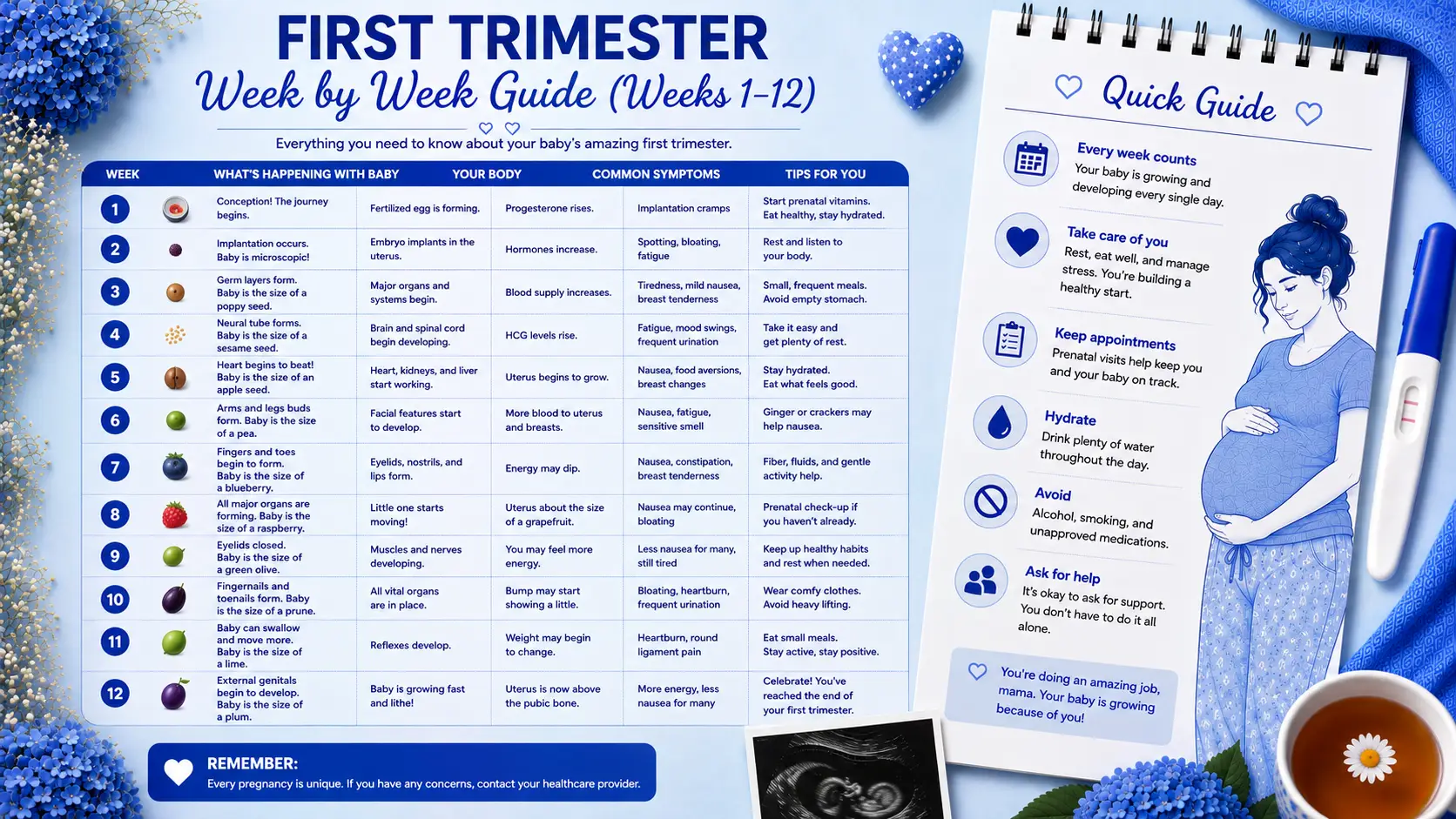
Weeks 1–4: Conception and Implantation
Weeks 1–2: This is your period and the lead-up to ovulation — before conception has actually happened.
Week 3: Conception occurs, and the fertilized egg begins traveling toward the uterus.
Week 4: Implantation happens, and the embryo starts producing hCG — the hormone that shows up on a positive pregnancy test. Your baby is about the size of a poppy seed. Many people notice light spotting or cramping around implantation, and by the end of this week, home tests can typically detect the pregnancy.
Weeks 5–8: Symptoms Kick In
Week 5: The neural tube — which becomes the brain and spinal cord — begins forming, and the earliest heart structures start pulsing.
Week 6: The heart begins beating, often visible on an early ultrasound. This is also when most people first discover they’re pregnant, and early symptoms like nausea, breast tenderness, and fatigue tend to intensify.
Week 7: Your baby is about the size of a blueberry. Brain and facial development accelerate.
Week 8: Fingers and toes begin forming, though still webbed. The embryo officially becomes known as a “fetus” around this point.
Morning sickness affects up to 80% of pregnant people and typically peaks around weeks 8–10 before gradually improving heading into the second trimester. Despite the name, it can strike at any time of day.
Weeks 9–12: Nearing the Finish Line
Week 9: Essential organs — heart, lungs, liver, kidneys — continue rapid development.
Week 10: All major body systems have formed and are beginning to function.
Week 11: The baby’s digestive system is fully formed, and the profile becomes more distinctly human.
Week 12: Your baby is about the size of a lime. Fingerprints are forming, reflexes like sucking and swallowing are developing, and — for many people — first-trimester symptoms begin to ease as hCG levels start to decline.
By the end of week 13 (the technical close of the first trimester), your baby measures about 2.9 inches from crown to rump, with all major organs formed and the foundation for the rest of pregnancy firmly in place.
Common First Trimester Symptoms
Nausea and vomiting (morning sickness)
Fatigue
Breast tenderness
Frequent urination
Food aversions or cravings
Mood swings
Heightened sense of smell
Mild cramping or light spotting
Symptoms vary enormously — some people feel almost nothing, and that’s just as normal as feeling all of the above.
Prenatal Appointments and Testing
Most providers schedule the first prenatal visit somewhere between weeks 8 and 12, though it can happen earlier if you have a history of complications or are experiencing bleeding or pain. This appointment typically includes bloodwork, a health history review, and often a dating ultrasound — sometimes your first chance to hear the heartbeat.
Nutrition and Safety Basics
Folic acid is critical early on, since the neural tube closes by around week 4 — often before pregnancy is even confirmed, which is why providers recommend starting prenatal vitamins before conception if possible
Limit caffeine to under 200 mg a day (about one 12-ounce coffee)
Avoid alcohol entirely — no amount is considered known to be safe
Steer clear of unpasteurized cheeses, deli meats, raw or undercooked seafood and eggs, and high-mercury fish
Avoid stand-alone vitamin A/retinol supplements and retinoid skincare, due to birth defect risk
Moderate exercise — walking, swimming, prenatal yoga, light strength training — is generally safe and encouraged
When to Call Your Doctor
Contact your provider promptly for heavy bleeding, severe abdominal pain, or symptoms of an ectopic pregnancy. Otherwise, mild cramping and light spotting are common and usually not cause for alarm — but it’s always reasonable to check in if something feels off.
FAQ
How many weeks is the first trimester?
The first trimester spans weeks 1 through 13 — roughly the first three months of pregnancy, counted from the first day of your last menstrual period.
When do first trimester symptoms start?
Most people notice symptoms like fatigue, nausea, and breast tenderness starting around weeks 5–6, with morning sickness typically peaking around weeks 8–10.
When is the first prenatal appointment?
Most providers schedule it between weeks 8 and 12, though it may be earlier if you have risk factors or symptoms that need evaluation sooner.
When does the baby’s heart start beating?
The heart typically begins beating around week 6, and it’s often visible on an early ultrasound around this time.
What foods should I avoid in the first trimester?
Alcohol, unpasteurized dairy and deli meats, raw or undercooked seafood and eggs, high-mercury fish, and excess caffeine (over 200 mg a day) are the main things to avoid during this stage.