
A false negative pregnancy test happens when a home urine test shows a negative result (no pregnancy) even though you are actually pregnant. These tests look for the hormone human chorionic gonadotropin (hCG), which the body starts producing after a fertilized egg implants in the uterus. While modern home pregnancy tests are highly accurate—often over 99% when used correctly after a missed period—false negatives occur more often than false positives, usually because hCG levels are still too low to detect.
Knowing the common reasons for a false negative can help you decide when to retest and when to seek medical confirmation. Many people who get an early negative result later discover they are pregnant once hormone levels rise.
How Home Pregnancy Tests Detect Pregnancy
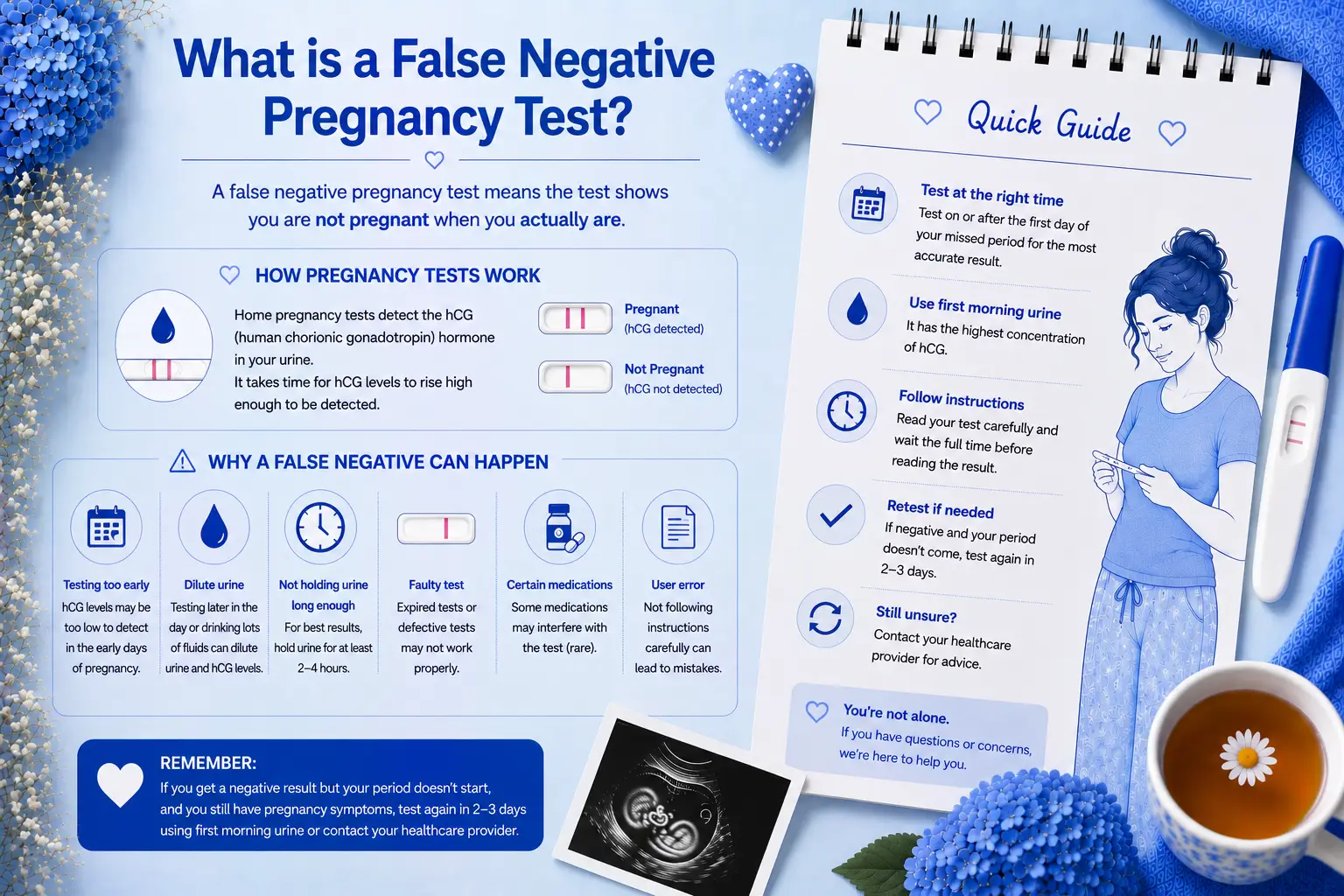
Shortly after implantation, the developing placenta produces hCG. Levels typically double every two to three days in early pregnancy. Home tests use antibodies that react to this hormone in urine, displaying results as lines, symbols, or digital words such as “not pregnant.”
Sensitivity differs between brands. Some early-detection tests can pick up lower hCG levels, but even the most sensitive ones work best after the first day of a missed period. Testing too early remains the leading cause of inaccurate negatives.
Common Causes of a False Negative Pregnancy Test
Several everyday factors can prevent the test from detecting hCG:
Testing too early This is the most frequent reason. hCG needs time to build up after implantation. If you test before or right around the expected period—especially if ovulation occurred later than usual—the hormone may not yet reach the test’s detection threshold. Waiting until at least the day of your missed period (or a few days after) greatly improves accuracy.
Diluted urine Drinking large amounts of fluids before testing can dilute hCG in the urine, making it harder for the test to detect. First-morning urine is usually the most concentrated and reliable. If you test later in the day, try to hold your urine for at least a few hours beforehand.
Incorrect timing when reading the result Checking the test too soon (before the recommended wait time) or too late can produce inaccurate results. Always set a timer and follow the package instructions exactly. Reading outside the stated window is a common user error.
Expired, damaged, or faulty test Pregnancy tests have expiration dates. The chemicals that detect hCG can degrade over time or if the test has been stored improperly. A defective test may simply fail to react properly.
Miscalculated cycle or irregular periods If your cycles vary in length, you may think you have missed a period when ovulation actually occurred later. This shifts the timeline for when hCG becomes detectable. Irregular cycles make it harder to know the optimal testing day.
The “hook effect” (rare) In uncommon cases, especially later in pregnancy or with multiples (twins or more), extremely high hCG levels can overwhelm the test. The excess hormone interferes with the antibodies, producing a false negative. This is rare but documented and more likely with advanced pregnancies or molar pregnancies.
How Common Are False Negative Pregnancy Tests?
False negatives are more common than false positives, particularly when testing early. Studies and clinical experience show that accuracy improves significantly after a missed period. Some research has noted that certain tests can miss pregnancies even weeks later due to high hormone fragments or the hook effect, though this affects a small percentage of cases. Overall, waiting a few days and retesting reduces the chance of error.
What to Do If You Suspect a False Negative
If you get a negative result but still feel pregnant, have a late period, or have pregnancy symptoms:
Wait a few days (ideally 3–7 days) and retest with a new kit using first-morning urine.
Consider a more sensitive early-detection test if available.
Contact a healthcare provider for a blood hCG test, which can detect lower levels of the hormone and track whether levels are rising.
Discuss any symptoms such as nausea, breast tenderness, fatigue, or spotting.
A blood test or ultrasound provides clearer confirmation. If periods remain absent and tests stay negative, a doctor can also investigate other causes such as hormonal imbalances, stress, thyroid issues, or polycystic ovary syndrome (PCOS).
Tips for More Accurate Results
Wait until at least the first day of a missed period for the highest reliability.
Use first-morning urine whenever possible.
Read and follow the instructions carefully, including the exact wait time.
Check the expiration date before using any test.
Avoid excessive fluids right before testing.
If cycles are irregular, track ovulation or wait longer after unprotected sex (at least 21 days) before testing.
Home pregnancy tests are a useful first tool, but they are not perfect. Timing and proper technique make the biggest difference. When results do not match how you feel or your cycle history, professional medical testing offers the most reliable answer.
FAQ
Can you be pregnant with a negative pregnancy test?
Yes. A false negative is possible, especially if you tested too early, used diluted urine, or have irregular cycles. Retesting a few days later or getting a blood test can confirm.
How soon can you take a pregnancy test for accurate results?
For the most reliable results, wait until the day of your expected period or later. Some sensitive tests claim to work up to six days earlier, but accuracy is lower then and false negatives are more likely.
Why is my period late but the pregnancy test is negative?
Possible reasons include testing too early, late ovulation, stress, hormonal changes, or other medical factors. If the period does not start and tests remain negative, see a healthcare provider.
Can diluted urine cause a false negative pregnancy test?
Yes. Excess fluids can lower the concentration of hCG in urine. Testing with first-morning urine or after holding urine for several hours helps avoid this.
Should I see a doctor after a negative home pregnancy test?
If your period is late, you have pregnancy symptoms, or you continue to get negative results with no period, yes. A blood test can detect lower hCG levels and rule out or confirm pregnancy more accurately.