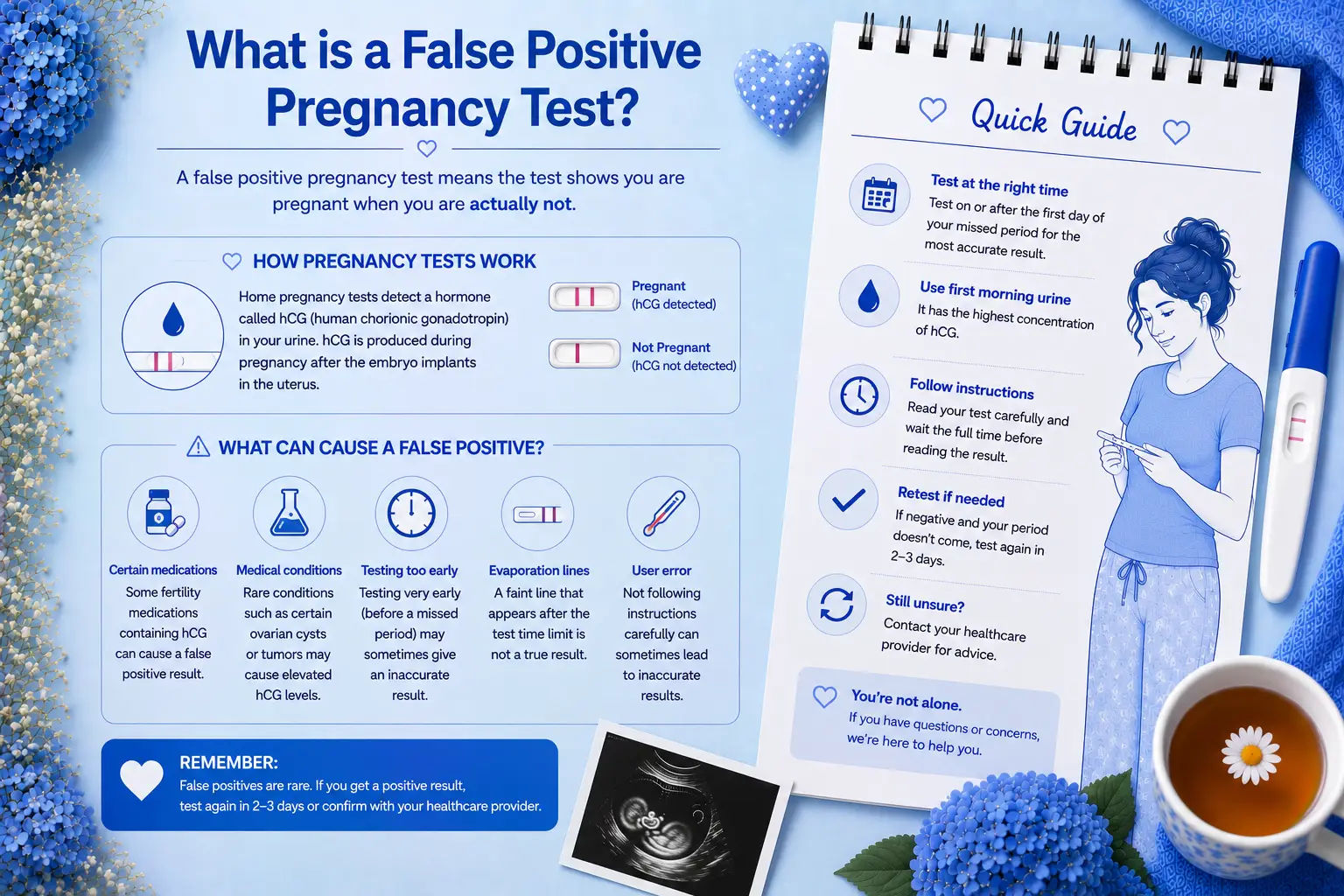

A false positive pregnancy test occurs when a home urine test shows a positive result (indicating pregnancy) even though you are not pregnant. These tests detect the hormone human chorionic gonadotropin (hCG), which the body produces after a fertilized egg implants in the uterus. While home pregnancy tests are highly accurate—often claiming over 99% accuracy when used correctly—a true false positive is rare. More often, the positive result reflects a real but short-lived pregnancy or residual hCG from another source.
Understanding why this happens helps reduce confusion and guides next steps. Most people who see a positive result are pregnant, but certain situations can produce a misleading positive.
How Home Pregnancy Tests Work
After implantation, the developing placenta begins producing hCG. Levels rise rapidly in early pregnancy, roughly doubling every two to three days. Home tests use antibodies that react to hCG in urine, typically showing results as lines, symbols, or digital words like “pregnant.”
Sensitivity varies by brand. Some can detect very low levels of hCG, which is useful for early testing but also increases the chance of picking up transient or non-pregnancy sources of the hormone. For the most reliable results, follow the instructions carefully, check the expiration date, use first-morning urine (when hCG is most concentrated), and read the result within the stated time window.
Common Causes of a False Positive Pregnancy Test
Several factors can lead to a positive result without an ongoing viable pregnancy. Here are the main ones:
Chemical pregnancy (early pregnancy loss) This is one of the most frequent explanations. A chemical pregnancy occurs when a fertilized egg implants and produces enough hCG to trigger a positive test, but the pregnancy stops developing very early—often before an ultrasound can confirm it. Many people experience a slightly delayed period and may never realize a pregnancy began. Chromosomal abnormalities are a common underlying reason. Sensitive modern tests detect these early losses more often than older tests did.
Recent pregnancy, miscarriage, or abortion hCG does not disappear immediately after a pregnancy ends. Levels can remain detectable for several weeks (sometimes up to four to six weeks or longer, depending on how high they were). Testing too soon after a miscarriage, abortion, or childbirth can produce a positive result that reflects residual hormone rather than a new pregnancy.
Fertility medications containing hCG Certain fertility treatments use injectable hCG (such as Ovidrel, Pregnyl, or Novarel) to trigger ovulation. These can stay in the system for up to 10–14 days and cause a positive test. Most other medications—including antibiotics, birth control pills, and common pain relievers—do not affect pregnancy test results.
User error or test issues Reading the test after the recommended time window can create an evaporation line—a faint, often colorless mark that appears as urine dries. This is not a true positive. Using an expired test, not following the instructions precisely, or misinterpreting faint lines can also lead to confusion. Evaporation lines typically lack color and appear later than a real result.
Medical conditions Rarely, elevated hCG or substances that interfere with the test can come from other sources. These include certain ovarian cysts, menopause or perimenopause (when hormone fluctuations occur), kidney issues, or, in very uncommon cases, specific tumors or cancers that produce hCG-like substances. Ectopic pregnancy (implantation outside the uterus) and molar pregnancy also produce hCG and will show positive on a test; these are genuine pregnancies but are not viable and require medical attention.
How Common Are False Positive Pregnancy Tests?
True false positives—where no pregnancy occurred at all—are uncommon. Manufacturers and medical sources describe them as rare. Many apparent false positives are actually chemical pregnancies or residual hCG from a recent pregnancy. False negatives (missing an actual pregnancy, often from testing too early) occur more frequently than false positives.
What to Do If You Suspect a False Positive
If you receive a positive result:
Retest in a few days with a new kit, preferably using first-morning urine.
See a healthcare provider for a blood hCG test, which is more precise and can track whether levels are rising, falling, or stable.
Discuss any recent pregnancies, fertility treatments, or symptoms (bleeding, pain, etc.).
A blood test or ultrasound can clarify the situation quickly. Early medical confirmation also allows timely care if the pregnancy is ectopic or otherwise complicated.
Tips for More Accurate Testing
Wait until at least the day of your expected period (or a few days after) for higher accuracy.
Follow the package directions exactly, including timing.
Avoid excess fluids before testing, which can dilute urine.
Store and use tests before their expiration date.
Confirm any positive result with a clinician, especially if you have irregular cycles, are perimenopausal, or are undergoing fertility treatment.
Home pregnancy tests remain a convenient and reliable first step for most people. Knowing the possible reasons for a false positive reduces unnecessary worry and helps you seek appropriate follow-up. If results are confusing or symptoms arise, professional medical advice is the best next move.
FAQ
How common is a false positive pregnancy test?
True false positives are rare. Most home tests are over 99% accurate when used correctly after a missed period. Many “false” positives turn out to be chemical pregnancies or leftover hCG from a recent pregnancy or medication.
Can medications cause a false positive pregnancy test?
Only certain fertility drugs that contain hCG can. Antibiotics, birth control, and most other common medications do not affect results.
What is a chemical pregnancy and how does it relate to false positives?
A chemical pregnancy is a very early pregnancy loss after implantation. It produces enough hCG for a positive test, but the pregnancy does not continue. This is a frequent reason people see a positive followed by a period or negative follow-up tests.
How can I tell an evaporation line from a real positive?
An evaporation line is usually colorless or gray, appears after the recommended reading time, and does not match the color of the control line. A true positive shows color within the stated time window.
Should I see a doctor after a positive home pregnancy test?
Yes. A healthcare provider can confirm the result with a blood test or ultrasound, rule out complications such as ectopic pregnancy, and provide guidance on next steps whether the pregnancy is continuing or not.