
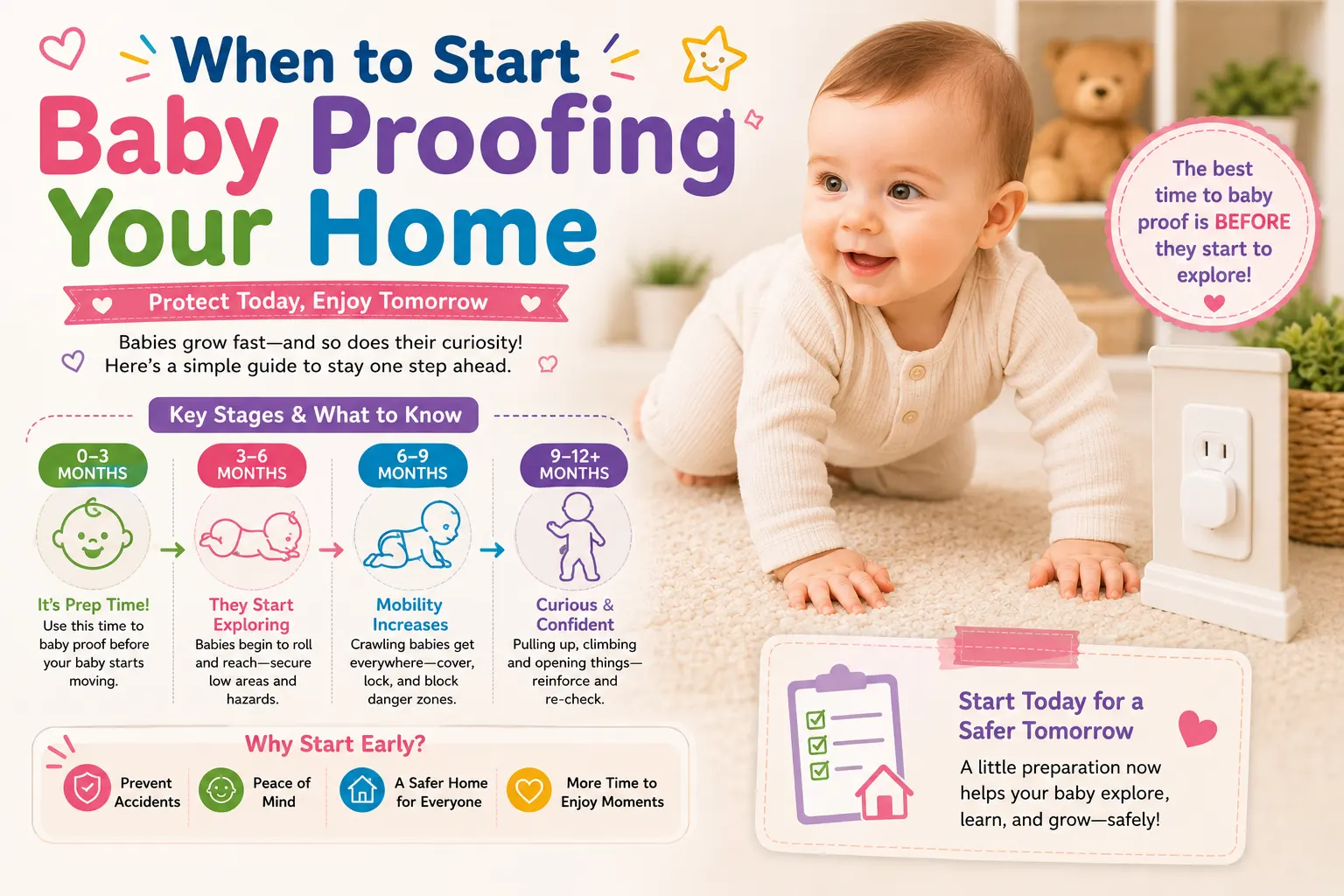

“I’ll baby proof once they start crawling” is the most common plan parents describe — and it’s also the plan that leaves the most families scrambling. Babies reach for objects around 4 months, roll as early as 4–5 months, and some skip crawling entirely and go straight from sitting to cruising along furniture. By the time crawling is obvious, several other risks are often already active.
This guide walks through the real milestone timeline, the specific signs that mean a hazard is about to become relevant, and why “before they need it” is the only timing that actually works.
Quick answer: Start baby proofing before birth for the highest-impact items (furniture anchors, safe sleep setup), then add layers by 4 months (reaching), 6 months (rolling and sitting), and 7–10 months (crawling) — waiting until crawling is confirmed is typically too late for several hazard categories.
Why “Wait Until They Crawl” Doesn’t Work
Two things make the “wait for crawling” plan risky:
- Reaching starts long before crawling. Around 4 months, babies begin deliberately reaching and grasping — which means anything within arm’s reach of a bouncer, changing table, or the floor near a couch is already a hazard, months before mobility.
- Rolling can happen even earlier, and unpredictably. Rolling typically starts between 4–7 months, and once a baby can roll, they can also reach new locations in a room they couldn’t get to the day before — this catches many parents off guard specifically because it doesn’t look like “real” mobility yet.
By the time crawling is confirmed and obvious, a baby has often already had weeks or months of increasing reach and occasional rolling-based repositioning — which is exactly the window when unanchored furniture, loose cords, and reachable outlets become relevant.
The Real Milestone Timeline
| Age | Typical Milestone | Relevant Hazard Becomes Active |
|---|---|---|
| 0–3 months | Lifts head, begins tracking objects | Low, but start planning now |
| 4–5 months | Reaches and grasps deliberately; rolling may begin | Anything within arm’s reach; loose small objects nearby |
| 6 months | Sits with support; many begin solids | Choking hazards at floor and low-table level |
| 6–8 months | Rocks on hands and knees; some begin scooting | Furniture edges; anything at crawling-height reach |
| 7–10 months | Crawling typically begins (range: 6–12 months) | Stairs, cabinets, outlets, cords, all floor-level hazards |
| 9–12 months | Pulls to stand, cruises along furniture | Tip-over risk on any furniture used to pull up; window access |
| 12–18 months | First independent steps | Full-height reach increases; climbing begins |
This range is wide by design — pediatric guidance is consistent that healthy babies vary significantly in timing, and a baby who’s “behind” on one milestone but progressing on others is usually not a concern. What matters for baby proofing purposes isn’t hitting an exact week, but staying a stage ahead of wherever your baby currently is.
Signs a Milestone Is About to Happen
Rather than tracking your baby’s age alone, watch for these physical signs, which tend to appear days to weeks before the milestone itself:
- About to reach and grasp: batting at objects, bringing hands to midline, watching hands with interest
- About to roll: lifting head and chest during tummy time, rocking side to side on their back
- About to sit: pushing up on arms during tummy time, briefly holding a sitting position when propped
- About to crawl: rocking on hands and knees, pivoting in a circle while on their belly, scooting backward before moving forward
- About to pull up and cruise: pulling knees under themselves to a kneeling position, reaching up for furniture edges while seated
When you see any of these signs, treat the next milestone’s hazards as already relevant — not the current one.
What to Baby Proof at Each Stage
Before your baby shows any of these signs (ideally before birth): Anchor tall furniture and TVs, set up a safe sleep space, install smoke and CO detectors. These don’t depend on your baby’s mobility at all, so there’s no reason to wait.
Once you see reaching signs (often 3–4 months): Clear small objects from surfaces at bouncer or changing-table height, secure any dangling cords near where your baby spends time, and start covering outlets in rooms your baby is regularly in.
Once you see rolling or pre-sitting signs (often 4–6 months): Extend the same clearing to any floor-level surface your baby might roll toward, and begin locking low cabinets in rooms where floor time happens.
Once you see crawling-readiness signs (often 6–8 months): Install stair gates now, before crawling is confirmed — this is the single most commonly delayed item, and stairs are one of the highest-risk hazards once mobility exists.
Once you see pulling-up signs (often 8–10 months): Re-check every piece of furniture your baby could use to pull up on for tip-over risk, and add window guards if you haven’t already.
The Babies Who Skip Stages Entirely
Not every baby crawls in the traditional sense, and some skip it entirely — moving straight from sitting to pulling up and cruising. This matters for baby proofing because it means you can’t rely on “they haven’t started crawling yet” as a reason to delay stair gates or furniture anchoring. A baby who skips crawling can still reach cruising and early walking on the same general timeline as a baby who crawled first, so the safer approach is to baby proof for mobility broadly, rather than for crawling specifically.
If You’re Starting Late
If your baby is already mobile and you’re behind on baby proofing, prioritize in this order rather than trying to do everything at once:
- Stairs (gates at top and bottom)
- Furniture and TV anchoring
- Outlets and cords
- Cabinets with chemicals or medicine
- Everything else, room by room
A baby who’s already crawling or cruising doesn’t need you to catch up on every hazard simultaneously — closing off the highest-risk areas first (like stairs) while you work through the rest is a reasonable, safe approach.
Continue exploring: browse the full Baby Safety hub.
Frequently Asked
Common Questions