
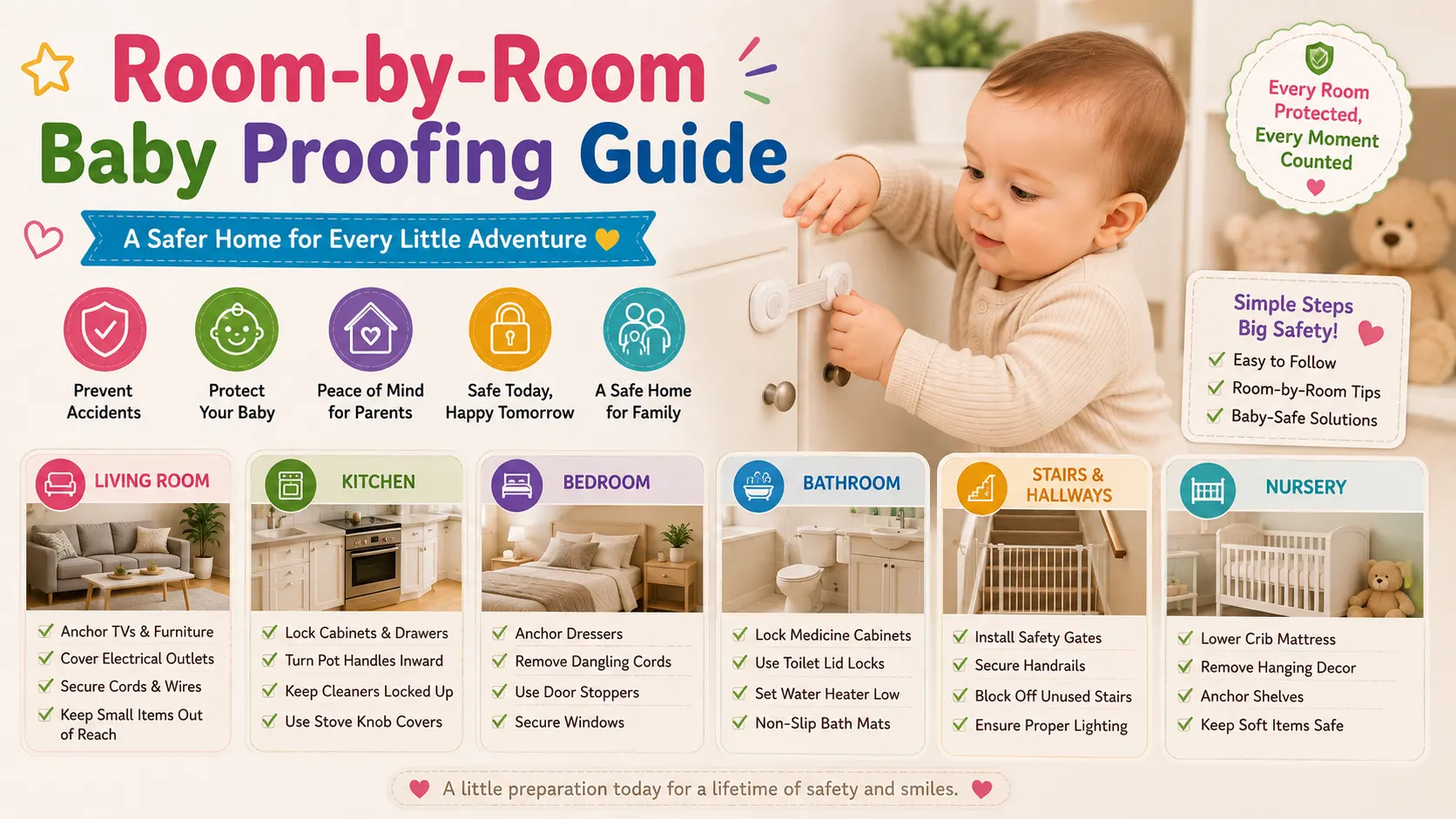

Most baby proofing guides either give you one giant checklist with no order of priority, or focus on a single room and leave you to figure out the rest. This guide does both: it tells you what to fix first, no matter your budget or timeline, then walks through every room in the house with the specific hazards that actually cause injuries in each one.
Quick answer: Start with the five highest-impact fixes regardless of room: anchor tall furniture and TVs, cover outlets, lock cabinets with chemicals or medicine, gate the stairs, and lower your water heater to 120°F (49°C) — together these address the leading causes of home injury and death for young children.
The 5 Fixes to Do First, Before Anything Else
If you only do five things before your baby starts moving, do these — they address the categories responsible for the most child injuries and deaths at home:
- Anchor tall furniture and TVs. Furniture and TV tip-overs injure an estimated 17,800 people a year in the U.S., and the vast majority of deaths from tip-overs involve children under five. Bookcases, dressers, and TV stands all need wall anchors installed into a wall stud, not just drywall.
- Cover accessible outlets. Use tamper-resistant outlet covers, not the small loose plug covers, which are themselves a choking hazard once removed.
- Lock up chemicals and medicine. Anything you wouldn’t want in your baby’s mouth — cleaning supplies, medications, laundry pods — needs a lock or to move to a high shelf.
- Gate the stairs. Install gates at both the top and bottom before your baby is mobile enough to reach them. Use hardware-mounted gates at the top of stairs specifically, since a pressure-mounted gate can be pushed loose under a fall’s weight.
- Check your water heater temperature. Set it to 120°F (49°C) or lower to prevent scalding — a baby’s skin burns far faster than an adult’s at higher temperatures.
Together these five categories cost relatively little (often under $50 total for anchors, covers, and locks) and address the highest-risk hazards in almost every home.
When to Start Baby Proofing (by Age and Milestone)
Baby proofing isn’t a single event — it’s phased in as your baby’s mobility changes:
| Age / Stage | What to Add |
|---|---|
| Before birth – 3 months | Anchor furniture, set up safe sleep space, install smoke/CO detectors |
| 4–6 months (rolling, sitting) | Remove small objects from floor level, add corner guards, secure loose cords |
| 6–10 months (crawling) | Install stair gates, add cabinet and drawer locks, lock the toilet lid |
| 10–14 months (pulling up, walking) | Re-check furniture stability, add door knob covers, install window guards |
| 14+ months (climbing, running) | Reassess every few months — a climbing toddler reaches things a crawler couldn’t |
A good rule: baby proof for the next stage before your baby reaches it, not after. Most parents underestimate how quickly crawling turns into climbing.
Kitchen Baby Proofing
- Lock any cabinet or drawer containing cleaning supplies, sharp tools, or small appliances with removable parts
- Leave one low cabinet unlocked and filled with baby-safe items (plastic containers, wooden spoons) to satisfy natural curiosity without a fight
- Use stove knob covers, and turn pot handles inward while cooking
- Store trash and recycling behind a locked cabinet or use a lidded bin baby can’t open
- Unplug and store small appliances (blenders, toasters) when not in use, and keep their cords off the counter edge
- Keep magnets (including decorative fridge magnets) out of reach — small, strong magnets are a serious ingestion hazard
Bathroom Baby Proofing
- Lock the toilet lid with a toilet lock, both for drowning risk and to prevent objects being dropped in
- Store all medications, supplements, and toiletries in a locked cabinet, not just a high one — babies become climbers faster than expected
- Set your water heater to 120°F (49°C) or lower, and always test bathwater with your wrist or a thermometer before placing your baby in
- Use a non-slip mat in the tub and consider a soft spout cover to prevent bump injuries
- Never leave your baby unattended in the bath, even for a few seconds — this applies regardless of any other safety product in place
- Keep razors, hair tools, and any small items off the edge of the tub or sink
Living Room Baby Proofing
- Anchor every tall piece of furniture — bookcases, entertainment centers, media consoles — to a wall stud
- Add corner and edge guards to coffee tables and low furniture with sharp corners, a leading cause of injury for new walkers between 8 and 24 months
- Secure the TV with an anti-tip strap in addition to any furniture it sits on, or wall-mount it directly
- Check remotes, key fobs, and any battery-powered item for accessible button batteries, which can cause serious internal injury if swallowed
- Remove small decorative items and breakables from low shelves and tabletops
- Verify houseplants are non-toxic — common varieties like pothos, philodendron, and peace lily are poisonous if ingested
Nursery and Bedroom Baby Proofing
- Confirm the crib meets current safety standards and check for recalls before use
- Keep the crib empty — no bumpers, pillows, loose blankets, or stuffed animals
- Anchor all dressers, bookshelves, and changing tables to the wall, the same as in any other room
- Position the crib away from windows, blinds, and any dangling cords
- Secure the changing table with a safety strap, and never leave your baby unattended on it, even briefly
- Use cordless window coverings in the nursery specifically, since this is the room your baby spends the most unsupervised time in
Stairs, Hallways, and Doors
- Install gates at both the top and bottom of every staircase before your baby is mobile enough to reach them
- Use hardware-mounted gates at the top of stairs — a fall from the top is the highest-risk scenario, and pressure-mounted gates aren’t rated for that location
- Add door knob covers to rooms you want off-limits (home offices, laundry rooms, garages)
- Check for gaps in railings wider than about 4 inches, which a baby’s head could pass through
- Keep hallways clear of trip hazards, especially once your baby is an early walker
Windows and Blinds (Every Room)
- Replace corded blinds with cordless versions wherever possible — corded blinds are a documented strangulation hazard
- If you can’t replace them yet, keep all cords and loops at least 36 inches above the floor using cord cleats mounted well out of reach
- Install window guards or stops that limit how far a window can open, generally to less than 4 inches
- Move furniture away from windows so it can’t be used as a step to climb toward one
Backyard and Garage
- Fence off pool access completely, separate from the general yard fence, with a self-closing and self-latching gate
- Store all garage chemicals, tools, and sharp equipment on high shelves or in locked cabinets
- Check for choking hazards in yard areas — mulch, small rocks, and fallen berries are easy to miss
- Secure any outdoor furniture or fire pits that could tip or burn
- Cover any accessible outdoor outlets the same as indoor ones
A Note on Rooms You Don’t Control (Grandparents, Rentals)
Not every space your baby spends time in is one you can fully modify:
- At relatives’ houses: Bring a portable kit (outlet covers, a travel gate, cabinet locks) and do a quick walkthrough of the specific room your baby will be in before you relax
- In a rental: Favor no-drill solutions — pressure-mounted gates where appropriate, furniture anchors that use adhesive mounts rather than drilling, and removable cord cleats — see our dedicated guide on renter-friendly baby proofing for a full breakdown
Continue exploring: browse the full Baby Safety hub.
Frequently Asked
Common Questions