
Prenatal vitamins get so much attention during pregnancy that it’s easy to assume more must be better. If one prenatal is good, would two be even better? Would adding extra vitamin C, vitamin D, or a separate iron supplement give your baby an extra boost? The honest answer is no — and in some cases, taking too many vitamins during pregnancy can actually be harmful. Here’s what’s worth knowing.
Vitamin Overdose During Pregnancy Is Possible
It’s a common misconception that vitamins are automatically safe simply because they’re “natural” or sold over the counter. In reality, vitamin overdose during pregnancy happens when you take more than the recommended daily amount — whether that’s from doubling up on a multivitamin, taking a prenatal alongside separate vitamin tablets, or combining several supplements that all contain the same nutrient without realizing it.
A helpful rule of thumb: taking more than twice the recommended daily allowance (RDA) of any nutrient is generally something to avoid during pregnancy. This is exactly why doctors ask about every supplement you’re taking, not just your prenatal.
Which Vitamins Pose the Biggest Risk in Excess?
Not all vitamins carry the same level of risk when overconsumed. Two categories matter most:
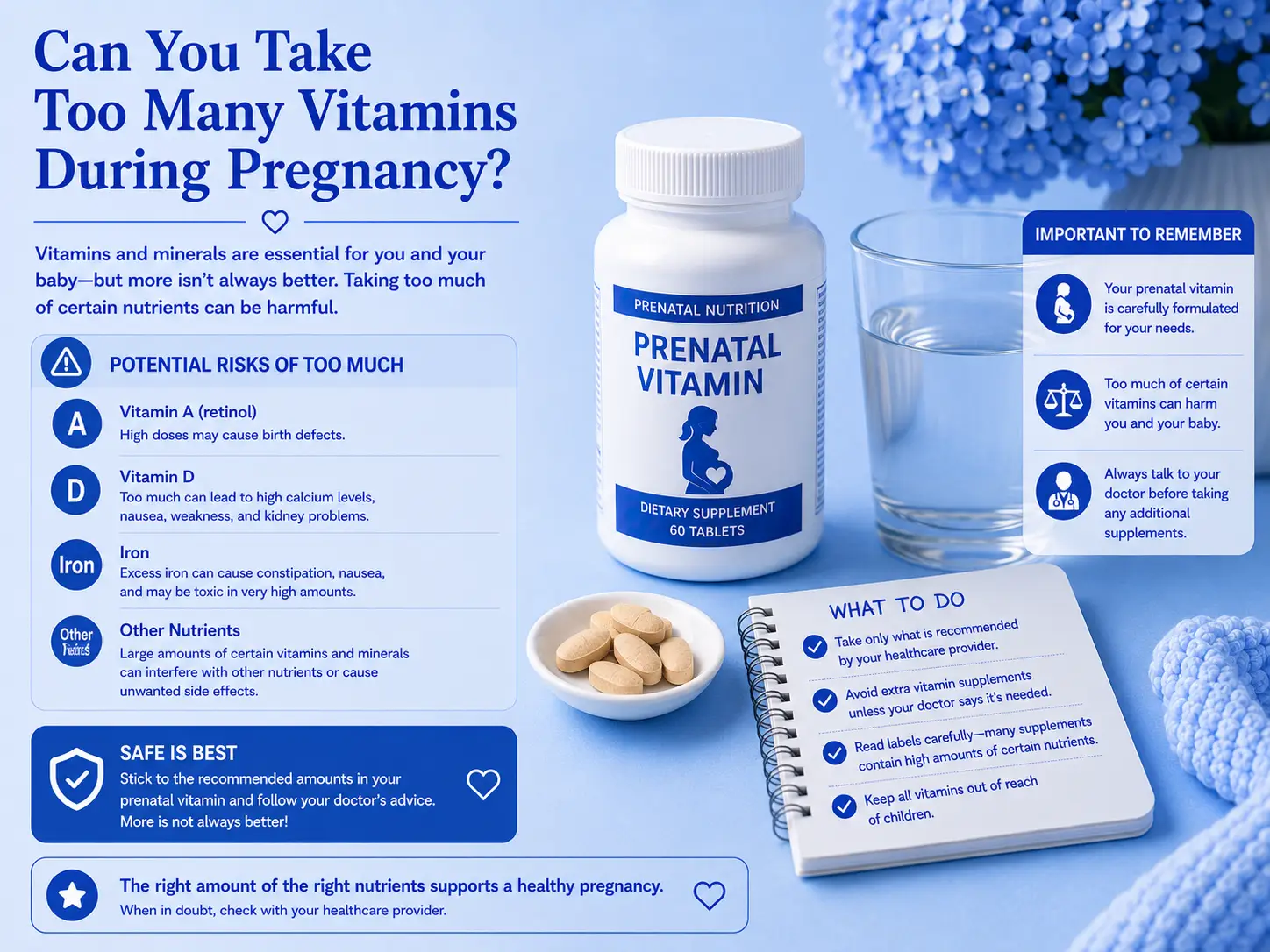
Fat-soluble vitamins (A, D, E, K) — These are stored in your liver and body fat rather than flushed out, so they can build up to toxic levels over time. Vitamin A is the biggest concern here: excessive intake, generally defined as more than 10,000 IU per day, has been linked to fetal malformations affecting the bones, urinary tract, and nervous system. This is why many prenatal vitamins deliberately use beta-carotene or conservative doses of vitamin A instead of high-dose retinol.
Iron and calcium — These are considered the two nutrients most likely to cause toxicity symptoms when significantly overdosed, even though your body does need higher amounts of both during pregnancy. Iron overdose in particular can cause gastrointestinal distress and, in severe cases, more serious complications.
Iodine is another nutrient where excess intake, not just deficiency, can cause problems during pregnancy, which is part of why it’s included in careful, measured amounts in most prenatal formulas rather than left up to separate supplementation.
By contrast, water-soluble vitamins like vitamin C and most B vitamins, including folic acid, are much harder to overdose on because your body excretes what it doesn’t need through urine. That said, “harder to overdose on” doesn’t mean unlimited — extremely high doses can still cause side effects like diarrhea or stomach upset.
What Vitamin Overdose Can Look Like
Symptoms of taking too many vitamins during pregnancy vary depending on which nutrient is involved, but commonly reported signs include:
Stomach ache or nausea
Muscle weakness or joint pain
Headaches
Skin changes, including a yellow-orange tint or rash
Increased sensitivity to sunlight
Constipation or loss of appetite
Rapid or irregular heartbeat in more severe cases
If you notice new or unusual symptoms after adjusting your supplement routine, it’s worth calling your healthcare provider rather than waiting it out.
What If You Accidentally Took an Extra Prenatal?
This is one of the most common real-world worries, and understandably so — prenatal routines get mixed up, especially in early pregnancy. The reassuring news is that a single, one-time double dose of a standard prenatal vitamin poses minimal risk. Birth defects and serious toxicity from vitamins typically require sustained megadoses over weeks, not a single accidental extra pill. Iron is usually the nutrient that causes the most noticeable discomfort in this scenario — think mild nausea or an upset stomach — but prenatal iron doses are formulated to stay well below dangerous thresholds even when doubled occasionally.
If this happens, the general advice is to stay hydrated, watch for symptoms like severe pain or vomiting, and simply resume your normal dosing the next day. Contact your provider if symptoms are severe or don’t resolve within a day.
So Do You Actually Need Extra Supplements?
For most healthy pregnancies, the answer is no. Research has consistently pointed out that only two nutrients truly require dedicated supplementation for nearly everyone: folic acid (400 mcg daily, starting before conception and continuing through the first trimester) and iodine. Beyond that, a well-balanced diet rich in vegetables, whole grains, lean protein, and healthy fats generally covers the rest — and a standard prenatal vitamin fills in any remaining gaps.
Adding extra individual supplements “just in case” is where problems tend to start. Unless a specific deficiency has been identified through bloodwork, stacking supplements on top of a prenatal is more likely to push you toward excess than to provide real benefit.
The Bottom Line
Yes, it’s entirely possible to take too many vitamins during pregnancy, and the risks are real for certain nutrients — particularly vitamin A, iron, calcium, and iodine. The safest approach is to stick to one prenatal vitamin as directed, avoid doubling up on multivitamins or adding standalone supplements without medical guidance, and always loop your OB/GYN in on anything extra you’re considering, including “natural” or herbal products.
FAQ
Can taking two prenatal vitamins in one day hurt my baby?
A single accidental double dose is generally considered low risk. Toxicity from vitamins usually requires sustained high doses over weeks, not a one-time slip-up. Still, contact your provider if you experience severe symptoms.
Which vitamin is most dangerous to take in excess during pregnancy?
Vitamin A is often flagged as the highest concern, since excessive intake has been linked to fetal malformations. Iron and calcium are also common culprits for overdose-related discomfort.
Is it safe to take a prenatal vitamin plus a separate vitamin C or vitamin D supplement?
Not without checking with your doctor first. Combining supplements can unintentionally push certain nutrients well above the recommended daily allowance, so it’s best to review your full supplement list with your provider.
What are the symptoms of taking too many vitamins while pregnant?
Common signs include stomach upset, muscle or joint pain, headaches, skin changes, and in more serious cases, a rapid heartbeat. Symptoms vary depending on which vitamin is involved.
Do I need extra folic acid on top of my prenatal vitamin?
Most prenatal vitamins already contain the recommended 400 mcg of folic acid, which is generally sufficient. Extra folic acid supplementation should only be added if your doctor specifically recommends it based on your history or bloodwork.