
The car seat may be installed perfectly in your vehicle, but there is still another critical step: making sure your child is properly secured in the harness.
One of the most common mistakes parents make is positioning the chest clip incorrectly.
Some place it too low on the child’s stomach. Others leave it too high near the neck. Some parents don’t use it at all.
The correct position is simple:
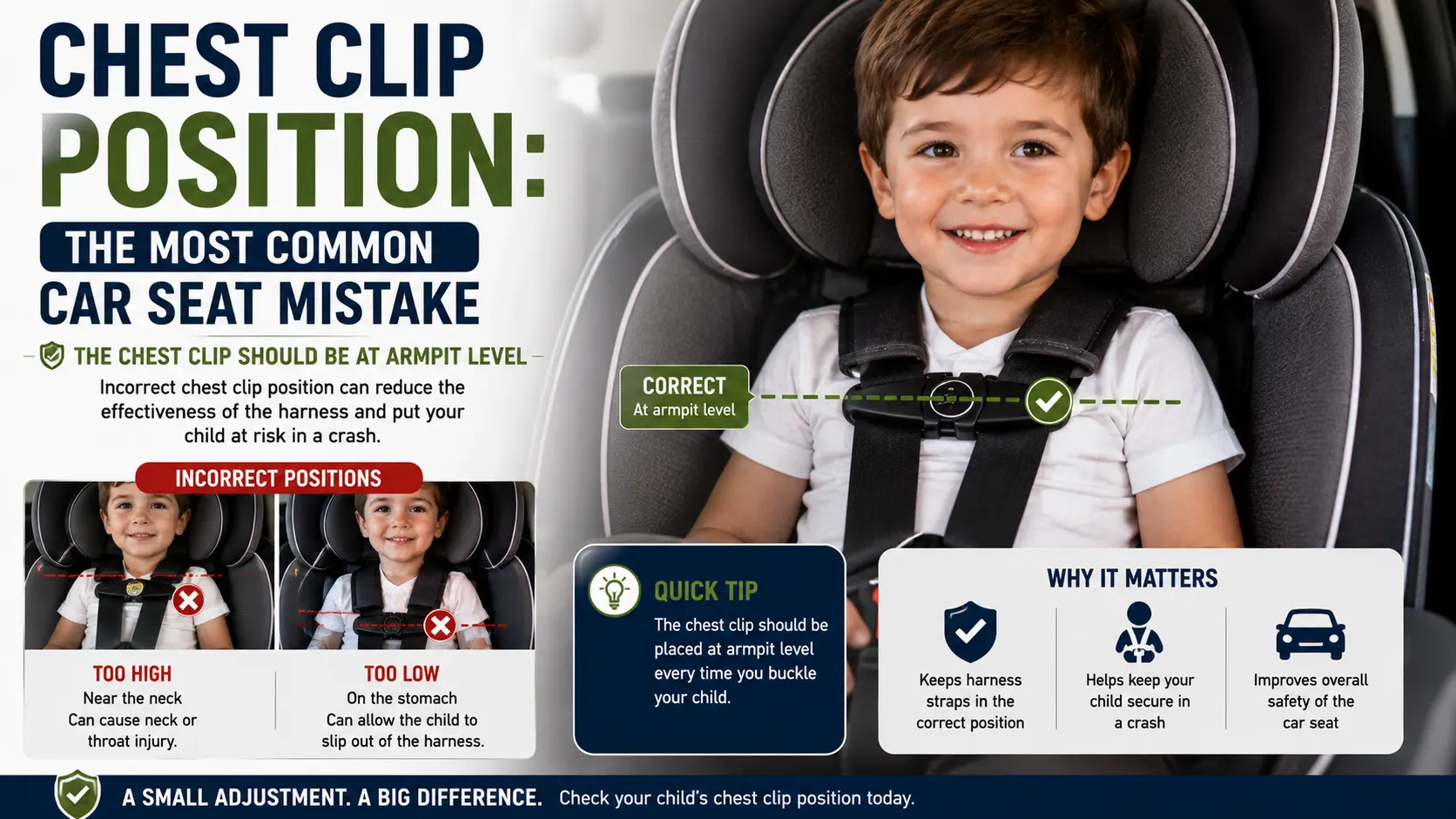
The chest clip should sit at approximately armpit level, across the child’s chest.
But getting the chest clip in the right position is only one part of proper harness use. The harness must also be snug, flat, correctly routed, and positioned at the appropriate height for your child’s size and the car seat’s configuration.
In this guide, we’ll explain exactly where the chest clip belongs, why its position matters, how to check the harness, and which common mistakes parents should avoid.
Important: Always follow the instructions provided with your specific car seat. Harness and chest-clip requirements can vary by manufacturer and model.
Where Should the Car Seat Chest Clip Be?
The chest clip should generally be positioned at the child’s armpit level, centered across the chest.
It should not sit:
- On the stomach
- Across the belly button
- Directly on the neck
- Under the armpits
- High against the throat
The clip should rest across the child’s chest at approximately the level of the armpits.
This positioning helps keep the harness straps properly positioned on the child’s shoulders.
Why Is Chest Clip Position Important?
The chest clip is not simply a comfort accessory.
Its primary purpose is to help keep the harness straps positioned correctly on the child’s shoulders.
If the clip is placed too low, the harness straps can potentially move away from the proper shoulder position.
If it’s placed too high, it may sit uncomfortably against the child’s neck.
The chest clip therefore works together with the harness system rather than functioning as the primary restraint by itself.
That’s why correct harness fit matters just as much as chest-clip placement.
The Correct Chest Clip Position: A Simple Rule
If you’re looking for one easy rule to remember:
Chest clip = armpit level.
After buckling your child into the car seat:
- Make sure both harness straps are positioned correctly over the shoulders.
- Buckle the harness.
- Bring the chest clip together.
- Slide it upward or downward until it sits approximately at armpit level.
- Tighten the harness until it is snug.
- Check that the straps remain flat and untwisted.
That’s the basic positioning check.
Chest Clip vs. Harness Buckle: What’s the Difference?
Parents sometimes confuse these two components.
They serve different purposes.
Chest Clip
The chest clip connects the two shoulder harness straps across the child’s chest.
Its purpose is to help maintain the harness straps in the proper position.
It should be positioned approximately at armpit level.
Harness Buckle
The harness buckle is the component that secures the harness straps around the child.
It is usually located lower on the child’s body, depending on the car seat design.
The two components should not be treated as interchangeable.
A correctly positioned chest clip does not compensate for a loose harness.
Does the Chest Clip Actually Hold the Child in the Car Seat?
Not by itself.
This is an important misconception.
The harness system is what restrains the child. The chest clip helps keep the shoulder straps properly positioned.
Think of it this way:
Harness = primary restraint
Chest clip = helps maintain proper harness positioning
That’s why moving the chest clip into the correct position is important, but it is not enough by itself.
The harness must also be properly tightened and adjusted.
The Most Important Check: The Harness Should Be Snug
After positioning the chest clip, perform a harness snugness check.
NHTSA advises that the harness should be snug enough that you cannot pinch extra harness webbing at the child’s shoulder. The chest clip should be positioned at approximately armpit level.
To perform the check:
- Buckle your child into the harness.
- Position the chest clip at armpit level.
- Tighten the harness.
- Place your fingers over the harness strap near the child’s shoulder.
- Try to pinch the strap vertically.
If you can easily pinch excess webbing, the harness may be too loose.
If you cannot pinch excess material, the harness is snug.
Chest Clip Too Low: Is That Dangerous?
A chest clip positioned too low is a common harness mistake.
For example, if the clip is sitting around the child’s stomach rather than near the armpits, the shoulder straps may not remain in their intended position.
Instead of allowing the clip to rest low on the abdomen, reposition it to approximately armpit level and check the harness snugness again.
If you’re unsure about the correct placement for your specific car seat, consult its manual.
Chest Clip Too High: What Happens?
The opposite mistake is positioning the chest clip too close to the child’s neck.
A chest clip that is too high can:
- Be uncomfortable
- Press against the neck
- Sit outside the intended position
- Encourage the harness straps to sit incorrectly
Move the clip down so it is centered across the chest at approximately armpit level.
It should not be resting against the child’s throat.
Should the Chest Clip Be on the Stomach?
No.
The chest clip should not be intentionally positioned around the child’s stomach or abdomen.
If you notice that the chest clip has slipped down toward the belly, stop and reposition it at approximately armpit level.
Then check the harness tension.
A chest clip that repeatedly slides down may indicate that the harness is not adjusted correctly.
What If the Chest Clip Keeps Sliding Down?
If the chest clip repeatedly moves downward after you buckle your child, don’t simply keep moving it back up without checking the harness.
First, check:
- Harness tension
- Harness routing
- Shoulder strap position
- Harness height
- Whether the straps are twisted
- Whether the car seat is appropriate for the child’s size
The chest clip should remain in the correct position during normal use.
If it consistently moves out of position, consult the car seat manufacturer’s instructions.
Chest Clip and Rear-Facing Car Seats
The chest clip should still be positioned correctly when your child is riding rear-facing.
The fact that the child faces the rear of the vehicle doesn’t change the need for a properly fitted harness.
For rear-facing use, check:
- Chest clip at approximately armpit level
- Harness snugness
- Straps lying flat
- Correct harness height
- Correct rear-facing recline angle
- Car seat installation
NHTSA recommends keeping children rear-facing as long as possible until they reach the maximum height or weight allowed by the car seat manufacturer.
Chest Clip and Forward-Facing Car Seats
The same basic chest-clip positioning applies when the child is forward-facing.
The chest clip should remain around armpit level, while the harness should be properly adjusted for the child’s size and the car seat’s forward-facing configuration.
Forward-facing seats may also require proper use of the top tether, depending on the manufacturer instructions.
Remember:
Chest clip position and car seat installation are two different checks.
The chest clip helps position the harness on the child; the tether helps secure the car seat to the vehicle.
Chest Clip Position by Age
Chest-clip positioning is not determined by age alone.
A toddler and a preschooler can both require the same general chest-clip position:
approximately at armpit level.
What changes as a child grows is often:
- Harness height
- Harness adjustment
- Car seat configuration
- Seat position
- Maximum height and weight limits
Always use the manufacturer’s instructions for your specific seat.
What About Infants?
For babies, proper harness adjustment is especially important because small children can be difficult to fit correctly.
Before each ride, make sure:
- The harness is snug.
- The straps are flat.
- The chest clip is approximately at armpit level.
- The harness is routed through the correct slots.
- The infant is positioned according to the manufacturer’s instructions.
- Any inserts being used are specifically approved for that car seat.
Don’t add aftermarket cushions, inserts, positioning devices, or padding unless the car seat manufacturer specifically permits them.
Chest Clip and Bulky Winter Clothing
Another common mistake involves putting a child into a car seat wearing a thick winter coat.
Bulky clothing can create extra space between the child’s body and the harness.
The harness may appear snug while actually being too loose around the child.
Instead, follow the car seat manufacturer’s guidance regarding clothing and harness fit.
A practical approach is to use thinner layers under the harness and add warmth over the properly tightened harness when appropriate.
The important point is:
Never loosen the harness simply to accommodate bulky clothing.
Can the Chest Clip Be Too Tight?
The chest clip should be positioned correctly without being used to compensate for an improperly adjusted harness.
The harness should provide the snug fit.
The chest clip should simply remain positioned across the chest at approximately armpit level.
If you feel that you have to tighten the chest clip excessively to keep the harness in place, check the harness adjustment and consult the car seat instructions.
Common Chest Clip Mistakes
Here are some of the most common errors parents should avoid.
1. Putting the Chest Clip on the Stomach
The clip should be approximately at armpit level—not around the belly.
2. Placing It Too Close to the Neck
The chest clip should not sit directly against the child’s throat.
3. Leaving the Harness Loose
A properly positioned chest clip cannot compensate for loose harness straps.
4. Twisting the Harness Straps
Harness straps should lie flat against the child.
5. Using the Chest Clip as the Main Restraint
The harness is the primary restraint system.
6. Loosening the Harness for a Winter Coat
Bulky clothing can interfere with proper harness fit.
7. Adding Unapproved Padding
Aftermarket products can affect the way the harness fits and should not be used unless specifically approved by the manufacturer.
8. Forgetting to Reposition the Clip
The chest clip can move while placing a child into the seat.
Always check its final position before driving.
The 5-Second Chest Clip Check
Before driving, you can quickly check the harness in five steps:
1. Shoulders:
Are both harness straps sitting correctly over the shoulders?
2. Straps:
Are they flat and untwisted?
3. Snugness:
Can you pinch excess webbing at the shoulder?
4. Chest Clip:
Is it approximately at armpit level?
5. Buckle:
Is the harness buckle fully secured?
If all five checks look correct, you’ve completed a quick harness-fit inspection.
Chest Clip vs. Inch Test
These checks are often confused because both are associated with car seat safety.
But they test completely different things.
Inch Test
Checks the connection between:
Car Seat → Vehicle
You hold the seat at the belt path and check whether it moves more than approximately one inch.
Chest Clip Check
Checks the connection between:
Harness → Child
You check whether the harness is snug and whether the chest clip is approximately at armpit level.
So a car seat can:
Pass the Inch Test but fail the harness check.
And that’s why both checks matter.
What About the Pinch Test?
The Pinch Test and chest-clip check should be performed together.
The Pinch Test evaluates harness snugness.
The chest clip check evaluates positioning.
A good routine is:
Harness snug → straps flat → chest clip at armpit level.
NHTSA recommends checking harness snugness and chest-clip positioning as part of proper car seat use.
Does the Chest Clip Need to Be Centered?
Yes.
The chest clip should be positioned centrally across the child’s chest, approximately at armpit level.
It shouldn’t be significantly shifted to one side.
After buckling the child, visually check that both harness straps are positioned symmetrically over the shoulders and that the chest clip is centered.
What If My Child Moves the Chest Clip?
Some children learn to slide the chest clip downward or unclip it.
If this happens:
- Stop and reposition the clip.
- Check the harness fit.
- Make sure the harness is properly tightened.
- Check the car seat manufacturer’s instructions.
- Consider seeking professional assistance if the child repeatedly escapes the harness.
Never modify the chest clip, harness, or buckle yourself to prevent a child from escaping.
If the child can repeatedly get out of the harness, the seat may need adjustment or may no longer be appropriate for the child’s size or developmental stage.
How Often Should You Check the Chest Clip?
Check it every time your child rides.
It’s particularly important to check after:
- Getting the child in and out of the seat
- Adjusting the harness
- Changing the harness height
- Switching between rear-facing and forward-facing configurations
- Changing clothing layers
- Cleaning the car seat
- Moving the car seat to another vehicle
The check takes only a few seconds.
A Complete Harness Safety Checklist
Before driving, check:
☐ Child is within the car seat’s height and weight limits.
☐ Harness is routed correctly.
☐ Harness straps are flat.
☐ Harness straps are not twisted.
☐ Harness is snug.
☐ You cannot pinch excess harness webbing at the shoulder.
☐ Chest clip is centered.
☐ Chest clip is approximately at armpit level.
☐ Harness buckle is properly secured.
☐ Clothing does not interfere with harness fit.
☐ No unapproved aftermarket products are being used.
This checklist is separate from checking whether the car seat itself is securely installed in the vehicle.
What If You’re Not Sure About the Chest Clip Position?
If you’re uncertain, don’t guess.
Start with the car seat manufacturer’s manual. It should explain the correct harness routing, adjustment, and chest-clip use for your particular model.
You can also have the child restraint checked by a trained Child Passenger Safety Technician.
A technician can assess both:
- How the car seat is installed in the vehicle
- How the child is secured in the harness
This is especially useful if you have recently changed car seats, switched vehicles, or adjusted the harness configuration.
The Bottom Line
The correct chest clip position is easy to remember:
Place the chest clip approximately at armpit level, centered across your child’s chest.
But don’t stop there.
A properly positioned chest clip does not automatically mean your child is correctly secured.
Before every ride, check:
Correct harness routing + snug harness + flat straps + chest clip at armpit level.
And remember that the chest clip is not the primary restraint. The harness system is what secures your child, while the chest clip helps maintain the correct positioning of the shoulder straps.
A few seconds of checking the harness before each trip can help prevent one of the most common car seat-use mistakes.
Continue exploring: browse the full Baby Safety hub.
Frequently Asked
Common Questions