
Choosing the right car seat can feel overwhelming, especially for first-time parents. With infant seats, convertible models, booster seats, and all-in-one options available, it’s easy to wonder which one your child actually needs—and when it’s time to switch.
The truth is that the safest car seat isn’t simply the most expensive one. It’s the one that matches your child’s age, height, weight, and developmental stage while being installed and used correctly every trip. Safety authorities recommend keeping children in each stage as long as they remain within the manufacturer’s height and weight limits because each transition changes the level of protection your child receives.
This complete guide explains every major type of car seat, compares their features, highlights common mistakes, and helps you choose the best option for your growing child.
Why Different Types of Car Seats Exist
Children’s bodies develop rapidly during the first decade of life.
A newborn’s head represents nearly one-quarter of total body weight, while neck muscles and spinal structures are still developing. As children grow, their bodies become better able to withstand crash forces, allowing them to transition through different restraint systems.
Each type of car seat is specifically engineered for a different stage of growth, providing age-appropriate protection that standard seat belts alone cannot offer.
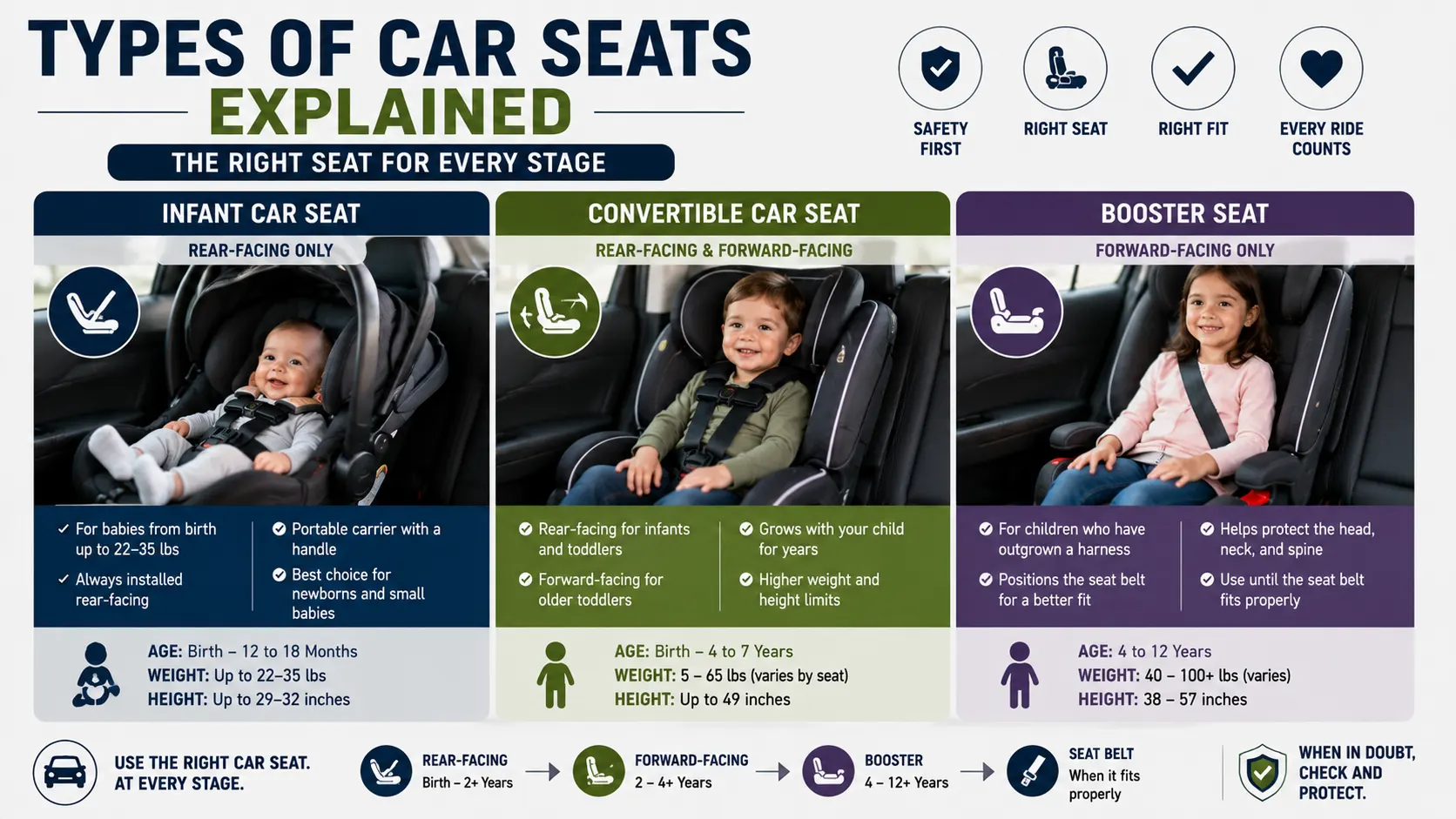
Types of Car Seats at a Glance
| Car Seat Type | Age | Direction | Best For |
|---|---|---|---|
| Infant Car Seat | Birth–12+ months | Rear-facing only | Newborns and young babies |
| Convertible Car Seat | Birth–4+ years | Rear & Forward-facing | Long-term use |
| Booster Seat | Around 5–12 years | Forward-facing | Older children using vehicle seat belt |
Infant Car Seats
What Is an Infant Car Seat?
An infant car seat is designed exclusively for newborns and young babies. It can only be installed in the rear-facing position, which provides the highest level of protection for an infant’s fragile neck, head, and spine.
Most infant seats feature a removable carrier that clicks into a base installed in the vehicle, making it easy to move a sleeping baby without disturbing them.
Advantages
- Excellent newborn fit
- Portable carrier
- Compatible with many strollers
- Easy transfers between vehicles
- Lightweight
Disadvantages
- Short lifespan
- Must eventually purchase another seat
- Weight limits reached relatively quickly
Convertible Car Seats
What Is a Convertible Car Seat?
A convertible car seat grows with your child by transitioning from rear-facing to forward-facing.
Unlike infant seats, convertible models stay installed inside the vehicle and are intended for years of use.
Many modern models support extended rear-facing, allowing children to remain in the safest position for longer.
Advantages
- Long lifespan
- Better value over time
- Higher rear-facing limits
- Excellent crash protection
Disadvantages
- Heavier
- Not portable
- Cannot function as an infant carrier
Booster Seats
What Is a Booster Seat?
Booster seats are designed for children who have outgrown a forward-facing harness but are still too small for an adult seat belt.
Rather than restraining the child directly, a booster positions the vehicle’s seat belt correctly across the strongest parts of the body.
There are two common types:
High-Back Booster
Ideal for vehicles without headrests or for children who benefit from additional side-impact protection.
Backless Booster
Suitable for older children in vehicles with adequate head support.
Infant vs Convertible vs Booster Comparison
| Feature | Infant | Convertible | Booster |
|---|---|---|---|
| Rear-facing | Yes | Yes | No |
| Forward-facing | No | Yes | Yes (seat belt) |
| Portable | Yes | No | Usually No |
| Best for newborn | Excellent | Good | Not suitable |
| Long-term use | Low | High | Medium |
| Works with stroller | Yes | No | No |
When Should You Switch Car Seats?
Instead of changing seats based on age alone, always follow the manufacturer’s height and weight limits. Safety experts recommend keeping children in each stage for as long as the seat allows.
Typical progression:
- Birth → Rear-facing infant or convertible seat
- Toddler → Rear-facing convertible
- Preschool → Forward-facing convertible
- School age → Booster
- Older child → Adult seat belt after proper belt fit
Which Type Is Safest?
No single type is universally safer than another.
The safest choice is always:
- Appropriate for your child’s size
- Correctly installed
- Properly adjusted
- Used on every ride
Research consistently shows that rear-facing travel provides superior protection for young children because it distributes crash forces across the back, neck, and head.
Common Parent Mistakes
Many injuries occur not because parents buy the wrong seat, but because they use the right seat incorrectly.
Avoid these common mistakes:
- Switching to forward-facing too early
- Moving to a booster before the child is ready
- Loose harness straps
- Twisted harness
- Bulky winter coats under the harness
- Incorrect recline angle
- Improper installation
- Ignoring expiration dates
- Using a seat after a moderate or severe crash
How to Choose the Right Car Seat
When shopping, consider:
- Your child’s current height and weight
- Your vehicle size
- Ease of installation
- Daily travel habits
- Budget
- Number of vehicles
- Future family plans
Families expecting multiple children often save money by investing in a high-quality convertible seat after the infant stage.
Cost Comparison
| Seat Type | Average Lifespan | Approximate Value |
|---|---|---|
| Infant | 9–18 months | Moderate |
| Convertible | 4–8 years | Excellent |
| Booster | 4–6 years | Good |
Although convertible seats usually cost more upfront, they often provide the best long-term value because they eliminate the need for an early replacement.
Myth vs Fact
Myth:
A more expensive car seat is always safer.
Fact: Every car seat sold in regulated markets must meet required federal safety standards. Premium models often add convenience features rather than higher crash protection.
Myth:
Children should face forward at their first birthday.
Fact: Children should remain rear-facing until they reach the rear-facing height or weight limit of their seat.
Myth:
Booster seats are only for short children.
Fact: Booster readiness depends on proper seat belt fit, not age or height alone.
Final Thoughts
Understanding the differences between infant, convertible, and booster car seats helps parents make informed decisions that keep children safer at every stage of growth.
Instead of rushing through each stage, keep your child in the current seat until they reach its maximum height or weight limit, ensure the seat is installed correctly, and check the harness fit before every trip. A properly chosen and correctly used car seat offers far more protection than simply upgrading to the next stage too early.
Continue exploring: browse the full Baby Safety hub.
Frequently Asked
Common Questions