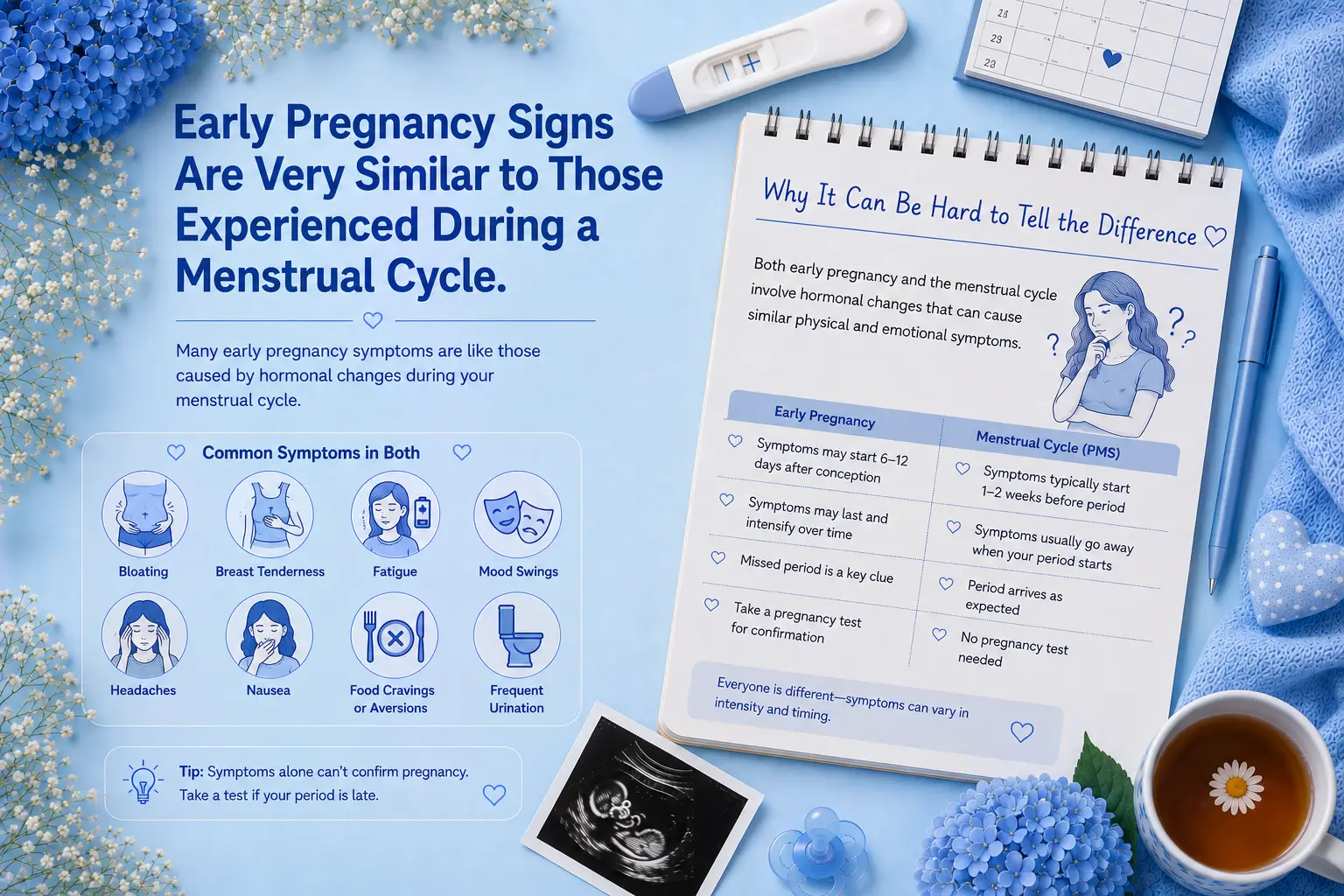
early pregnancy signs are very similar to those experienced during a menstrual cycle

If you’ve ever found yourself Googling “am I pregnant or getting my period” in the days before your period is due, you’re far from alone. It’s estimated that almost 90% of people with early pregnancies report symptoms that closely resemble PMS. That overlap isn’t a coincidence, it comes down to shared biology. Both premenstrual syndrome (PMS) and early pregnancy are driven by the same hormone, progesterone, which is exactly why so many early signs feel identical until you get an actual answer.
Why the Symptoms Overlap in the First Place
Progesterone rises in the second half of every menstrual cycle, whether or not conception happens. It thickens the uterine lining to prepare for a possible pregnancy, and if you don’t conceive, levels drop sharply, triggering your period, along with the PMS symptoms tied to that drop. If you do conceive, progesterone instead keeps climbing to support the pregnancy, and those elevated levels produce many of the same physical sensations, just extended and often intensified.
Symptoms Common to Both PMS and Early Pregnancy
Breast tenderness. Hormonal shifts make breast tissue feel sore, heavy, or swollen in both scenarios.
Fatigue. Both PMS and early pregnancy involve rising progesterone, which can leave you feeling unusually drained.
Bloating. Progesterone slows digestion and encourages fluid retention either way, producing that swollen, uncomfortable feeling.
Mood swings. Hormonal fluctuations can bring on irritability, weepiness, or emotional ups and downs in both cases.
Cramping. Mild abdominal cramping is common before a period and can also occur around implantation in early pregnancy.
Headaches and back pain. Both are commonly linked to hormonal changes and increased blood flow.
Food cravings or aversions. Shifting hormones affect appetite and taste in both PMS and early pregnancy.
Frequent urination. Increased blood flow and fluid shifts can cause more frequent bathroom trips either way.
Constipation. Progesterone’s effect on digestion can slow things down whether or not you’re pregnant.
Clues That Lean More Toward Pregnancy
While there’s no symptom that guarantees pregnancy, a handful tend to point more clearly in that direction:
Nausea. Queasiness, especially persistent or occurring in the morning, isn’t a typical PMS symptom and is a stronger early pregnancy indicator.
Timing and duration. PMS symptoms usually appear one to two weeks before your period and fade once bleeding starts. Pregnancy symptoms tend to continue past when your period was expected and often intensify rather than ease up.
Areola changes. Darkening or enlargement of the areolas is more specific to early pregnancy than to PMS.
Cervical mucus changes. Some people notice their cervical mucus becomes thicker, whiter, or milkier in early pregnancy, a shift distinct from typical premenstrual patterns.
Basal body temperature. If you track your basal body temperature, a rise that stays elevated well past the point where you’d expect a pre-period dip can suggest pregnancy rather than an approaching cycle.
Implantation bleeding. Light pink or brown spotting that’s noticeably lighter and shorter than your usual period, occurring around 10 to 14 days after conception, is a pregnancy-specific sign rather than a menstrual one.
Metallic taste. An unusual metallic or off taste in the mouth is a quirky but fairly commonly reported early pregnancy symptom not typically associated with PMS.
The One Symptom That Actually Settles It
A missed period remains the clearest single signal, though even that can be misleading if your cycle is irregular or influenced by stress, illness, or other factors. Ultimately, the only reliable way to know whether you’re experiencing PMS or early pregnancy is a pregnancy test. Testing is most accurate once your period is late, since it takes time for hCG (human chorionic gonadotropin) to build up to detectable levels. Testing too early, even with symptoms that feel convincing, increases the risk of a false negative.
What to Do While You’re Waiting to Find Out
If you’re in that uncertain window between suspecting something and being able to confirm it, a few things can help:
Track your symptoms and their timing so you have a clearer picture to compare against what happens next
Avoid over-interpreting any single symptom, since almost everything on this list can go either way
Wait for the most accurate testing window rather than testing very early and risking an unreliable result
Talk to a healthcare provider if you have irregular cycles or persistent uncertainty, since they can run a blood test that detects pregnancy earlier and more reliably than a home test
The Bottom Line
Early pregnancy and PMS share so much biological overlap, largely thanks to progesterone, that it’s genuinely difficult, often impossible, to tell them apart by symptoms alone. A few clues, like persistent nausea, cervical mucus changes, or symptoms that continue past your expected period, can nudge the odds one way or another, but none of them are conclusive on their own. If you’re trying to figure out what your body is telling you, the most reliable next step is simply waiting for your missed period and taking a test.
FAQ
Why do early pregnancy symptoms feel like PMS?
Both are driven by rising progesterone. In PMS, levels rise and then drop, triggering your period; in pregnancy, they keep climbing instead, producing similar but often more prolonged symptoms.
What early pregnancy symptom is least likely to be PMS?
Persistent nausea, areola darkening, and implantation bleeding are among the symptoms more specific to pregnancy than PMS.
How long before a missed period can pregnancy symptoms appear?
Some people notice symptoms as early as 6 to 12 days after ovulation, around implantation, though many don’t notice anything until closer to their expected period.
Can you have pregnancy symptoms and still get your period?
No, a true period means pregnancy hasn’t occurred that cycle. However, light implantation bleeding is sometimes mistaken for a period, which can cause confusion.
Is there any way to know for sure without taking a test?
No. While certain signs may lean more toward pregnancy, none are definitive. A pregnancy test, ideally taken after a missed period, is the only reliable way to confirm.