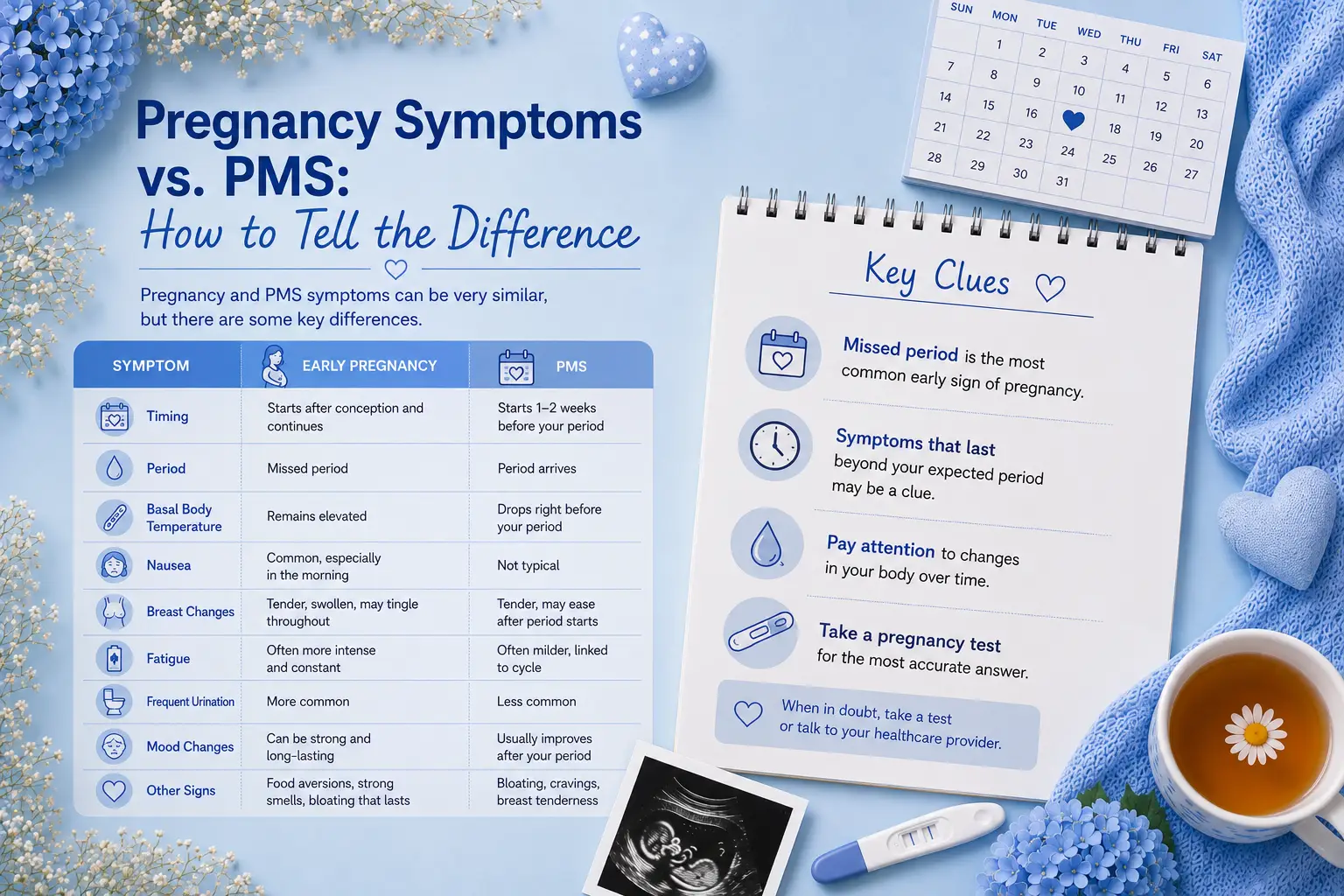

Sore breasts, bloating, fatigue, mood swings — if you’re staring down these symptoms and wondering “am I pregnant or is my period just coming,” you’re dealing with one of the most common sources of confusion in women’s health. PMS and early pregnancy share the same hormonal driver, progesterone, which is why the symptoms can feel nearly identical. But looking closely at a few specific symptoms, side by side, can help you make a more informed guess while you wait to test. Here’s a symptom-by-symptom breakdown.
Breast Tenderness
PMS: Breasts often feel achy, heavy, or sensitive in the days before your period, and the discomfort typically fades once bleeding starts.
Pregnancy: Tenderness tends to be more intense and persistent, sometimes accompanied by visible changes like darkening or enlarging areolas and more prominent veins, changes not typically seen with PMS.
Fatigue
PMS: Tiredness is common in the days leading up to your period, but energy usually bounces back once it arrives.
Pregnancy: Fatigue tends to feel heavier and doesn’t resolve on its own. It’s driven by a rapid rise in progesterone that keeps climbing rather than dropping.
Nausea
PMS: Nausea isn’t a typical PMS symptom. Some people feel mildly queasy, but it’s uncommon and usually minor.
Pregnancy: Persistent nausea, especially in the morning (though it can strike any time of day), is one of the more reliable indicators leaning toward pregnancy rather than PMS.
Cramping
PMS: Cramps are usually a direct lead-up to your period, often more intense, and resolve once bleeding starts.
Pregnancy: Mild cramping can occur around implantation, roughly a week to ten days after ovulation, but it tends to be lighter and briefer than period cramps and isn’t followed by a full flow.
Bleeding or Spotting
PMS: Any bleeding is your actual period, typically starting light and building to a heavier flow over several days.
Pregnancy: Implantation bleeding, if it happens at all, is usually much lighter, pink or brown rather than red, and lasts only a day or two rather than the typical 3 to 7 days of a period.
Mood Swings
PMS: Emotional ups and downs are extremely common and tend to ease once your period begins.
Pregnancy: Mood changes can feel similar but often continue rather than resolving, and may feel more intense or unfamiliar than your usual premenstrual pattern.
Bloating
PMS: Bloating is common and usually resolves by the end of your cycle.
Pregnancy: Bloating tends to persist and often continues right through and past a missed period, since the same progesterone surge that would normally drop keeps climbing instead.
Frequent Urination
PMS: Not a hallmark symptom, though some people notice mild changes.
Pregnancy: Increased bathroom trips are common early on, driven by rising blood volume and increased blood flow to the kidneys, and tend to be more noticeable than anything typical of PMS.
Food Cravings and Aversions
PMS: Cravings, especially for salty or sweet foods, are common and generally mild.
Pregnancy: Cravings or aversions can be stronger and more specific, sometimes involving foods you’d never normally want, or sudden distaste for foods you usually enjoy.
The Most Reliable Differentiator: Timing
Across nearly every symptom, the clearest pattern is timing. PMS symptoms typically appear one to two weeks before your period and fade shortly after it starts. Pregnancy symptoms tend to begin around the same window but continue rather than resolving, often persisting well past when your period was due and, in many cases, gradually intensifying instead of easing off.
When Symptoms Alone Aren’t Enough
It’s worth being honest about the limits here: even with all these comparisons, there’s no way to be fully certain based on symptoms alone. The hormonal overlap between PMS and early pregnancy is simply too significant. Almost 90% of people who go on to have confirmed pregnancies report symptoms that closely resembled PMS in those early days.
When and How to Test
A pregnancy test remains the only definitive way to know. For the most accurate results:
Wait until your period is late, or ideally a few days to a week past that point, since hCG levels need time to build up to detectable amounts.
Use first-morning urine, when hCG is most concentrated.
If a test is negative but your period still doesn’t arrive, wait a few days and test again, or consider a blood test through your doctor, which can detect pregnancy slightly earlier and more reliably than a home urine test.
Track your cycle, so you have a clearer sense of when your period is actually due rather than guessing.
When to See a Doctor
If you’re consistently unsure whether you’re experiencing PMS or pregnancy cycle after cycle, or if your periods are irregular enough that timing isn’t a useful clue, it’s worth talking to a healthcare provider. They can run blood tests, check hormone levels, and help rule out other causes of your symptoms, such as thyroid issues, which can also mimic both conditions.
The Bottom Line
PMS and early pregnancy overlap so heavily because they’re driven by the same hormone doing two different things: peaking and then dropping in PMS, or continuing to rise in pregnancy. Persistent nausea, symptoms that continue past your expected period, and lighter-than-usual spotting all lean toward pregnancy, while symptoms that resolve once your period starts point back to PMS. Still, none of these clues are a substitute for an actual pregnancy test.
FAQ
What’s the biggest difference between PMS and early pregnancy symptoms?
Timing and duration. PMS symptoms fade once your period starts; pregnancy symptoms tend to persist and often intensify past your expected period.
Is nausea more common with PMS or pregnancy?
Pregnancy. Nausea isn’t a typical PMS symptom, so persistent queasiness, especially recurring in the morning, leans more toward pregnancy.
Can implantation bleeding be mistaken for a period?
Yes, though it’s usually much lighter, shorter, and a different color (pink or brown rather than red) than a typical period.
How soon can I take a pregnancy test to know for sure?
Testing is most accurate once your period is late. Testing earlier increases the risk of a false negative even if you are pregnant.
Can PMS symptoms and pregnancy symptoms really be identical?
Yes, for many symptoms they can feel nearly indistinguishable, since both are driven by rising progesterone. This is exactly why a test, not symptoms, is the reliable way to know.